Compare commits
1 Commits
| Author | SHA1 | Date | |
|---|---|---|---|

|
5c8d8c44ee |
5
.github/workflows/pypi-release.yml
vendored
@@ -6,7 +6,6 @@ on:
|
||||
|
||||
env:
|
||||
RELEASE_TAG: ${{ github.event.release.tag_name }}
|
||||
GITHUB_BRANCH: master
|
||||
|
||||
jobs:
|
||||
release-prowler-job:
|
||||
@@ -17,8 +16,7 @@ jobs:
|
||||
steps:
|
||||
# Checks-out your repository under $GITHUB_WORKSPACE, so your job can access it
|
||||
- uses: actions/checkout@v3
|
||||
with:
|
||||
ref: ${{ env.GITHUB_BRANCH }}
|
||||
|
||||
- name: Install dependencies
|
||||
run: |
|
||||
pipx install poetry
|
||||
@@ -48,6 +46,7 @@ jobs:
|
||||
with:
|
||||
token: ${{ secrets.PROWLER_ACCESS_TOKEN }}
|
||||
commit-message: "chore(release): update Prowler Version to ${{ env.RELEASE_TAG }}."
|
||||
base: master
|
||||
branch: release-${{ env.RELEASE_TAG }}
|
||||
labels: "status/waiting-for-revision, severity/low"
|
||||
title: "chore(release): update Prowler Version to ${{ env.RELEASE_TAG }}"
|
||||
|
||||
@@ -57,11 +57,10 @@ repos:
|
||||
args: ["--ignore=E266,W503,E203,E501,W605"]
|
||||
|
||||
- repo: https://github.com/python-poetry/poetry
|
||||
rev: 1.5.1 # add version here
|
||||
rev: 1.4.0 # add version here
|
||||
hooks:
|
||||
- id: poetry-check
|
||||
- id: poetry-lock
|
||||
args: ["--no-update"]
|
||||
|
||||
- repo: https://github.com/hadolint/hadolint
|
||||
rev: v2.12.1-beta
|
||||
@@ -76,15 +75,6 @@ repos:
|
||||
entry: bash -c 'pylint --disable=W,C,R,E -j 0 -rn -sn prowler/'
|
||||
language: system
|
||||
|
||||
- id: trufflehog
|
||||
name: TruffleHog
|
||||
description: Detect secrets in your data.
|
||||
# entry: bash -c 'trufflehog git file://. --only-verified --fail'
|
||||
# For running trufflehog in docker, use the following entry instead:
|
||||
entry: bash -c 'docker run -v "$(pwd):/workdir" -i --rm trufflesecurity/trufflehog:latest git file:///workdir --only-verified --fail'
|
||||
language: system
|
||||
stages: ["commit", "push"]
|
||||
|
||||
- id: pytest-check
|
||||
name: pytest-check
|
||||
entry: bash -c 'pytest tests -n auto'
|
||||
|
||||
@@ -1,13 +0,0 @@
|
||||
# Do you want to learn on how to...
|
||||
|
||||
- Contribute with your code or fixes to Prowler
|
||||
- Create a new check for a provider
|
||||
- Create a new security compliance framework
|
||||
- Add a custom output format
|
||||
- Add a new integration
|
||||
- Contribute with documentation
|
||||
|
||||
Want some swag as appreciation for your contribution?
|
||||
|
||||
# Prowler Developer Guide
|
||||
https://docs.prowler.cloud/en/latest/tutorials/developer-guide/
|
||||
72
README.md
@@ -11,10 +11,11 @@
|
||||
</p>
|
||||
<p align="center">
|
||||
<a href="https://join.slack.com/t/prowler-workspace/shared_invite/zt-1hix76xsl-2uq222JIXrC7Q8It~9ZNog"><img alt="Slack Shield" src="https://img.shields.io/badge/slack-prowler-brightgreen.svg?logo=slack"></a>
|
||||
<a href="https://pypi.org/project/prowler/"><img alt="Python Version" src="https://img.shields.io/pypi/v/prowler.svg"></a>
|
||||
<a href="https://pypi.python.org/pypi/prowler/"><img alt="Python Version" src="https://img.shields.io/pypi/pyversions/prowler.svg"></a>
|
||||
<a href="https://pypi.org/project/prowler-cloud/"><img alt="Python Version" src="https://img.shields.io/pypi/v/prowler.svg"></a>
|
||||
<a href="https://pypi.python.org/pypi/prowler-cloud/"><img alt="Python Version" src="https://img.shields.io/pypi/pyversions/prowler.svg"></a>
|
||||
<a href="https://pypistats.org/packages/prowler"><img alt="PyPI Prowler Downloads" src="https://img.shields.io/pypi/dw/prowler.svg?label=prowler%20downloads"></a>
|
||||
<a href="https://pypistats.org/packages/prowler-cloud"><img alt="PyPI Prowler-Cloud Downloads" src="https://img.shields.io/pypi/dw/prowler-cloud.svg?label=prowler-cloud%20downloads"></a>
|
||||
<a href="https://formulae.brew.sh/formula/prowler#default"><img alt="Brew Prowler Downloads" src="https://img.shields.io/homebrew/installs/dm/prowler?label=brew%20downloads"></a>
|
||||
<a href="https://hub.docker.com/r/toniblyx/prowler"><img alt="Docker Pulls" src="https://img.shields.io/docker/pulls/toniblyx/prowler"></a>
|
||||
<a href="https://hub.docker.com/r/toniblyx/prowler"><img alt="Docker" src="https://img.shields.io/docker/cloud/build/toniblyx/prowler"></a>
|
||||
<a href="https://hub.docker.com/r/toniblyx/prowler"><img alt="Docker" src="https://img.shields.io/docker/image-size/toniblyx/prowler"></a>
|
||||
@@ -35,14 +36,7 @@
|
||||
|
||||
`Prowler` is an Open Source security tool to perform AWS, GCP and Azure security best practices assessments, audits, incident response, continuous monitoring, hardening and forensics readiness.
|
||||
|
||||
It contains hundreds of controls covering CIS, NIST 800, NIST CSF, CISA, RBI, FedRAMP, PCI-DSS, GDPR, HIPAA, FFIEC, SOC2, GXP, AWS Well-Architected Framework Security Pillar, AWS Foundational Technical Review (FTR), ENS (Spanish National Security Scheme) and your custom security frameworks.
|
||||
|
||||
| Provider | Checks | Services | [Compliance Frameworks](https://docs.prowler.cloud/en/latest/tutorials/compliance/) | [Categories](https://docs.prowler.cloud/en/latest/tutorials/misc/#categories) |
|
||||
|---|---|---|---|---|
|
||||
| AWS | 283 | 55 -> `prowler aws --list-services` | 25 -> `prowler aws --list-compliance` | 5 -> `prowler aws --list-categories` |
|
||||
| GCP | 73 | 11 -> `prowler gcp --list-services` | 1 -> `prowler gcp --list-compliance` | 0 -> `prowler gcp --list-categories`|
|
||||
| Azure | 20 | 3 -> `prowler azure --list-services` | CIS soon | 1 -> `prowler azure --list-categories` |
|
||||
| Kubernetes | Planned | - | - | - |
|
||||
It contains hundreds of controls covering CIS, PCI-DSS, ISO27001, GDPR, HIPAA, FFIEC, SOC2, AWS FTR, ENS and custom security frameworks.
|
||||
|
||||
# 📖 Documentation
|
||||
|
||||
@@ -91,11 +85,11 @@ python prowler.py -v
|
||||
|
||||
You can run Prowler from your workstation, an EC2 instance, Fargate or any other container, Codebuild, CloudShell and Cloud9.
|
||||
|
||||

|
||||
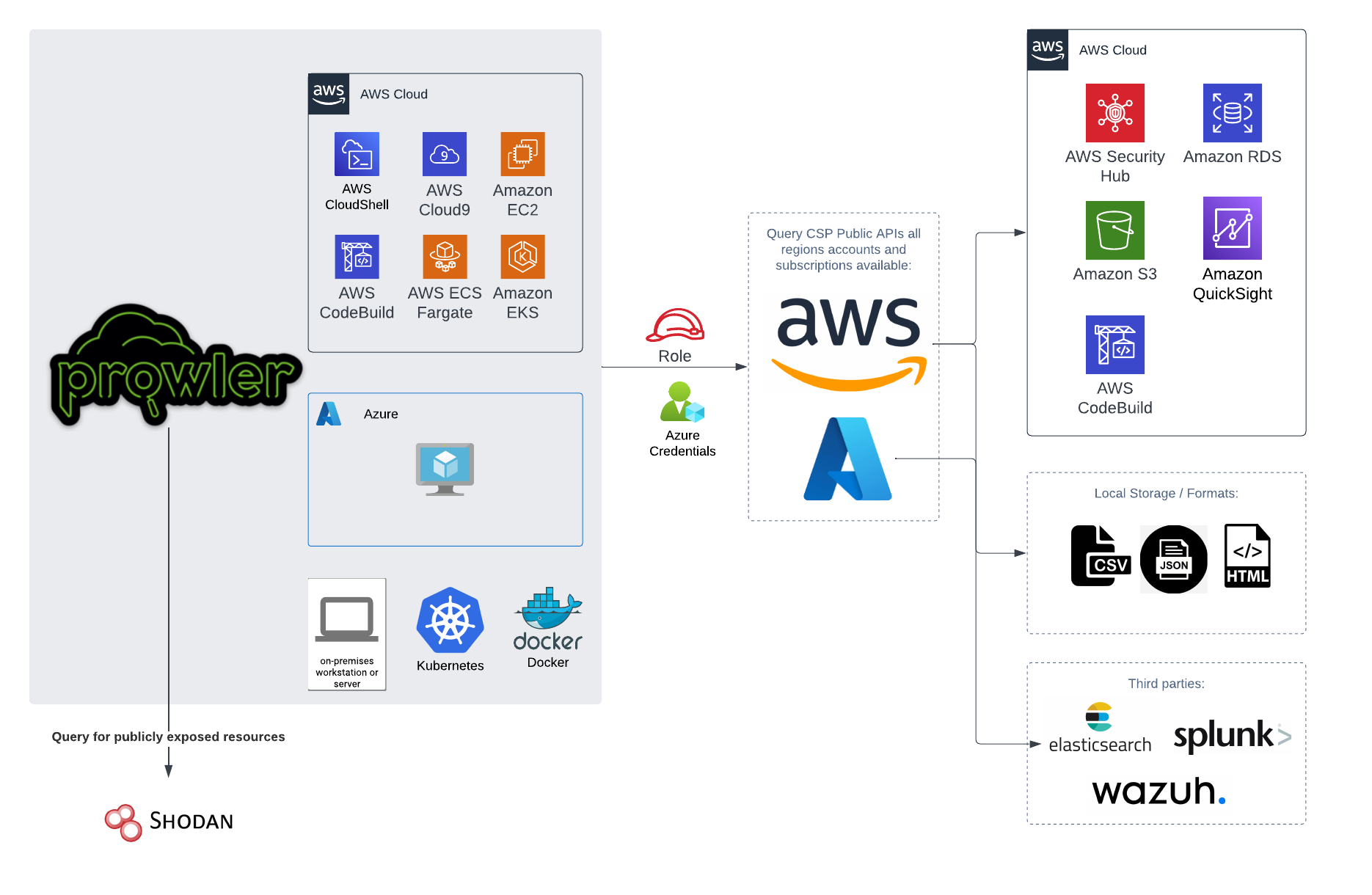
|
||||
|
||||
# 📝 Requirements
|
||||
|
||||
Prowler has been written in Python using the [AWS SDK (Boto3)](https://boto3.amazonaws.com/v1/documentation/api/latest/index.html#), [Azure SDK](https://azure.github.io/azure-sdk-for-python/) and [GCP API Python Client](https://github.com/googleapis/google-api-python-client/).
|
||||
Prowler has been written in Python using the [AWS SDK (Boto3)](https://boto3.amazonaws.com/v1/documentation/api/latest/index.html#) and [Azure SDK](https://azure.github.io/azure-sdk-for-python/).
|
||||
## AWS
|
||||
|
||||
Since Prowler uses AWS Credentials under the hood, you can follow any authentication method as described [here](https://docs.aws.amazon.com/cli/latest/userguide/cli-configure-quickstart.html#cli-configure-quickstart-precedence).
|
||||
@@ -122,6 +116,22 @@ Those credentials must be associated to a user or role with proper permissions t
|
||||
|
||||
> If you want Prowler to send findings to [AWS Security Hub](https://aws.amazon.com/security-hub), make sure you also attach the custom policy [prowler-security-hub.json](https://github.com/prowler-cloud/prowler/blob/master/permissions/prowler-security-hub.json).
|
||||
|
||||
## Google Cloud Platform
|
||||
|
||||
Prowler will follow the same credentials search as [Google authentication libraries](https://cloud.google.com/docs/authentication/application-default-credentials#search_order):
|
||||
|
||||
1. [GOOGLE_APPLICATION_CREDENTIALS environment variable](https://cloud.google.com/docs/authentication/application-default-credentials#GAC)
|
||||
2. [User credentials set up by using the Google Cloud CLI](https://cloud.google.com/docs/authentication/application-default-credentials#personal)
|
||||
3. [The attached service account, returned by the metadata server](https://cloud.google.com/docs/authentication/application-default-credentials#attached-sa)
|
||||
|
||||
Those credentials must be associated to a user or service account with proper permissions to do all checks. To make sure, add the following roles to the member associated with the credentials:
|
||||
|
||||
- Viewer
|
||||
- Security Reviewer
|
||||
- Stackdriver Account Viewer
|
||||
|
||||
> `prowler` will scan the project associated with the credentials.
|
||||
|
||||
## Azure
|
||||
|
||||
Prowler for Azure supports the following authentication types:
|
||||
@@ -144,7 +154,7 @@ export AZURE_CLIENT_SECRET="XXXXXXX"
|
||||
If you try to execute Prowler with the `--sp-env-auth` flag and those variables are empty or not exported, the execution is going to fail.
|
||||
### AZ CLI / Browser / Managed Identity authentication
|
||||
|
||||
The other three cases do not need additional configuration, `--az-cli-auth` and `--managed-identity-auth` are automated options, `--browser-auth` needs the user to authenticate using the default browser to start the scan. Also `--browser-auth` needs the tenant id to be specified with `--tenant-id`.
|
||||
The other three cases do not need additional configuration, `--az-cli-auth` and `--managed-identity-auth` are automated options, `--browser-auth` needs the user to authenticate using the default browser to start the scan.
|
||||
|
||||
### Permissions
|
||||
|
||||
@@ -170,22 +180,6 @@ Regarding the subscription scope, Prowler by default scans all the subscriptions
|
||||
- `Reader`
|
||||
|
||||
|
||||
## Google Cloud Platform
|
||||
|
||||
Prowler will follow the same credentials search as [Google authentication libraries](https://cloud.google.com/docs/authentication/application-default-credentials#search_order):
|
||||
|
||||
1. [GOOGLE_APPLICATION_CREDENTIALS environment variable](https://cloud.google.com/docs/authentication/application-default-credentials#GAC)
|
||||
2. [User credentials set up by using the Google Cloud CLI](https://cloud.google.com/docs/authentication/application-default-credentials#personal)
|
||||
3. [The attached service account, returned by the metadata server](https://cloud.google.com/docs/authentication/application-default-credentials#attached-sa)
|
||||
|
||||
Those credentials must be associated to a user or service account with proper permissions to do all checks. To make sure, add the following roles to the member associated with the credentials:
|
||||
|
||||
- Viewer
|
||||
- Security Reviewer
|
||||
- Stackdriver Account Viewer
|
||||
|
||||
> By default, `prowler` will scan all accessible GCP Projects, use flag `--project-ids` to specify the projects to be scanned.
|
||||
|
||||
# 💻 Basic Usage
|
||||
|
||||
To run prowler, you will need to specify the provider (e.g aws or azure):
|
||||
@@ -251,6 +245,14 @@ prowler aws --profile custom-profile -f us-east-1 eu-south-2
|
||||
```
|
||||
> By default, `prowler` will scan all AWS regions.
|
||||
|
||||
## Google Cloud Platform
|
||||
|
||||
Optionally, you can provide the location of an application credential JSON file with the following argument:
|
||||
|
||||
```console
|
||||
prowler gcp --credentials-file path
|
||||
```
|
||||
|
||||
## Azure
|
||||
|
||||
With Azure you need to specify which auth method is going to be used:
|
||||
@@ -260,14 +262,12 @@ prowler azure [--sp-env-auth, --az-cli-auth, --browser-auth, --managed-identity-
|
||||
```
|
||||
> By default, `prowler` will scan all Azure subscriptions.
|
||||
|
||||
## Google Cloud Platform
|
||||
# 🎉 New Features
|
||||
|
||||
Optionally, you can provide the location of an application credential JSON file with the following argument:
|
||||
|
||||
```console
|
||||
prowler gcp --credentials-file path
|
||||
```
|
||||
> By default, `prowler` will scan all accessible GCP Projects, use flag `--project-ids` to specify the projects to be scanned.
|
||||
- Python: we got rid of all bash and it is now all in Python.
|
||||
- Faster: huge performance improvements (same account from 2.5 hours to 4 minutes).
|
||||
- Developers and community: we have made it easier to contribute with new checks and new compliance frameworks. We also included unit tests.
|
||||
- Multi-cloud: in addition to AWS, we have added Azure, we plan to include GCP and OCI soon, let us know if you want to contribute!
|
||||
|
||||
# 📃 License
|
||||
|
||||
|
||||
@@ -1,24 +1,45 @@
|
||||
# Build command
|
||||
# docker build --platform=linux/amd64 --no-cache -t prowler:latest .
|
||||
|
||||
ARG PROWLER_VERSION=latest
|
||||
FROM public.ecr.aws/amazonlinux/amazonlinux:2022
|
||||
|
||||
FROM toniblyx/prowler:${PROWLER_VERSION}
|
||||
ARG PROWLERVER=2.9.0
|
||||
ARG USERNAME=prowler
|
||||
ARG USERID=34000
|
||||
|
||||
USER 0
|
||||
# hadolint ignore=DL3018
|
||||
RUN apk --no-cache add bash aws-cli jq
|
||||
# Install Dependencies
|
||||
RUN \
|
||||
dnf update -y && \
|
||||
dnf install -y bash file findutils git jq python3 python3-pip \
|
||||
python3-setuptools python3-wheel shadow-utils tar unzip which && \
|
||||
dnf remove -y awscli && \
|
||||
dnf clean all && \
|
||||
useradd -l -s /bin/sh -U -u ${USERID} ${USERNAME} && \
|
||||
curl "https://awscli.amazonaws.com/awscli-exe-linux-x86_64.zip" -o "awscliv2.zip" && \
|
||||
unzip awscliv2.zip && \
|
||||
./aws/install && \
|
||||
pip3 install --no-cache-dir --upgrade pip && \
|
||||
pip3 install --no-cache-dir "git+https://github.com/ibm/detect-secrets.git@master#egg=detect-secrets" && \
|
||||
rm -rf aws awscliv2.zip /var/cache/dnf
|
||||
|
||||
ARG MULTI_ACCOUNT_SECURITY_HUB_PATH=/home/prowler/multi-account-securityhub
|
||||
# Place script and env vars
|
||||
COPY .awsvariables run-prowler-securityhub.sh /
|
||||
|
||||
USER prowler
|
||||
# Installs prowler and change permissions
|
||||
RUN \
|
||||
curl -L "https://github.com/prowler-cloud/prowler/archive/refs/tags/${PROWLERVER}.tar.gz" -o "prowler.tar.gz" && \
|
||||
tar xvzf prowler.tar.gz && \
|
||||
rm -f prowler.tar.gz && \
|
||||
mv prowler-${PROWLERVER} prowler && \
|
||||
chown ${USERNAME}:${USERNAME} /run-prowler-securityhub.sh && \
|
||||
chmod 500 /run-prowler-securityhub.sh && \
|
||||
chown ${USERNAME}:${USERNAME} /.awsvariables && \
|
||||
chmod 400 /.awsvariables && \
|
||||
chown ${USERNAME}:${USERNAME} -R /prowler && \
|
||||
chmod +x /prowler/prowler
|
||||
|
||||
# Move script and environment variables
|
||||
RUN mkdir "${MULTI_ACCOUNT_SECURITY_HUB_PATH}"
|
||||
COPY --chown=prowler:prowler .awsvariables run-prowler-securityhub.sh "${MULTI_ACCOUNT_SECURITY_HUB_PATH}"/
|
||||
RUN chmod 500 "${MULTI_ACCOUNT_SECURITY_HUB_PATH}"/run-prowler-securityhub.sh & \
|
||||
chmod 400 "${MULTI_ACCOUNT_SECURITY_HUB_PATH}"/.awsvariables
|
||||
# Drop to user
|
||||
USER ${USERNAME}
|
||||
|
||||
WORKDIR ${MULTI_ACCOUNT_SECURITY_HUB_PATH}
|
||||
|
||||
ENTRYPOINT ["./run-prowler-securityhub.sh"]
|
||||
# Run script
|
||||
ENTRYPOINT ["/run-prowler-securityhub.sh"]
|
||||
|
||||
51
contrib/multi-account-securityhub/run-prowler-securityhub.sh
Executable file → Normal file
@@ -1,17 +1,20 @@
|
||||
#!/bin/bash
|
||||
# Run Prowler against All AWS Accounts in an AWS Organization
|
||||
|
||||
# Change Directory (rest of the script, assumes you're in the root directory)
|
||||
cd / || exit
|
||||
|
||||
# Show Prowler Version
|
||||
prowler -v
|
||||
./prowler/prowler -V
|
||||
|
||||
# Source .awsvariables
|
||||
# shellcheck disable=SC1091
|
||||
source .awsvariables
|
||||
|
||||
# Get Values from Environment Variables
|
||||
echo "ROLE: ${ROLE}"
|
||||
echo "PARALLEL_ACCOUNTS: ${PARALLEL_ACCOUNTS}"
|
||||
echo "REGION: ${REGION}"
|
||||
echo "ROLE: $ROLE"
|
||||
echo "PARALLEL_ACCOUNTS: $PARALLEL_ACCOUNTS"
|
||||
echo "REGION: $REGION"
|
||||
|
||||
# Function to unset AWS Profile Variables
|
||||
unset_aws() {
|
||||
@@ -21,33 +24,33 @@ unset_aws
|
||||
|
||||
# Find THIS Account AWS Number
|
||||
CALLER_ARN=$(aws sts get-caller-identity --output text --query "Arn")
|
||||
PARTITION=$(echo "${CALLER_ARN}" | cut -d: -f2)
|
||||
THISACCOUNT=$(echo "${CALLER_ARN}" | cut -d: -f5)
|
||||
echo "THISACCOUNT: ${THISACCOUNT}"
|
||||
echo "PARTITION: ${PARTITION}"
|
||||
PARTITION=$(echo "$CALLER_ARN" | cut -d: -f2)
|
||||
THISACCOUNT=$(echo "$CALLER_ARN" | cut -d: -f5)
|
||||
echo "THISACCOUNT: $THISACCOUNT"
|
||||
echo "PARTITION: $PARTITION"
|
||||
|
||||
# Function to Assume Role to THIS Account & Create Session
|
||||
this_account_session() {
|
||||
unset_aws
|
||||
role_credentials=$(aws sts assume-role --role-arn arn:"${PARTITION}":iam::"${THISACCOUNT}":role/"${ROLE}" --role-session-name ProwlerRun --output json)
|
||||
AWS_ACCESS_KEY_ID=$(echo "${role_credentials}" | jq -r .Credentials.AccessKeyId)
|
||||
AWS_SECRET_ACCESS_KEY=$(echo "${role_credentials}" | jq -r .Credentials.SecretAccessKey)
|
||||
AWS_SESSION_TOKEN=$(echo "${role_credentials}" | jq -r .Credentials.SessionToken)
|
||||
role_credentials=$(aws sts assume-role --role-arn arn:"$PARTITION":iam::"$THISACCOUNT":role/"$ROLE" --role-session-name ProwlerRun --output json)
|
||||
AWS_ACCESS_KEY_ID=$(echo "$role_credentials" | jq -r .Credentials.AccessKeyId)
|
||||
AWS_SECRET_ACCESS_KEY=$(echo "$role_credentials" | jq -r .Credentials.SecretAccessKey)
|
||||
AWS_SESSION_TOKEN=$(echo "$role_credentials" | jq -r .Credentials.SessionToken)
|
||||
export AWS_ACCESS_KEY_ID AWS_SECRET_ACCESS_KEY AWS_SESSION_TOKEN
|
||||
}
|
||||
|
||||
# Find AWS Master Account
|
||||
this_account_session
|
||||
AWSMASTER=$(aws organizations describe-organization --query Organization.MasterAccountId --output text)
|
||||
echo "AWSMASTER: ${AWSMASTER}"
|
||||
echo "AWSMASTER: $AWSMASTER"
|
||||
|
||||
# Function to Assume Role to Master Account & Create Session
|
||||
master_account_session() {
|
||||
unset_aws
|
||||
role_credentials=$(aws sts assume-role --role-arn arn:"${PARTITION}":iam::"${AWSMASTER}":role/"${ROLE}" --role-session-name ProwlerRun --output json)
|
||||
AWS_ACCESS_KEY_ID=$(echo "${role_credentials}" | jq -r .Credentials.AccessKeyId)
|
||||
AWS_SECRET_ACCESS_KEY=$(echo "${role_credentials}" | jq -r .Credentials.SecretAccessKey)
|
||||
AWS_SESSION_TOKEN=$(echo "${role_credentials}" | jq -r .Credentials.SessionToken)
|
||||
role_credentials=$(aws sts assume-role --role-arn arn:"$PARTITION":iam::"$AWSMASTER":role/"$ROLE" --role-session-name ProwlerRun --output json)
|
||||
AWS_ACCESS_KEY_ID=$(echo "$role_credentials" | jq -r .Credentials.AccessKeyId)
|
||||
AWS_SECRET_ACCESS_KEY=$(echo "$role_credentials" | jq -r .Credentials.SecretAccessKey)
|
||||
AWS_SESSION_TOKEN=$(echo "$role_credentials" | jq -r .Credentials.SessionToken)
|
||||
export AWS_ACCESS_KEY_ID AWS_SECRET_ACCESS_KEY AWS_SESSION_TOKEN
|
||||
}
|
||||
|
||||
@@ -57,20 +60,20 @@ ACCOUNTS_IN_ORGS=$(aws organizations list-accounts --query Accounts[*].Id --outp
|
||||
|
||||
# Run Prowler against Accounts in AWS Organization
|
||||
echo "AWS Accounts in Organization"
|
||||
echo "${ACCOUNTS_IN_ORGS}"
|
||||
for accountId in ${ACCOUNTS_IN_ORGS}; do
|
||||
echo "$ACCOUNTS_IN_ORGS"
|
||||
for accountId in $ACCOUNTS_IN_ORGS; do
|
||||
# shellcheck disable=SC2015
|
||||
test "$(jobs | wc -l)" -ge "${PARALLEL_ACCOUNTS}" && wait -n || true
|
||||
test "$(jobs | wc -l)" -ge $PARALLEL_ACCOUNTS && wait -n || true
|
||||
{
|
||||
START_TIME=${SECONDS}
|
||||
START_TIME=$SECONDS
|
||||
# Unset AWS Profile Variables
|
||||
unset_aws
|
||||
# Run Prowler
|
||||
echo -e "Assessing AWS Account: ${accountId}, using Role: ${ROLE} on $(date)"
|
||||
echo -e "Assessing AWS Account: $accountId, using Role: $ROLE on $(date)"
|
||||
# Pipe stdout to /dev/null to reduce unnecessary Cloudwatch logs
|
||||
prowler aws -R arn:"${PARTITION}":iam::"${accountId}":role/"${ROLE}" -q -S -f "${REGION}" > /dev/null
|
||||
./prowler/prowler -R "$ROLE" -A "$accountId" -M json-asff -q -S -f "$REGION" > /dev/null
|
||||
TOTAL_SEC=$((SECONDS - START_TIME))
|
||||
printf "Completed AWS Account: ${accountId} in %02dh:%02dm:%02ds" $((TOTAL_SEC / 3600)) $((TOTAL_SEC % 3600 / 60)) $((TOTAL_SEC % 60))
|
||||
printf "Completed AWS Account: $accountId in %02dh:%02dm:%02ds" $((TOTAL_SEC / 3600)) $((TOTAL_SEC % 3600 / 60)) $((TOTAL_SEC % 60))
|
||||
echo ""
|
||||
} &
|
||||
done
|
||||
|
||||
@@ -1,6 +1,6 @@
|
||||
# Organizational Prowler with Serverless
|
||||
|
||||
Language: [Korean](README_kr.md)
|
||||
Langage: [Korean](README_kr.md)
|
||||
|
||||
This project is created to apply prowler in a multi-account environment within AWS Organizations.
|
||||
CloudWatch triggers CodeBuild every fixed time.
|
||||
@@ -18,12 +18,12 @@ For more information on how to use prowler, see [here](https://github.com/prowle
|
||||
2. **Master Account**
|
||||
1. Deploy [ProwlerRole.yaml](templates/ProwlerRole.yaml) stack to CloudFormation in a bid to create resources to master account itself.
|
||||
(The template will be also deployed for other member accounts as a StackSet)
|
||||
- ProwlerCodeBuildAccount : Audit Account ID where CodeBuild resides. (preferably Audit/Security account)
|
||||
- ProwlerCodeBuildAccount : Audit Acccount ID where CodeBuild resides. (preferably Audit/Security account)
|
||||
- ProwlerCodeBuildRole : Role name to use in CodeBuild service
|
||||
- ProwlerCrossAccountRole : Role name to assume for Cross account
|
||||
- ProwlerS3 : The S3 bucket name where reports will be put
|
||||
1. Create **StackSet** with [ProwlerRole.yaml](templates/ProwlerRole.yaml) to deploy Role into member accounts in AWS Organizations.
|
||||
- ProwlerCodeBuildAccount : Audit Account ID where CodeBuild resides. (preferably Audit/Security account)
|
||||
- ProwlerCodeBuildAccount : Audit Acccount ID where CodeBuild resides. (preferably Audit/Security account)
|
||||
- ProwlerCodeBuildRole : Role name to use in CodeBuild service
|
||||
- ProwlerCrossAccountRole : Role name to assume for Cross account
|
||||
- ProwlerS3 : The S3 bucket name where reports will be put
|
||||
@@ -45,4 +45,4 @@ For more information on how to use prowler, see [here](https://github.com/prowle
|
||||
- ProwlerReportS3Account : The account where the report S3 bucket resides.
|
||||
1. If you'd like to change the scheduled time,
|
||||
1. You can change the cron expression of ScheduleExpression within [ProwlerCodeBuildStack.yaml](templates/ProwlerCodeBuildStack.yaml).
|
||||
2. Alternatively, you can make changes directly from Events > Rules > ProwlerExecuteRule > Actions > Edit in CloudWatch console.
|
||||
2. Alternatively, you can make changes directrly from Events > Rules > ProwlerExecuteRule > Actions > Edit in CloudWatch console.
|
||||
|
||||
@@ -1,6 +1,6 @@
|
||||
# Organizational Prowler with Serverless
|
||||
|
||||
Language: [English](README.md)
|
||||
Langage: [English](README.md)
|
||||
|
||||
이 문서는 AWS Organization 내의 multi account 환경에서 prowler 를 적용하기 위해 작성된 문서입니다.
|
||||
일정 시간마다 CloudWatch는 CodeBuild 를 트리거합니다.
|
||||
@@ -22,7 +22,7 @@ prowler 의 자세한 사용방법은 [이 곳](https://github.com/prowler-cloud
|
||||
|
||||
[ProwlerRole.yaml](templates/ProwlerRole.yaml)
|
||||
|
||||
- ProwlerCodeBuildAccount : CodeBuild 가 있는 Audit Account ID
|
||||
- ProwlerCodeBuildAccount : CodeBuild 가 있는 Audit Acccount ID
|
||||
- ProwlerCodeBuildRole : CodeBuild의 생성될 Role 이름
|
||||
- ProwlerCrossAccountRole : Cross account 용 Assume할 Role 이름
|
||||
- ProwlerS3 : report 가 저장될 S3 bucket 명
|
||||
@@ -30,7 +30,7 @@ prowler 의 자세한 사용방법은 [이 곳](https://github.com/prowler-cloud
|
||||
|
||||
[ProwlerRole.yaml](templates/ProwlerRole.yaml)
|
||||
|
||||
- ProwlerCodeBuildAccount : CodeBuild 가 있는 Audit Account
|
||||
- ProwlerCodeBuildAccount : CodeBuild 가 있는 Audit Acccount
|
||||
- ProwlerCodeBuildRole : CodeBuild에서 사용할 Role 이름
|
||||
- ProwlerCrossAccountRole : Cross account 용 Assume할 Role 이름
|
||||
- ProwlerS3 : report 가 저장될 S3 bucket 명
|
||||
|
||||
@@ -2,7 +2,7 @@
|
||||
|
||||
## Introduction
|
||||
|
||||
The following demonstrates how to quickly install the resources necessary to perform a security baseline using Prowler. The speed is based on the prebuilt terraform module that can configure all the resources necessary to run Prowler with the findings being sent to AWS Security Hub.
|
||||
The following demonstartes how to quickly install the resources necessary to perform a security baseline using Prowler. The speed is based on the prebuilt terraform module that can configure all the resources necessuary to run Prowler with the findings being sent to AWS Security Hub.
|
||||
|
||||
## Install
|
||||
|
||||
@@ -24,7 +24,7 @@ Installing Prowler with Terraform is simple and can be completed in under 1 minu
|
||||
|
||||

|
||||
|
||||
- It is likely an error will return related to the SecurityHub subscription. This appears to be Terraform related and you can validate the configuration by navigating to the SecurityHub console. Click Integrations and search for Prowler. Take note of the green check where it says *Accepting findings*
|
||||
- It is likely an error will return related to the SecurityHub subscription. This appears to be Terraform related and you can validate the configuration by navigating to the SecurityHub console. Click Integreations and search for Prowler. Take note of the green check where it says *Accepting findings*
|
||||
|
||||

|
||||
|
||||
|
||||
@@ -92,7 +92,7 @@ To make sure rules are working fine, run `/var/ossec/bin/ossec-logtest` and copy
|
||||
```
|
||||
You must see 3 phases goin on.
|
||||
|
||||
To check if there is any error you can enable the debug mode of `modulesd` setting the `wazuh_modules.debug=0` variable to 2 in `/var/ossec/etc/internal_options.conf` file. Restart wazuh-manager and errors should appear in the `/var/ossec/logs/ossec.log` file.
|
||||
To check if there is any error you can enable the debug mode of `modulesd` setting the `wazuh_modules.debug=0` variable to 2 in `/var/ossec/etc/internal_options.conf` file. Restart wazun-manager and errors should appear in the `/var/ossec/logs/ossec.log` file.
|
||||
|
||||
## Thanks
|
||||
|
||||
|
||||
@@ -1,6 +1,6 @@
|
||||
# Requirements
|
||||
|
||||
Prowler has been written in Python using the [AWS SDK (Boto3)](https://boto3.amazonaws.com/v1/documentation/api/latest/index.html#), [Azure SDK](https://azure.github.io/azure-sdk-for-python/) and [GCP API Python Client](https://github.com/googleapis/google-api-python-client/).
|
||||
Prowler has been written in Python using the [AWS SDK (Boto3)](https://boto3.amazonaws.com/v1/documentation/api/latest/index.html#) and [Azure SDK](https://learn.microsoft.com/en-us/python/api/overview/azure/?view=azure-python).
|
||||
## AWS
|
||||
|
||||
Since Prowler uses AWS Credentials under the hood, you can follow any authentication method as described [here](https://docs.aws.amazon.com/cli/latest/userguide/cli-configure-quickstart.html#cli-configure-quickstart-precedence).
|
||||
@@ -30,12 +30,23 @@ Those credentials must be associated to a user or role with proper permissions t
|
||||
|
||||
> If you want Prowler to send findings to [AWS Security Hub](https://aws.amazon.com/security-hub), make sure you also attach the custom policy [prowler-security-hub.json](https://github.com/prowler-cloud/prowler/blob/master/permissions/prowler-security-hub.json).
|
||||
|
||||
### Multi-Factor Authentication
|
||||
## Google Cloud
|
||||
|
||||
If your IAM entity enforces MFA you can use `--mfa` and Prowler will ask you to input the following values to get a new session:
|
||||
### GCP Authentication
|
||||
|
||||
- ARN of your MFA device
|
||||
- TOTP (Time-Based One-Time Password)
|
||||
Prowler will follow the same credentials search as [Google authentication libraries](https://cloud.google.com/docs/authentication/application-default-credentials#search_order):
|
||||
|
||||
1. [GOOGLE_APPLICATION_CREDENTIALS environment variable](https://cloud.google.com/docs/authentication/application-default-credentials#GAC)
|
||||
2. [User credentials set up by using the Google Cloud CLI](https://cloud.google.com/docs/authentication/application-default-credentials#personal)
|
||||
3. [The attached service account, returned by the metadata server](https://cloud.google.com/docs/authentication/application-default-credentials#attached-sa)
|
||||
|
||||
Those credentials must be associated to a user or service account with proper permissions to do all checks. To make sure, add the following roles to the member associated with the credentials:
|
||||
|
||||
- Viewer
|
||||
- Security Reviewer
|
||||
- Stackdriver Account Viewer
|
||||
|
||||
> `prowler` will scan the project associated with the credentials.
|
||||
|
||||
## Azure
|
||||
|
||||
@@ -59,7 +70,7 @@ export AZURE_CLIENT_SECRET="XXXXXXX"
|
||||
If you try to execute Prowler with the `--sp-env-auth` flag and those variables are empty or not exported, the execution is going to fail.
|
||||
### AZ CLI / Browser / Managed Identity authentication
|
||||
|
||||
The other three cases does not need additional configuration, `--az-cli-auth` and `--managed-identity-auth` are automated options. To use `--browser-auth` the user needs to authenticate against Azure using the default browser to start the scan, also `tenant-id` is required.
|
||||
The other three cases does not need additional configuration, `--az-cli-auth` and `--managed-identity-auth` are automated options, `--browser-auth` needs the user to authenticate using the default browser to start the scan.
|
||||
|
||||
### Permissions
|
||||
|
||||
@@ -86,21 +97,3 @@ Regarding the subscription scope, Prowler by default scans all the subscriptions
|
||||
|
||||
- `Security Reader`
|
||||
- `Reader`
|
||||
|
||||
## Google Cloud
|
||||
|
||||
### GCP Authentication
|
||||
|
||||
Prowler will follow the same credentials search as [Google authentication libraries](https://cloud.google.com/docs/authentication/application-default-credentials#search_order):
|
||||
|
||||
1. [GOOGLE_APPLICATION_CREDENTIALS environment variable](https://cloud.google.com/docs/authentication/application-default-credentials#GAC)
|
||||
2. [User credentials set up by using the Google Cloud CLI](https://cloud.google.com/docs/authentication/application-default-credentials#personal)
|
||||
3. [The attached service account, returned by the metadata server](https://cloud.google.com/docs/authentication/application-default-credentials#attached-sa)
|
||||
|
||||
Those credentials must be associated to a user or service account with proper permissions to do all checks. To make sure, add the following roles to the member associated with the credentials:
|
||||
|
||||
- Viewer
|
||||
- Security Reviewer
|
||||
- Stackdriver Account Viewer
|
||||
|
||||
> By default, `prowler` will scan all accessible GCP Projects, use flag `--project-ids` to specify the projects to be scanned.
|
||||
|
||||

|
Before Width: | Height: | Size: 283 KiB After Width: | Height: | Size: 258 KiB |

|
Before Width: | Height: | Size: 11 KiB |

|
Before Width: | Height: | Size: 22 KiB |
@@ -109,7 +109,7 @@ Prowler is available as a project in [PyPI](https://pypi.org/project/prowler-clo
|
||||
_Requirements_:
|
||||
|
||||
* AWS, GCP and/or Azure credentials
|
||||
* Latest Amazon Linux 2 should come with Python 3.9 already installed however it may need pip. Install Python pip 3.9 with: `sudo yum install -y python3-pip`.
|
||||
* Latest Amazon Linux 2 should come with Python 3.9 already installed however it may need pip. Install Python pip 3.9 with: `sudo dnf install -y python3-pip`.
|
||||
* Make sure setuptools for python is already installed with: `pip3 install setuptools`
|
||||
|
||||
_Commands_:
|
||||
@@ -237,7 +237,7 @@ prowler azure --excluded-services defender iam
|
||||
prowler gcp --excluded-services kms
|
||||
```
|
||||
|
||||
More options and executions methods that will save your time in [Miscellaneous](tutorials/misc.md).
|
||||
More options and executions methods that will save your time in [Miscelaneous](tutorials/misc.md).
|
||||
|
||||
You can always use `-h`/`--help` to access to the usage information and all the possible options:
|
||||
|
||||
@@ -256,6 +256,25 @@ prowler aws --profile custom-profile -f us-east-1 eu-south-2
|
||||
|
||||
See more details about AWS Authentication in [Requirements](getting-started/requirements.md)
|
||||
|
||||
### Google Cloud
|
||||
|
||||
Prowler will use by default your User Account credentials, you can configure it using:
|
||||
|
||||
- `gcloud init` to use a new account
|
||||
- `gcloud config set account <account>` to use an existing account
|
||||
|
||||
Then, obtain your access credentials using: `gcloud auth application-default login`
|
||||
|
||||
Otherwise, you can generate and download Service Account keys in JSON format (refer to https://cloud.google.com/iam/docs/creating-managing-service-account-keys) and provide the location of the file with the following argument:
|
||||
|
||||
```console
|
||||
prowler gcp --credentials-file path
|
||||
```
|
||||
|
||||
> `prowler` will scan the GCP project associated with the credentials.
|
||||
|
||||
See more details about GCP Authentication in [Requirements](getting-started/requirements.md)
|
||||
|
||||
### Azure
|
||||
|
||||
With Azure you need to specify which auth method is going to be used:
|
||||
@@ -276,29 +295,7 @@ prowler azure --managed-identity-auth
|
||||
|
||||
See more details about Azure Authentication in [Requirements](getting-started/requirements.md)
|
||||
|
||||
Prowler by default scans all the subscriptions that is allowed to scan, if you want to scan a single subscription or various specific subscriptions you can use the following flag (using az cli auth as example):
|
||||
Prowler by default scans all the subscriptions that is allowed to scan, if you want to scan a single subscription or various concrete subscriptions you can use the following flag (using az cli auth as example):
|
||||
```console
|
||||
prowler azure --az-cli-auth --subscription-ids <subscription ID 1> <subscription ID 2> ... <subscription ID N>
|
||||
```
|
||||
|
||||
### Google Cloud
|
||||
|
||||
Prowler will use by default your User Account credentials, you can configure it using:
|
||||
|
||||
- `gcloud init` to use a new account
|
||||
- `gcloud config set account <account>` to use an existing account
|
||||
|
||||
Then, obtain your access credentials using: `gcloud auth application-default login`
|
||||
|
||||
Otherwise, you can generate and download Service Account keys in JSON format (refer to https://cloud.google.com/iam/docs/creating-managing-service-account-keys) and provide the location of the file with the following argument:
|
||||
|
||||
```console
|
||||
prowler gcp --credentials-file path
|
||||
```
|
||||
|
||||
Prowler by default scans all the GCP Projects that is allowed to scan, if you want to scan a single project or various specific projects you can use the following flag:
|
||||
```console
|
||||
prowler gcp --project-ids <Project ID 1> <Project ID 2> ... <Project ID N>
|
||||
```
|
||||
|
||||
See more details about GCP Authentication in [Requirements](getting-started/requirements.md)
|
||||
|
||||
@@ -7,11 +7,9 @@ You can use `-w`/`--allowlist-file` with the path of your allowlist yaml file, b
|
||||
|
||||
## Allowlist Yaml File Syntax
|
||||
|
||||
### Account, Check and/or Region can be * to apply for all the cases.
|
||||
### Resources and tags are lists that can have either Regex or Keywords.
|
||||
### Tags is an optional list that matches on tuples of 'key=value' and are "ANDed" together.
|
||||
### Use an alternation Regex to match one of multiple tags with "ORed" logic.
|
||||
### For each check you can except Accounts, Regions, Resources and/or Tags.
|
||||
### Account, Check and/or Region can be * to apply for all the cases
|
||||
### Resources is a list that can have either Regex or Keywords
|
||||
### Tags is an optional list containing tuples of 'key=value'
|
||||
########################### ALLOWLIST EXAMPLE ###########################
|
||||
Allowlist:
|
||||
Accounts:
|
||||
@@ -23,19 +21,14 @@ You can use `-w`/`--allowlist-file` with the path of your allowlist yaml file, b
|
||||
Resources:
|
||||
- "user-1" # Will ignore user-1 in check iam_user_hardware_mfa_enabled
|
||||
- "user-2" # Will ignore user-2 in check iam_user_hardware_mfa_enabled
|
||||
"ec2_*":
|
||||
Regions:
|
||||
- "*"
|
||||
Resources:
|
||||
- "*" # Will ignore every EC2 check in every account and region
|
||||
"*":
|
||||
Regions:
|
||||
- "*"
|
||||
Resources:
|
||||
- "test"
|
||||
- "test" # Will ignore every resource containing the string "test" and the tags 'test=test' and 'project=test' in account 123456789012 and every region
|
||||
Tags:
|
||||
- "test=test" # Will ignore every resource containing the string "test" and the tags 'test=test' and
|
||||
- "project=test|project=stage" # either of ('project=test' OR project=stage) in account 123456789012 and every region
|
||||
- "test=test" # Will ignore every resource containing the string "test" and the tags 'test=test' and 'project=test' in account 123456789012 and every region
|
||||
- "project=test"
|
||||
|
||||
"*":
|
||||
Checks:
|
||||
@@ -46,7 +39,7 @@ You can use `-w`/`--allowlist-file` with the path of your allowlist yaml file, b
|
||||
Resources:
|
||||
- "ci-logs" # Will ignore bucket "ci-logs" AND ALSO bucket "ci-logs-replica" in specified check and regions
|
||||
- "logs" # Will ignore EVERY BUCKET containing the string "logs" in specified check and regions
|
||||
- ".+-logs" # Will ignore all buckets containing the terms ci-logs, qa-logs, etc. in specified check and regions
|
||||
- "[[:alnum:]]+-logs" # Will ignore all buckets containing the terms ci-logs, qa-logs, etc. in specified check and regions
|
||||
"*":
|
||||
Regions:
|
||||
- "*"
|
||||
@@ -55,33 +48,6 @@ You can use `-w`/`--allowlist-file` with the path of your allowlist yaml file, b
|
||||
Tags:
|
||||
- "environment=dev" # Will ignore every resource containing the tag 'environment=dev' in every account and region
|
||||
|
||||
"*":
|
||||
Checks:
|
||||
"ecs_task_definitions_no_environment_secrets":
|
||||
Regions:
|
||||
- "*"
|
||||
Resources:
|
||||
- "*"
|
||||
Exceptions:
|
||||
Accounts:
|
||||
- "0123456789012"
|
||||
Regions:
|
||||
- "eu-west-1"
|
||||
- "eu-south-2" # Will ignore every resource in check ecs_task_definitions_no_environment_secrets except the ones in account 0123456789012 located in eu-south-2 or eu-west-1
|
||||
|
||||
"123456789012":
|
||||
Checks:
|
||||
"*":
|
||||
Regions:
|
||||
- "*"
|
||||
Resources:
|
||||
- "*"
|
||||
Exceptions:
|
||||
Resources:
|
||||
- "test"
|
||||
Tags:
|
||||
- "environment=prod" # Will ignore every resource except in account 123456789012 except the ones containing the string "test" and tag environment=prod
|
||||
|
||||
|
||||
## Supported Allowlist Locations
|
||||
|
||||
@@ -116,9 +82,6 @@ prowler aws -w arn:aws:dynamodb:<region_name>:<account_id>:table/<table_name>
|
||||
- Regions (List): This field contains a list of regions where this allowlist rule is applied (it can also contains an `*` to apply all scanned regions).
|
||||
- Resources (List): This field contains a list of regex expressions that applies to the resources that are wanted to be allowlisted.
|
||||
- Tags (List): -Optional- This field contains a list of tuples in the form of 'key=value' that applies to the resources tags that are wanted to be allowlisted.
|
||||
- Exceptions (Map): -Optional- This field contains a map of lists of accounts/regions/resources/tags that are wanted to be excepted in the allowlist.
|
||||
|
||||
The following example will allowlist all resources in all accounts for the EC2 checks in the regions `eu-west-1` and `us-east-1` with the tags `environment=dev` and `environment=prod`, except the resources containing the string `test` in the account `012345678912` and region `eu-west-1` with the tag `environment=prod`:
|
||||
|
||||
<img src="../img/allowlist-row.png"/>
|
||||
|
||||
|
||||
@@ -1,35 +0,0 @@
|
||||
# AWS Authentication
|
||||
|
||||
Make sure you have properly configured your AWS-CLI with a valid Access Key and Region or declare AWS variables properly (or instance profile/role):
|
||||
|
||||
```console
|
||||
aws configure
|
||||
```
|
||||
|
||||
or
|
||||
|
||||
```console
|
||||
export AWS_ACCESS_KEY_ID="ASXXXXXXX"
|
||||
export AWS_SECRET_ACCESS_KEY="XXXXXXXXX"
|
||||
export AWS_SESSION_TOKEN="XXXXXXXXX"
|
||||
```
|
||||
|
||||
Those credentials must be associated to a user or role with proper permissions to do all checks. To make sure, add the following AWS managed policies to the user or role being used:
|
||||
|
||||
- arn:aws:iam::aws:policy/SecurityAudit
|
||||
- arn:aws:iam::aws:policy/job-function/ViewOnlyAccess
|
||||
|
||||
> Moreover, some read-only additional permissions are needed for several checks, make sure you attach also the custom policy [prowler-additions-policy.json](https://github.com/prowler-cloud/prowler/blob/master/permissions/prowler-additions-policy.json) to the role you are using.
|
||||
|
||||
> If you want Prowler to send findings to [AWS Security Hub](https://aws.amazon.com/security-hub), make sure you also attach the custom policy [prowler-security-hub.json](https://github.com/prowler-cloud/prowler/blob/master/permissions/prowler-security-hub.json).
|
||||
|
||||
## Multi-Factor Authentication
|
||||
|
||||
If your IAM entity enforces MFA you can use `--mfa` and Prowler will ask you to input the following values to get a new session:
|
||||
|
||||
- ARN of your MFA device
|
||||
- TOTP (Time-Based One-Time Password)
|
||||
|
||||
## STS Endpoint Region
|
||||
|
||||
If you are using Prowler in AWS regions that are not enabled by default you need to use the argument `--sts-endpoint-region` to point the AWS STS API calls `assume-role` and `get-caller-identity` to the non-default region, e.g.: `prowler aws --sts-endpoint-region eu-south-2`.
|
||||
@@ -1,9 +1,7 @@
|
||||
# Boto3 Retrier Configuration
|
||||
|
||||
Prowler's AWS Provider uses the Boto3 [Standard](https://boto3.amazonaws.com/v1/documentation/api/latest/guide/retries.html) retry mode to assist in retrying client calls to AWS services when these kinds of errors or exceptions are experienced. This mode includes the following behaviours:
|
||||
|
||||
- A default value of 3 for maximum retry attempts. This can be overwritten with the `--aws-retries-max-attempts 5` argument.
|
||||
|
||||
- Retry attempts for an expanded list of errors/exceptions:
|
||||
```
|
||||
# Transient errors/exceptions
|
||||
@@ -28,7 +26,6 @@ Prowler's AWS Provider uses the Boto3 [Standard](https://boto3.amazonaws.com/v1/
|
||||
SlowDown
|
||||
EC2ThrottledException
|
||||
```
|
||||
|
||||
- Retry attempts on nondescriptive, transient error codes. Specifically, these HTTP status codes: 500, 502, 503, 504.
|
||||
|
||||
- Any retry attempt will include an exponential backoff by a base factor of 2 for a maximum backoff time of 20 seconds.
|
||||
|
||||
@@ -1,6 +1,6 @@
|
||||
# AWS CloudShell
|
||||
|
||||
Prowler can be easily executed in AWS CloudShell but it has some prerequisites to be able to to so. AWS CloudShell is a container running with `Amazon Linux release 2 (Karoo)` that comes with Python 3.7, since Prowler requires Python >= 3.9 we need to first install a newer version of Python. Follow the steps below to successfully execute Prowler v3 in AWS CloudShell:
|
||||
Prowler can be easely executed in AWS CloudShell but it has some prerequsites to be able to to so. AWS CloudShell is a container running with `Amazon Linux release 2 (Karoo)` that comes with Python 3.7, since Prowler requires Python >= 3.9 we need to first install a newer version of Python. Follow the steps below to successfully execute Prowler v3 in AWS CloudShell:
|
||||
|
||||
- First install all dependences and then Python, in this case we need to compile it because there is not a package available at the time this document is written:
|
||||
```
|
||||
|
||||
@@ -41,7 +41,7 @@ for accountId in $ACCOUNTS_LIST; do
|
||||
done
|
||||
```
|
||||
|
||||
## Scan multiple accounts from AWS Organizations in parallel
|
||||
## Scan mutiple accounts from AWS Organizations in parallel
|
||||
|
||||
- Declare a variable with all the accounts to scan. To do so, get the list of your AWS accounts in your AWS Organization by running the following command (will create a variable with all your ACTIVE accounts). Remember to run that command with the permissions needed to get that information in your AWS Organizations Management account.
|
||||
|
||||
|
||||
@@ -10,7 +10,7 @@ If you have AWS Organizations Prowler can get your account details like Account
|
||||
```
|
||||
prowler aws -O arn:aws:iam::<management_organizations_account_id>:role/<role_name>
|
||||
```
|
||||
> Make sure the role in your AWS Organizations management account has the permissions `organizations:ListAccounts*` and `organizations:ListTagsForResource`.
|
||||
> Make sure the role in your AWS Organizatiosn management account has the permissions `organizations:ListAccounts*` and `organizations:ListTagsForResource`.
|
||||
|
||||
- In that command Prowler will scan the account and getting the account details from the AWS Organizations management account assuming a role and creating two reports with those details in JSON and CSV.
|
||||
|
||||
|
||||
@@ -1,81 +0,0 @@
|
||||
# AWS Regions and Partitions
|
||||
|
||||
By default Prowler is able to scan the following AWS partitions:
|
||||
|
||||
- Commercial: `aws`
|
||||
- China: `aws-cn`
|
||||
- GovCloud (US): `aws-us-gov`
|
||||
|
||||
> To check the available regions for each partition and service please refer to the following document [aws_regions_by_service.json](https://github.com/prowler-cloud/prowler/blob/master/prowler/providers/aws/aws_regions_by_service.json)
|
||||
|
||||
It is important to take into consideration that to scan the China (`aws-cn`) or GovCloud (`aws-us-gov`) partitions it is either required to have a valid region for that partition in your AWS credentials or to specify the regions you want to audit for that partition using the `-f/--region` flag.
|
||||
> Please, refer to https://boto3.amazonaws.com/v1/documentation/api/latest/guide/credentials.html#configuring-credentials for more information about the AWS credentials configuration.
|
||||
|
||||
You can get more information about the available partitions and regions in the following [Botocore](https://github.com/boto/botocore) [file](https://github.com/boto/botocore/blob/22a19ea7c4c2c4dd7df4ab8c32733cba0c7597a4/botocore/data/partitions.json).
|
||||
## AWS China
|
||||
|
||||
To scan your AWS account in the China partition (`aws-cn`):
|
||||
|
||||
- Using the `-f/--region` flag:
|
||||
```
|
||||
prowler aws --region cn-north-1 cn-northwest-1
|
||||
```
|
||||
- Using the region configured in your AWS profile at `~/.aws/credentials` or `~/.aws/config`:
|
||||
```
|
||||
[default]
|
||||
aws_access_key_id = XXXXXXXXXXXXXXXXXXX
|
||||
aws_secret_access_key = XXXXXXXXXXXXXXXXXXX
|
||||
region = cn-north-1
|
||||
```
|
||||
> With this option all the partition regions will be scanned without the need of use the `-f/--region` flag
|
||||
|
||||
|
||||
## AWS GovCloud (US)
|
||||
|
||||
To scan your AWS account in the GovCloud (US) partition (`aws-us-gov`):
|
||||
|
||||
- Using the `-f/--region` flag:
|
||||
```
|
||||
prowler aws --region us-gov-east-1 us-gov-west-1
|
||||
```
|
||||
- Using the region configured in your AWS profile at `~/.aws/credentials` or `~/.aws/config`:
|
||||
```
|
||||
[default]
|
||||
aws_access_key_id = XXXXXXXXXXXXXXXXXXX
|
||||
aws_secret_access_key = XXXXXXXXXXXXXXXXXXX
|
||||
region = us-gov-east-1
|
||||
```
|
||||
> With this option all the partition regions will be scanned without the need of use the `-f/--region` flag
|
||||
|
||||
|
||||
## AWS ISO (US & Europe)
|
||||
|
||||
For the AWS ISO partitions, which are known as "secret partitions" and are air-gapped from the Internet, there is no builtin way to scan it. If you want to audit an AWS account in one of the AWS ISO partitions you should manually update the [aws_regions_by_service.json](https://github.com/prowler-cloud/prowler/blob/master/prowler/providers/aws/aws_regions_by_service.json) and include the partition, region and services, e.g.:
|
||||
```json
|
||||
"iam": {
|
||||
"regions": {
|
||||
"aws": [
|
||||
"eu-west-1",
|
||||
"us-east-1",
|
||||
],
|
||||
"aws-cn": [
|
||||
"cn-north-1",
|
||||
"cn-northwest-1"
|
||||
],
|
||||
"aws-us-gov": [
|
||||
"us-gov-east-1",
|
||||
"us-gov-west-1"
|
||||
],
|
||||
"aws-iso": [
|
||||
"aws-iso-global",
|
||||
"us-iso-east-1",
|
||||
"us-iso-west-1"
|
||||
],
|
||||
"aws-iso-b": [
|
||||
"aws-iso-b-global",
|
||||
"us-isob-east-1"
|
||||
],
|
||||
"aws-iso-e": [],
|
||||
}
|
||||
},
|
||||
```
|
||||
@@ -5,7 +5,7 @@ Prowler uses the AWS SDK (Boto3) underneath so it uses the same authentication m
|
||||
However, there are few ways to run Prowler against multiple accounts using IAM Assume Role feature depending on each use case:
|
||||
|
||||
1. You can just set up your custom profile inside `~/.aws/config` with all needed information about the role to assume then call it with `prowler aws -p/--profile your-custom-profile`.
|
||||
- An example profile that performs role-chaining is given below. The `credential_source` can either be set to `Environment`, `Ec2InstanceMetadata`, or `EcsContainer`.
|
||||
- An example profile that performs role-chaining is given below. The `credential_source` can either be set to `Environment`, `Ec2InstanceMetadata`, or `EcsContainer`.
|
||||
- Alternatively, you could use the `source_profile` instead of `credential_source` to specify a separate named profile that contains IAM user credentials with permission to assume the target the role. More information can be found [here](https://docs.aws.amazon.com/cli/latest/userguide/cli-configure-role.html).
|
||||
```
|
||||
[profile crossaccountrole]
|
||||
@@ -23,17 +23,6 @@ prowler aws -R arn:aws:iam::<account_id>:role/<role_name>
|
||||
prowler aws -T/--session-duration <seconds> -I/--external-id <external_id> -R arn:aws:iam::<account_id>:role/<role_name>
|
||||
```
|
||||
|
||||
## STS Endpoint Region
|
||||
|
||||
If you are using Prowler in AWS regions that are not enabled by default you need to use the argument `--sts-endpoint-region` to point the AWS STS API calls `assume-role` and `get-caller-identity` to the non-default region, e.g.: `prowler aws --sts-endpoint-region eu-south-2`.
|
||||
|
||||
## Role MFA
|
||||
|
||||
If your IAM Role has MFA configured you can use `--mfa` along with `-R`/`--role <role_arn>` and Prowler will ask you to input the following values to get a new temporary session for the IAM Role provided:
|
||||
|
||||
- ARN of your MFA device
|
||||
- TOTP (Time-Based One-Time Password)
|
||||
|
||||
## Create Role
|
||||
|
||||
To create a role to be assumed in one or multiple accounts you can use either as CloudFormation Stack or StackSet the following [template](https://github.com/prowler-cloud/prowler/blob/master/permissions/create_role_to_assume_cfn.yaml) and adapt it.
|
||||
|
||||
@@ -29,34 +29,14 @@ prowler -S -f eu-west-1
|
||||
|
||||
> **Note 1**: It is recommended to send only fails to Security Hub and that is possible adding `-q` to the command.
|
||||
|
||||
> **Note 2**: Since Prowler perform checks to all regions by default you may need to filter by region when running Security Hub integration, as shown in the example above. Remember to enable Security Hub in the region or regions you need by calling `aws securityhub enable-security-hub --region <region>` and run Prowler with the option `-f <region>` (if no region is used it will try to push findings in all regions hubs). Prowler will send findings to the Security Hub on the region where the scanned resource is located.
|
||||
> **Note 2**: Since Prowler perform checks to all regions by defauls you may need to filter by region when runing Security Hub integration, as shown in the example above. Remember to enable Security Hub in the region or regions you need by calling `aws securityhub enable-security-hub --region <region>` and run Prowler with the option `-f <region>` (if no region is used it will try to push findings in all regions hubs).
|
||||
|
||||
> **Note 3**: To have updated findings in Security Hub you have to run Prowler periodically. Once a day or every certain amount of hours.
|
||||
> **Note 3** to have updated findings in Security Hub you have to run Prowler periodically. Once a day or every certain amount of hours.
|
||||
|
||||
Once you run findings for first time you will be able to see Prowler findings in Findings section:
|
||||
|
||||

|
||||
|
||||
## Send findings to Security Hub assuming an IAM Role
|
||||
|
||||
When you are auditing a multi-account AWS environment, you can send findings to a Security Hub of another account by assuming an IAM role from that account using the `-R` flag in the Prowler command:
|
||||
|
||||
```sh
|
||||
prowler -S -R arn:aws:iam::123456789012:role/ProwlerExecRole
|
||||
```
|
||||
|
||||
> Remember that the used role needs to have permissions to send findings to Security Hub. To get more information about the permissions required, please refer to the following IAM policy [prowler-security-hub.json](https://github.com/prowler-cloud/prowler/blob/master/permissions/prowler-security-hub.json)
|
||||
|
||||
|
||||
## Send only failed findings to Security Hub
|
||||
|
||||
When using Security Hub it is recommended to send only the failed findings generated. To follow that recommendation you could add the `-q` flag to the Prowler command:
|
||||
|
||||
```sh
|
||||
prowler -S -q
|
||||
```
|
||||
|
||||
|
||||
## Skip sending updates of findings to Security Hub
|
||||
|
||||
By default, Prowler archives all its findings in Security Hub that have not appeared in the last scan.
|
||||
|
||||
@@ -1,6 +1,6 @@
|
||||
# Check mapping between Prowler v3 and v2
|
||||
|
||||
Prowler v3 comes with different identifiers but we maintained the same checks that were implemented in v2. The reason for this change is because in previous versions of Prowler, check names were mostly based on CIS Benchmark for AWS. In v3 all checks are independent from any security framework and they have its own name and ID.
|
||||
Prowler v3 comes with different identifiers but we maintained the same checks that were implemented in v2. The reason for this change is because in previows versions of Prowler, check names were mostly based on CIS Benchmark for AWS. In v3 all checks are independent from any security framework and they have its own name and ID.
|
||||
|
||||
If you need more information about how new compliance implementation works in Prowler v3 see [Compliance](../../compliance/) section.
|
||||
|
||||
|
||||
@@ -18,7 +18,7 @@ prowler azure --sp-env-auth
|
||||
prowler azure --az-cli-auth
|
||||
|
||||
# To use browser authentication
|
||||
prowler azure --browser-auth --tenant-id "XXXXXXXX"
|
||||
prowler azure --browser-auth
|
||||
|
||||
# To use managed identity auth
|
||||
prowler azure --managed-identity-auth
|
||||
|
||||
@@ -13,7 +13,6 @@ Currently, the available frameworks are:
|
||||
- `ens_rd2022_aws`
|
||||
- `aws_audit_manager_control_tower_guardrails_aws`
|
||||
- `aws_foundational_security_best_practices_aws`
|
||||
- `aws_well_architected_framework_security_pillar_aws`
|
||||
- `cisa_aws`
|
||||
- `fedramp_low_revision_4_aws`
|
||||
- `fedramp_moderate_revision_4_aws`
|
||||
|
||||
@@ -4,7 +4,7 @@ You can extend Prowler in many different ways, in most cases you will want to cr
|
||||
|
||||
## Get the code and install all dependencies
|
||||
|
||||
First of all, you need a version of Python 3.9 or higher and also pip installed to be able to install all dependencies required. Once that is satisfied go a head and clone the repo:
|
||||
First of all, you need a version of Python 3.9 or higher and also pip installed to be able to install all dependencies requred. Once that is satisfied go a head and clone the repo:
|
||||
|
||||
```
|
||||
git clone https://github.com/prowler-cloud/prowler
|
||||
@@ -229,7 +229,7 @@ If you want to create or contribute with your own security frameworks or add pub
|
||||
|
||||
Each file version of a framework will have the following structure at high level with the case that each framework needs to be generally identified, one requirement can be also called one control but one requirement can be linked to multiple prowler checks.:
|
||||
|
||||
- `Framework`: string. Distinguish name of the framework, like CIS
|
||||
- `Framework`: string. Indistiguish name of the framework, like CIS
|
||||
- `Provider`: string. Provider where the framework applies, such as AWS, Azure, OCI,...
|
||||
- `Version`: string. Version of the framework itself, like 1.4 for CIS.
|
||||
- `Requirements`: array of objects. Include all requirements or controls with the mapping to Prowler.
|
||||
@@ -269,7 +269,7 @@ Finally, to have a proper output file for your reports, your framework data mode
|
||||
|
||||
## Contribute with documentation
|
||||
|
||||
We use `mkdocs` to build this Prowler documentation site so you can easily contribute back with new docs or improving them.
|
||||
We use `mkdocs` to build this Prowler documentation site so you can easely contribute back with new docs or improving them.
|
||||
|
||||
1. Install `mkdocs` with your favorite package manager.
|
||||
2. Inside the `prowler` repository folder run `mkdocs serve` and point your browser to `http://localhost:8000` and you will see live changes to your local copy of this documentation site.
|
||||
|
||||
@@ -1,29 +0,0 @@
|
||||
# GCP authentication
|
||||
|
||||
Prowler will use by default your User Account credentials, you can configure it using:
|
||||
|
||||
- `gcloud init` to use a new account
|
||||
- `gcloud config set account <account>` to use an existing account
|
||||
|
||||
Then, obtain your access credentials using: `gcloud auth application-default login`
|
||||
|
||||
Otherwise, you can generate and download Service Account keys in JSON format (refer to https://cloud.google.com/iam/docs/creating-managing-service-account-keys) and provide the location of the file with the following argument:
|
||||
|
||||
```console
|
||||
prowler gcp --credentials-file path
|
||||
```
|
||||
|
||||
> `prowler` will scan the GCP project associated with the credentials.
|
||||
|
||||
|
||||
Prowler will follow the same credentials search as [Google authentication libraries](https://cloud.google.com/docs/authentication/application-default-credentials#search_order):
|
||||
|
||||
1. [GOOGLE_APPLICATION_CREDENTIALS environment variable](https://cloud.google.com/docs/authentication/application-default-credentials#GAC)
|
||||
2. [User credentials set up by using the Google Cloud CLI](https://cloud.google.com/docs/authentication/application-default-credentials#personal)
|
||||
3. [The attached service account, returned by the metadata server](https://cloud.google.com/docs/authentication/application-default-credentials#attached-sa)
|
||||
|
||||
Those credentials must be associated to a user or service account with proper permissions to do all checks. To make sure, add the following roles to the member associated with the credentials:
|
||||
|
||||
- Viewer
|
||||
- Security Reviewer
|
||||
- Stackdriver Account Viewer
|
||||

|
Before Width: | Height: | Size: 94 KiB After Width: | Height: | Size: 51 KiB |

|
Before Width: | Height: | Size: 61 KiB |

|
Before Width: | Height: | Size: 67 KiB |

|
Before Width: | Height: | Size: 200 KiB |

|
Before Width: | Height: | Size: 456 KiB |

|
Before Width: | Height: | Size: 69 KiB |
@@ -1,36 +0,0 @@
|
||||
# Integrations
|
||||
|
||||
## Slack
|
||||
|
||||
Prowler can be integrated with [Slack](https://slack.com/) to send a summary of the execution having configured a Slack APP in your channel with the following command:
|
||||
|
||||
```sh
|
||||
prowler <provider> --slack
|
||||
```
|
||||
|
||||

|
||||
|
||||
> Slack integration needs SLACK_API_TOKEN and SLACK_CHANNEL_ID environment variables.
|
||||
### Configuration
|
||||
|
||||
To configure the Slack Integration, follow the next steps:
|
||||
|
||||
1. Create a Slack Application:
|
||||
- Go to [Slack API page](https://api.slack.com/tutorials/tracks/getting-a-token), scroll down to the *Create app* button and select your workspace:
|
||||

|
||||
|
||||
- Install the application in your selected workspaces:
|
||||

|
||||
|
||||
- Get the *Slack App OAuth Token* that Prowler needs to send the message:
|
||||

|
||||
|
||||
2. Optionally, create a Slack Channel (you can use an existing one)
|
||||
|
||||
3. Integrate the created Slack App to your Slack channel:
|
||||
- Click on the channel, go to the Integrations tab, and Add an App.
|
||||

|
||||
|
||||
4. Set the following environment variables that Prowler will read:
|
||||
- `SLACK_API_TOKEN`: the *Slack App OAuth Token* that was previously get.
|
||||
- `SLACK_CHANNEL_ID`: the name of your Slack Channel where Prowler will send the message.
|
||||
@@ -66,12 +66,6 @@ The custom checks folder must contain one subfolder per check, each subfolder mu
|
||||
>The check name must start with the service name followed by an underscore (e.g., ec2_instance_public_ip).
|
||||
|
||||
To see more information about how to write checks see the [Developer Guide](../developer-guide/#create-a-new-check-for-a-provider).
|
||||
|
||||
> If you want to run ONLY your custom check(s), import it with -x (--checks-folder) and then run it with -c (--checks), e.g.:
|
||||
```console
|
||||
prowler aws -x s3://bucket/prowler/providers/aws/services/s3/s3_bucket_policy/ -c s3_bucket_policy
|
||||
```
|
||||
|
||||
## Severities
|
||||
Each of Prowler's checks has a severity, which can be:
|
||||
- informational
|
||||
|
||||
@@ -6,12 +6,12 @@ Prowler has some checks that analyse pentesting risks (Secrets, Internet Exposed
|
||||
|
||||
Prowler uses `detect-secrets` library to search for any secrets that are stores in plaintext within your environment.
|
||||
|
||||
The actual checks that have this functionality are:
|
||||
The actual checks that have this funcionality are:
|
||||
|
||||
1. autoscaling_find_secrets_ec2_launch_configuration
|
||||
- awslambda_function_no_secrets_in_code
|
||||
- awslambda_function_no_secrets_in_variables
|
||||
- cloudformation_stack_outputs_find_secrets
|
||||
- cloudformation_outputs_find_secrets
|
||||
- ec2_instance_secrets_user_data
|
||||
- ecs_task_definitions_no_environment_secrets
|
||||
- ssm_document_secrets
|
||||
|
||||
@@ -16,5 +16,4 @@ prowler <provider> -i
|
||||
|
||||

|
||||
|
||||
## Objections
|
||||
The inventorying process is done with `resourcegroupstaggingapi` calls which means that only resources they have or have had tags will appear (except for the IAM and S3 resources which are done with Boto3 API calls).
|
||||
> The inventorying process is done with `resourcegroupstaggingapi` calls (except for the IAM resources which are done with Boto3 API calls.)
|
||||
|
||||
@@ -1,9 +1,9 @@
|
||||
# Reporting
|
||||
|
||||
By default, Prowler will generate a CSV, JSON, JSON-OCSF and a HTML report, however you could generate a JSON-ASFF (used by AWS Security Hub) report with `-M` or `--output-modes`:
|
||||
By default, Prowler will generate a CSV, JSON and a HTML report, however you could generate a JSON-ASFF (used by AWS Security Hub) report with `-M` or `--output-modes`:
|
||||
|
||||
```console
|
||||
prowler <provider> -M csv json json-ocsf json-asff html
|
||||
prowler <provider> -M csv json json-asff html
|
||||
```
|
||||
|
||||
## Custom Output Flags
|
||||
@@ -19,25 +19,19 @@ prowler <provider> -M csv json json-asff html -F <custom_report_name>
|
||||
```console
|
||||
prowler <provider> -M csv json json-asff html -o <custom_report_directory>
|
||||
```
|
||||
> Both flags can be used simultaneously to provide a custom directory and filename.
|
||||
> Both flags can be used simultainously to provide a custom directory and filename.
|
||||
```console
|
||||
prowler <provider> -M csv json json-asff html -F <custom_report_name> -o <custom_report_directory>
|
||||
```
|
||||
## Send report to AWS S3 Bucket
|
||||
|
||||
To save your report in an S3 bucket, use `-B`/`--output-bucket`.
|
||||
|
||||
```sh
|
||||
prowler <provider> -B my-bucket/folder/
|
||||
```
|
||||
|
||||
By default Prowler sends HTML, JSON and CSV output formats, if you want to send a custom output format or a single one of the defaults you can specify it with the `-M` flag.
|
||||
To save your report in an S3 bucket, use `-B`/`--output-bucket` to define a custom output bucket along with `-M` to define the output format that is going to be uploaded to S3:
|
||||
|
||||
```sh
|
||||
prowler <provider> -M csv -B my-bucket/folder/
|
||||
```
|
||||
|
||||
> In the case you do not want to use the assumed role credentials but the initial credentials to put the reports into the S3 bucket, use `-D`/`--output-bucket-no-assume` instead of `-B`/`--output-bucket`.
|
||||
> In the case you do not want to use the assumed role credentials but the initial credentials to put the reports into the S3 bucket, use `-D`/`--output-bucket-no-assume` instead of `-B`/`--output-bucket.
|
||||
|
||||
> Make sure that the used credentials have s3:PutObject permissions in the S3 path where the reports are going to be uploaded.
|
||||
|
||||
@@ -47,7 +41,6 @@ Prowler supports natively the following output formats:
|
||||
|
||||
- CSV
|
||||
- JSON
|
||||
- JSON-OCSF
|
||||
- JSON-ASFF
|
||||
- HTML
|
||||
|
||||
@@ -154,265 +147,6 @@ Hereunder is the structure for each of the supported report formats by Prowler:
|
||||
|
||||
> NOTE: Each finding is a `json` object.
|
||||
|
||||
### JSON-OCSF
|
||||
|
||||
Based on [Open Cybersecurity Schema Framework Security Finding v1.0.0-rc.3](https://schema.ocsf.io/1.0.0-rc.3/classes/security_finding?extensions=)
|
||||
|
||||
```
|
||||
[{
|
||||
"finding": {
|
||||
"title": "Check if ACM Certificates are about to expire in specific days or less",
|
||||
"desc": "Check if ACM Certificates are about to expire in specific days or less",
|
||||
"supporting_data": {
|
||||
"Risk": "Expired certificates can impact service availability.",
|
||||
"Notes": ""
|
||||
},
|
||||
"remediation": {
|
||||
"kb_articles": [
|
||||
"https://docs.aws.amazon.com/config/latest/developerguide/acm-certificate-expiration-check.html"
|
||||
],
|
||||
"desc": "Monitor certificate expiration and take automated action to renew; replace or remove. Having shorter TTL for any security artifact is a general recommendation; but requires additional automation in place. If not longer required delete certificate. Use AWS config using the managed rule: acm-certificate-expiration-check."
|
||||
},
|
||||
"types": [
|
||||
"Data Protection"
|
||||
],
|
||||
"src_url": "https://docs.aws.amazon.com/config/latest/developerguide/acm-certificate-expiration-check.html",
|
||||
"uid": "prowler-aws-acm_certificates_expiration_check-012345678912-eu-west-1-*.xxxxxxxxxxxxxx",
|
||||
"related_events": []
|
||||
},
|
||||
"resources": [
|
||||
{
|
||||
"group": {
|
||||
"name": "acm"
|
||||
},
|
||||
"region": "eu-west-1",
|
||||
"name": "xxxxxxxxxxxxxx",
|
||||
"uid": "arn:aws:acm:eu-west-1:012345678912:certificate/xxxxxxxxxxxxxx",
|
||||
"labels": [
|
||||
{
|
||||
"Key": "project",
|
||||
"Value": "prowler-pro"
|
||||
},
|
||||
{
|
||||
"Key": "environment",
|
||||
"Value": "dev"
|
||||
},
|
||||
{
|
||||
"Key": "terraform",
|
||||
"Value": "true"
|
||||
},
|
||||
{
|
||||
"Key": "terraform_state",
|
||||
"Value": "aws"
|
||||
}
|
||||
],
|
||||
"type": "AwsCertificateManagerCertificate",
|
||||
"details": ""
|
||||
}
|
||||
],
|
||||
"status_detail": "ACM Certificate for xxxxxxxxxxxxxx expires in 111 days.",
|
||||
"compliance": {
|
||||
"status": "Success",
|
||||
"requirements": [
|
||||
"CISA: ['your-data-2']",
|
||||
"SOC2: ['cc_6_7']",
|
||||
"MITRE-ATTACK: ['T1040']",
|
||||
"GDPR: ['article_32']",
|
||||
"HIPAA: ['164_308_a_4_ii_a', '164_312_e_1']",
|
||||
"AWS-Well-Architected-Framework-Security-Pillar: ['SEC09-BP01']",
|
||||
"NIST-800-171-Revision-2: ['3_13_1', '3_13_2', '3_13_8', '3_13_11']",
|
||||
"NIST-800-53-Revision-4: ['ac_4', 'ac_17_2', 'sc_12']",
|
||||
"NIST-800-53-Revision-5: ['sc_7_12', 'sc_7_16']",
|
||||
"NIST-CSF-1.1: ['ac_5', 'ds_2']",
|
||||
"RBI-Cyber-Security-Framework: ['annex_i_1_3']",
|
||||
"FFIEC: ['d3-pc-im-b-1']",
|
||||
"FedRamp-Moderate-Revision-4: ['ac-4', 'ac-17-2', 'sc-12']",
|
||||
"FedRAMP-Low-Revision-4: ['ac-17', 'sc-12']"
|
||||
],
|
||||
"status_detail": "ACM Certificate for xxxxxxxxxxxxxx expires in 111 days."
|
||||
},
|
||||
"message": "ACM Certificate for xxxxxxxxxxxxxx expires in 111 days.",
|
||||
"severity_id": 4,
|
||||
"severity": "High",
|
||||
"cloud": {
|
||||
"account": {
|
||||
"name": "",
|
||||
"uid": "012345678912"
|
||||
},
|
||||
"region": "eu-west-1",
|
||||
"org": {
|
||||
"uid": "",
|
||||
"name": ""
|
||||
},
|
||||
"provider": "aws",
|
||||
"project_uid": ""
|
||||
},
|
||||
"time": "2023-06-30 10:28:55.297615",
|
||||
"metadata": {
|
||||
"original_time": "2023-06-30T10:28:55.297615",
|
||||
"profiles": [
|
||||
"dev"
|
||||
],
|
||||
"product": {
|
||||
"language": "en",
|
||||
"name": "Prowler",
|
||||
"version": "3.6.1",
|
||||
"vendor_name": "Prowler/ProwlerPro",
|
||||
"feature": {
|
||||
"name": "acm_certificates_expiration_check",
|
||||
"uid": "acm_certificates_expiration_check",
|
||||
"version": "3.6.1"
|
||||
}
|
||||
},
|
||||
"version": "1.0.0-rc.3"
|
||||
},
|
||||
"state_id": 0,
|
||||
"state": "New",
|
||||
"status_id": 1,
|
||||
"status": "Success",
|
||||
"type_uid": 200101,
|
||||
"type_name": "Security Finding: Create",
|
||||
"impact_id": 0,
|
||||
"impact": "Unknown",
|
||||
"confidence_id": 0,
|
||||
"confidence": "Unknown",
|
||||
"activity_id": 1,
|
||||
"activity_name": "Create",
|
||||
"category_uid": 2,
|
||||
"category_name": "Findings",
|
||||
"class_uid": 2001,
|
||||
"class_name": "Security Finding"
|
||||
},{
|
||||
"finding": {
|
||||
"title": "Check if ACM Certificates are about to expire in specific days or less",
|
||||
"desc": "Check if ACM Certificates are about to expire in specific days or less",
|
||||
"supporting_data": {
|
||||
"Risk": "Expired certificates can impact service availability.",
|
||||
"Notes": ""
|
||||
},
|
||||
"remediation": {
|
||||
"kb_articles": [
|
||||
"https://docs.aws.amazon.com/config/latest/developerguide/acm-certificate-expiration-check.html"
|
||||
],
|
||||
"desc": "Monitor certificate expiration and take automated action to renew; replace or remove. Having shorter TTL for any security artifact is a general recommendation; but requires additional automation in place. If not longer required delete certificate. Use AWS config using the managed rule: acm-certificate-expiration-check."
|
||||
},
|
||||
"types": [
|
||||
"Data Protection"
|
||||
],
|
||||
"src_url": "https://docs.aws.amazon.com/config/latest/developerguide/acm-certificate-expiration-check.html",
|
||||
"uid": "prowler-aws-acm_certificates_expiration_check-012345678912-eu-west-1-xxxxxxxxxxxxx",
|
||||
"related_events": []
|
||||
},
|
||||
"resources": [
|
||||
{
|
||||
"group": {
|
||||
"name": "acm"
|
||||
},
|
||||
"region": "eu-west-1",
|
||||
"name": "xxxxxxxxxxxxx",
|
||||
"uid": "arn:aws:acm:eu-west-1:012345678912:certificate/3ea965a0-368d-4d13-95eb-5042a994edc4",
|
||||
"labels": [
|
||||
{
|
||||
"Key": "name",
|
||||
"Value": "prowler-pro-saas-dev-acm-internal-wildcard"
|
||||
},
|
||||
{
|
||||
"Key": "project",
|
||||
"Value": "prowler-pro-saas"
|
||||
},
|
||||
{
|
||||
"Key": "environment",
|
||||
"Value": "dev"
|
||||
},
|
||||
{
|
||||
"Key": "terraform",
|
||||
"Value": "true"
|
||||
},
|
||||
{
|
||||
"Key": "terraform_state",
|
||||
"Value": "aws/saas/base"
|
||||
}
|
||||
],
|
||||
"type": "AwsCertificateManagerCertificate",
|
||||
"details": ""
|
||||
}
|
||||
],
|
||||
"status_detail": "ACM Certificate for xxxxxxxxxxxxx expires in 119 days.",
|
||||
"compliance": {
|
||||
"status": "Success",
|
||||
"requirements": [
|
||||
"CISA: ['your-data-2']",
|
||||
"SOC2: ['cc_6_7']",
|
||||
"MITRE-ATTACK: ['T1040']",
|
||||
"GDPR: ['article_32']",
|
||||
"HIPAA: ['164_308_a_4_ii_a', '164_312_e_1']",
|
||||
"AWS-Well-Architected-Framework-Security-Pillar: ['SEC09-BP01']",
|
||||
"NIST-800-171-Revision-2: ['3_13_1', '3_13_2', '3_13_8', '3_13_11']",
|
||||
"NIST-800-53-Revision-4: ['ac_4', 'ac_17_2', 'sc_12']",
|
||||
"NIST-800-53-Revision-5: ['sc_7_12', 'sc_7_16']",
|
||||
"NIST-CSF-1.1: ['ac_5', 'ds_2']",
|
||||
"RBI-Cyber-Security-Framework: ['annex_i_1_3']",
|
||||
"FFIEC: ['d3-pc-im-b-1']",
|
||||
"FedRamp-Moderate-Revision-4: ['ac-4', 'ac-17-2', 'sc-12']",
|
||||
"FedRAMP-Low-Revision-4: ['ac-17', 'sc-12']"
|
||||
],
|
||||
"status_detail": "ACM Certificate for xxxxxxxxxxxxx expires in 119 days."
|
||||
},
|
||||
"message": "ACM Certificate for xxxxxxxxxxxxx expires in 119 days.",
|
||||
"severity_id": 4,
|
||||
"severity": "High",
|
||||
"cloud": {
|
||||
"account": {
|
||||
"name": "",
|
||||
"uid": "012345678912"
|
||||
},
|
||||
"region": "eu-west-1",
|
||||
"org": {
|
||||
"uid": "",
|
||||
"name": ""
|
||||
},
|
||||
"provider": "aws",
|
||||
"project_uid": ""
|
||||
},
|
||||
"time": "2023-06-30 10:28:55.297615",
|
||||
"metadata": {
|
||||
"original_time": "2023-06-30T10:28:55.297615",
|
||||
"profiles": [
|
||||
"dev"
|
||||
],
|
||||
"product": {
|
||||
"language": "en",
|
||||
"name": "Prowler",
|
||||
"version": "3.6.1",
|
||||
"vendor_name": "Prowler/ProwlerPro",
|
||||
"feature": {
|
||||
"name": "acm_certificates_expiration_check",
|
||||
"uid": "acm_certificates_expiration_check",
|
||||
"version": "3.6.1"
|
||||
}
|
||||
},
|
||||
"version": "1.0.0-rc.3"
|
||||
},
|
||||
"state_id": 0,
|
||||
"state": "New",
|
||||
"status_id": 1,
|
||||
"status": "Success",
|
||||
"type_uid": 200101,
|
||||
"type_name": "Security Finding: Create",
|
||||
"impact_id": 0,
|
||||
"impact": "Unknown",
|
||||
"confidence_id": 0,
|
||||
"confidence": "Unknown",
|
||||
"activity_id": 1,
|
||||
"activity_name": "Create",
|
||||
"category_uid": 2,
|
||||
"category_name": "Findings",
|
||||
"class_uid": 2001,
|
||||
"class_name": "Security Finding"
|
||||
}]
|
||||
```
|
||||
|
||||
> NOTE: Each finding is a `json` object.
|
||||
### JSON-ASFF
|
||||
|
||||
```
|
||||
|
||||
@@ -9,7 +9,7 @@ theme:
|
||||
language: en
|
||||
logo: img/prowler-logo.png
|
||||
name: material
|
||||
favicon: img/prowler-icon.svg
|
||||
favicon: img/ProwlerPro-icon.svg
|
||||
features:
|
||||
- navigation.tabs
|
||||
- navigation.tabs.sticky
|
||||
@@ -33,18 +33,15 @@ nav:
|
||||
- Reporting: tutorials/reporting.md
|
||||
- Compliance: tutorials/compliance.md
|
||||
- Quick Inventory: tutorials/quick-inventory.md
|
||||
- Integrations: tutorials/integrations.md
|
||||
- Configuration File: tutorials/configuration_file.md
|
||||
- Logging: tutorials/logging.md
|
||||
- Allowlist: tutorials/allowlist.md
|
||||
- Pentesting: tutorials/pentesting.md
|
||||
- Developer Guide: tutorials/developer-guide.md
|
||||
- AWS:
|
||||
- Authentication: tutorials/aws/authentication.md
|
||||
- Assume Role: tutorials/aws/role-assumption.md
|
||||
- AWS Security Hub: tutorials/aws/securityhub.md
|
||||
- AWS Organizations: tutorials/aws/organizations.md
|
||||
- AWS Regions and Partitions: tutorials/aws/regions-and-partitions.md
|
||||
- Scan Multiple AWS Accounts: tutorials/aws/multiaccount.md
|
||||
- AWS CloudShell: tutorials/aws/cloudshell.md
|
||||
- Checks v2 to v3 Mapping: tutorials/aws/v2_to_v3_checks_mapping.md
|
||||
@@ -54,8 +51,6 @@ nav:
|
||||
- Azure:
|
||||
- Authentication: tutorials/azure/authentication.md
|
||||
- Subscriptions: tutorials/azure/subscriptions.md
|
||||
- Google Cloud:
|
||||
- Authentication: tutorials/gcp/authentication.md
|
||||
- Developer Guide: tutorials/developer-guide.md
|
||||
- Security: security.md
|
||||
- Contact Us: contact.md
|
||||
|
||||
@@ -6,34 +6,28 @@
|
||||
"account:Get*",
|
||||
"appstream:Describe*",
|
||||
"appstream:List*",
|
||||
"backup:List*",
|
||||
"cloudtrail:GetInsightSelectors",
|
||||
"codeartifact:List*",
|
||||
"codebuild:BatchGet*",
|
||||
"drs:Describe*",
|
||||
"ds:Get*",
|
||||
"ds:Describe*",
|
||||
"ds:Get*",
|
||||
"ds:List*",
|
||||
"ec2:GetEbsEncryptionByDefault",
|
||||
"ecr:Describe*",
|
||||
"ecr:GetRegistryScanningConfiguration",
|
||||
"elasticfilesystem:DescribeBackupPolicy",
|
||||
"glue:GetConnections",
|
||||
"glue:GetSecurityConfiguration*",
|
||||
"glue:SearchTables",
|
||||
"lambda:GetFunction*",
|
||||
"logs:FilterLogEvents",
|
||||
"macie2:GetMacieSession",
|
||||
"s3:GetAccountPublicAccessBlock",
|
||||
"shield:DescribeProtection",
|
||||
"shield:GetSubscriptionState",
|
||||
"securityhub:BatchImportFindings",
|
||||
"securityhub:GetFindings",
|
||||
"ssm:GetDocument",
|
||||
"ssm-incidents:List*",
|
||||
"support:Describe*",
|
||||
"tag:GetTagKeys",
|
||||
"wellarchitected:List*"
|
||||
"organizations:DescribeOrganization",
|
||||
"organizations:ListPolicies*",
|
||||
"organizations:DescribePolicy"
|
||||
],
|
||||
"Resource": "*",
|
||||
"Effect": "Allow",
|
||||
@@ -45,8 +39,7 @@
|
||||
"apigateway:GET"
|
||||
],
|
||||
"Resource": [
|
||||
"arn:aws:apigateway:*::/restapis/*",
|
||||
"arn:aws:apigateway:*::/apis/*"
|
||||
"arn:aws:apigateway:*::/restapis/*"
|
||||
]
|
||||
}
|
||||
]
|
||||
|
||||
1156
poetry.lock
generated
@@ -1,7 +1,6 @@
|
||||
#!/usr/bin/env python3
|
||||
# -*- coding: utf-8 -*-
|
||||
|
||||
import os
|
||||
import sys
|
||||
|
||||
from prowler.lib.banner import print_banner
|
||||
@@ -12,6 +11,7 @@ from prowler.lib.check.check import (
|
||||
exclude_services_to_run,
|
||||
execute_checks,
|
||||
list_categories,
|
||||
list_checks,
|
||||
list_services,
|
||||
parse_checks_from_folder,
|
||||
print_categories,
|
||||
@@ -29,7 +29,6 @@ from prowler.lib.outputs.compliance import display_compliance_table
|
||||
from prowler.lib.outputs.html import add_html_footer, fill_html_overview_statistics
|
||||
from prowler.lib.outputs.json import close_json
|
||||
from prowler.lib.outputs.outputs import extract_findings_statistics, send_to_s3_bucket
|
||||
from prowler.lib.outputs.slack import send_slack_message
|
||||
from prowler.lib.outputs.summary_table import display_summary_table
|
||||
from prowler.providers.aws.lib.security_hub.security_hub import (
|
||||
resolve_security_hub_previous_findings,
|
||||
@@ -79,7 +78,7 @@ def prowler():
|
||||
bulk_checks_metadata = bulk_load_checks_metadata(provider)
|
||||
|
||||
if args.list_categories:
|
||||
print_categories(list_categories(bulk_checks_metadata))
|
||||
print_categories(list_categories(provider, bulk_checks_metadata))
|
||||
sys.exit()
|
||||
|
||||
bulk_compliance_frameworks = {}
|
||||
@@ -100,6 +99,18 @@ def prowler():
|
||||
)
|
||||
sys.exit()
|
||||
|
||||
# If -l/--list-checks passed as argument, print checks to execute and quit
|
||||
if args.list_checks:
|
||||
print_checks(provider, list_checks(provider), bulk_checks_metadata)
|
||||
sys.exit()
|
||||
|
||||
# Set the audit info based on the selected provider
|
||||
audit_info = set_provider_audit_info(provider, args.__dict__)
|
||||
|
||||
# Import custom checks from folder
|
||||
if checks_folder:
|
||||
parse_checks_from_folder(audit_info, checks_folder, provider)
|
||||
|
||||
# Load checks to execute
|
||||
checks_to_execute = load_checks_to_execute(
|
||||
bulk_checks_metadata,
|
||||
@@ -113,18 +124,6 @@ def prowler():
|
||||
provider,
|
||||
)
|
||||
|
||||
# If -l/--list-checks passed as argument, print checks to execute and quit
|
||||
if args.list_checks:
|
||||
print_checks(provider, sorted(checks_to_execute), bulk_checks_metadata)
|
||||
sys.exit()
|
||||
|
||||
# Set the audit info based on the selected provider
|
||||
audit_info = set_provider_audit_info(provider, args.__dict__)
|
||||
|
||||
# Import custom checks from folder
|
||||
if checks_folder:
|
||||
parse_checks_from_folder(audit_info, checks_folder, provider)
|
||||
|
||||
# Exclude checks if -e/--excluded-checks
|
||||
if excluded_checks:
|
||||
checks_to_execute = exclude_checks_to_run(checks_to_execute, excluded_checks)
|
||||
@@ -135,14 +134,14 @@ def prowler():
|
||||
checks_to_execute, excluded_services, provider
|
||||
)
|
||||
|
||||
# Sort final check list
|
||||
checks_to_execute = sorted(checks_to_execute)
|
||||
|
||||
# Once the audit_info is set and we have the eventual checks based on the resource identifier,
|
||||
# it is time to check what Prowler's checks are going to be executed
|
||||
if audit_info.audit_resources:
|
||||
checks_to_execute = set_provider_execution_parameters(provider, audit_info)
|
||||
|
||||
# Sort final check list
|
||||
checks_to_execute = sorted(checks_to_execute)
|
||||
|
||||
# Parse Allowlist
|
||||
allowlist_file = set_provider_allowlist(provider, audit_info, args)
|
||||
|
||||
@@ -153,7 +152,7 @@ def prowler():
|
||||
|
||||
# Run the quick inventory for the provider if available
|
||||
if hasattr(args, "quick_inventory") and args.quick_inventory:
|
||||
run_provider_quick_inventory(provider, audit_info, args)
|
||||
run_provider_quick_inventory(provider, audit_info, args.output_directory)
|
||||
sys.exit()
|
||||
|
||||
# Execute checks
|
||||
@@ -170,25 +169,10 @@ def prowler():
|
||||
# Extract findings stats
|
||||
stats = extract_findings_statistics(findings)
|
||||
|
||||
if args.slack:
|
||||
if "SLACK_API_TOKEN" in os.environ and "SLACK_CHANNEL_ID" in os.environ:
|
||||
_ = send_slack_message(
|
||||
os.environ["SLACK_API_TOKEN"],
|
||||
os.environ["SLACK_CHANNEL_ID"],
|
||||
stats,
|
||||
provider,
|
||||
audit_info,
|
||||
)
|
||||
else:
|
||||
logger.critical(
|
||||
"Slack integration needs SLACK_API_TOKEN and SLACK_CHANNEL_ID environment variables (see more in https://docs.prowler.cloud/en/latest/tutorials/integrations/#slack)."
|
||||
)
|
||||
sys.exit(1)
|
||||
|
||||
if args.output_modes:
|
||||
for mode in args.output_modes:
|
||||
# Close json file if exists
|
||||
if "json" in mode:
|
||||
if mode == "json" or mode == "json-asff":
|
||||
close_json(
|
||||
audit_output_options.output_filename, args.output_directory, mode
|
||||
)
|
||||
|
||||
@@ -1,79 +0,0 @@
|
||||
{
|
||||
"Framework": "AWS-Well-Architected-Framework-Reliability-Pillar",
|
||||
"Version": "",
|
||||
"Provider": "AWS",
|
||||
"Description": "Best Practices for the AWS Well-Architected Framework Reliability Pillar encompasses the ability of a workload to perform its intended function correctly and consistently when it’s expected to. This includes the ability to operate and test the workload through its total lifecycle.",
|
||||
"Requirements": [
|
||||
{
|
||||
"Id": "REL09-BP03",
|
||||
"Description": "Configure backups to be taken automatically based on a periodic schedule informed by the Recovery Point Objective (RPO), or by changes in the dataset. Critical datasets with low data loss requirements need to be backed up automatically on a frequent basis, whereas less critical data where some loss is acceptable can be backed up less frequently.",
|
||||
"Attributes": [
|
||||
{
|
||||
"Name": "REL09-BP03 Perform data backup automatically",
|
||||
"WellArchitectedQuestionId": "backing-up-data",
|
||||
"WellArchitectedPracticeId": "rel_backing_up_data_automated_backups_data",
|
||||
"Section": "Failure management",
|
||||
"SubSection": "Backup up data",
|
||||
"LevelOfRisk": "High",
|
||||
"AssessmentMethod": "Automated",
|
||||
"Description": "Configure backups to be taken automatically based on a periodic schedule informed by the Recovery Point Objective (RPO), or by changes in the dataset. Critical datasets with low data loss requirements need to be backed up automatically on a frequent basis, whereas less critical data where some loss is acceptable can be backed up less frequently.",
|
||||
"ImplementationGuidanceUrl": "https://docs.aws.amazon.com/wellarchitected/latest/reliability-pillar/rel_backing_up_data_automated_backups_data.html#implementation-guidance"
|
||||
}
|
||||
],
|
||||
"Checks": [
|
||||
"cloudformation_stacks_termination_protection_enabled",
|
||||
"rds_instance_backup_enabled",
|
||||
"rds_instance_deletion_protection",
|
||||
"dynamodb_tables_pitr_enabled"
|
||||
]
|
||||
},
|
||||
{
|
||||
"Id": "REL06-BP01",
|
||||
"Description": "Monitor components and services of AWS workload effectifely, using tools like Amazon CloudWatch and AWS Health Dashboard. Define relevant metrics, set thresholds, and analyze metrics and logs for early detection of issues.",
|
||||
"Attributes": [
|
||||
{
|
||||
"Name": "REL06-BP01 Monitor all components for the workload (Generation)",
|
||||
"WellArchitectedQuestionId": "monitor-aws-resources",
|
||||
"WellArchitectedPracticeId": "rel_monitor_aws_resources_monitor_resources",
|
||||
"Section": "Change management",
|
||||
"SubSection": "Monitor workload resources",
|
||||
"LevelOfRisk": "High",
|
||||
"AssessmentMethod": "Automated",
|
||||
"Description": "Monitor components and services of AWS workload effectifely, using tools like Amazon CloudWatch and AWS Health Dashboard. Define relevant metrics, set thresholds, and analyze metrics and logs for early detection of issues.",
|
||||
"ImplementationGuidanceUrl": "https://docs.aws.amazon.com/wellarchitected/latest/reliability-pillar/rel_monitor_aws_resources_monitor_resources.html#implementation-guidance"
|
||||
}
|
||||
],
|
||||
"Checks": [
|
||||
"apigateway_logging_enabled",
|
||||
"apigatewayv2_access_logging_enabled",
|
||||
"awslambda_function_invoke_api_operations_cloudtrail_logging_enabled",
|
||||
"cloudtrail_cloudwatch_logging_enabled",
|
||||
"elb_logging_enabled",
|
||||
"opensearch_service_domains_audit_logging_enabled",
|
||||
"opensearch_service_domains_cloudwatch_logging_enabled",
|
||||
"rds_instance_enhanced_monitoring_enabled",
|
||||
"rds_instance_integration_cloudwatch_logs"
|
||||
]
|
||||
},
|
||||
{
|
||||
"Id": "REL10-BP01",
|
||||
"Description": "Distribute workload data and resources across multiple Availability Zones or, where necessary, across AWS Regions. These locations can be as diverse as required.",
|
||||
"Attributes": [
|
||||
{
|
||||
"Name": "REL10-BP01 Deploy the workload to multiple locations",
|
||||
"WellArchitectedQuestionId": "fault-isolation",
|
||||
"WellArchitectedPracticeId": "rel_fault_isolation_multiaz_region_system",
|
||||
"Section": "Failure management",
|
||||
"SubSection": "Use fault isolation to protect your workload",
|
||||
"LevelOfRisk": "High",
|
||||
"AssessmentMethod": "Automated",
|
||||
"Description": "Distribute workload data and resources across multiple Availability Zones or, where necessary, across AWS Regions. These locations can be as diverse as required.",
|
||||
"ImplementationGuidanceUrl": "https://docs.aws.amazon.com/wellarchitected/latest/reliability-pillar/use-fault-isolation-to-protect-your-workload.html#implementation-guidance."
|
||||
}
|
||||
],
|
||||
"Checks": [
|
||||
"rds_instance_multi_az"
|
||||
]
|
||||
}
|
||||
]
|
||||
}
|
||||
@@ -74,30 +74,6 @@
|
||||
"iam_support_role_created"
|
||||
]
|
||||
},
|
||||
{
|
||||
"Id": "op.acc.3.r2.aws.iam.1",
|
||||
"Description": "Privilegios de auditoría",
|
||||
"Attributes": [
|
||||
{
|
||||
"IdGrupoControl": "op.acc.3.r2",
|
||||
"Marco": "operacional",
|
||||
"Categoria": "control de acceso",
|
||||
"DescripcionControl": "Disponer de cuentas con privilegios de auditoría estrictamente controladas y personalizadas.",
|
||||
"Nivel": "opcional",
|
||||
"Tipo": "refuerzo",
|
||||
"Dimensiones": [
|
||||
"confidencialidad",
|
||||
"integridad",
|
||||
"trazabilidad",
|
||||
"autenticidad"
|
||||
],
|
||||
"ModoEjecucion": "automático"
|
||||
}
|
||||
],
|
||||
"Checks": [
|
||||
"iam_securityaudit_role_created"
|
||||
]
|
||||
},
|
||||
{
|
||||
"Id": "op.acc.4.aws.iam.1",
|
||||
"Description": "Proceso de gestión de derechos de acceso",
|
||||
@@ -128,9 +104,7 @@
|
||||
"awslambda_function_url_cors_policy",
|
||||
"iam_policy_allows_privilege_escalation",
|
||||
"iam_aws_attached_policy_no_administrative_privileges",
|
||||
"iam_customer_attached_policy_no_administrative_privileges",
|
||||
"organizations_scp_check_deny_regions",
|
||||
"organizations_account_part_of_organizations"
|
||||
"iam_customer_attached_policy_no_administrative_privileges"
|
||||
]
|
||||
},
|
||||
{
|
||||
@@ -535,31 +509,6 @@
|
||||
"config_recorder_all_regions_enabled"
|
||||
]
|
||||
},
|
||||
{
|
||||
"Id": "op.exp.1.aws.cfg.2",
|
||||
"Description": "Inventario de activos",
|
||||
"Attributes": [
|
||||
{
|
||||
"IdGrupoControl": "op.exp.1",
|
||||
"Marco": "operacional",
|
||||
"Categoria": "explotación",
|
||||
"DescripcionControl": "Configurar una regla de Config Rules que alerte sobre el despliegue de recursos sin las etiquetas correspondientes asociadas.",
|
||||
"Nivel": "bajo",
|
||||
"Tipo": "recomendacion",
|
||||
"Dimensiones": [
|
||||
"confidencialidad",
|
||||
"integridad",
|
||||
"trazabilidad",
|
||||
"autenticidad",
|
||||
"disponibilidad"
|
||||
],
|
||||
"ModoEjecucion": "automático"
|
||||
}
|
||||
],
|
||||
"Checks": [
|
||||
"config_recorder_all_regions_enabled"
|
||||
]
|
||||
},
|
||||
{
|
||||
"Id": "op.exp.1.aws.sys.1",
|
||||
"Description": "Inventario de activos",
|
||||
@@ -586,81 +535,6 @@
|
||||
"ssm_managed_compliant_patching"
|
||||
]
|
||||
},
|
||||
{
|
||||
"Id": "op.exp.1.aws.sys.2",
|
||||
"Description": "Inventario de activos",
|
||||
"Attributes": [
|
||||
{
|
||||
"IdGrupoControl": "op.exp.1",
|
||||
"Marco": "operacional",
|
||||
"Categoria": "explotación",
|
||||
"DescripcionControl": "Asignar metadatos personalizados a cada nodo administrado con información sobre el responsable del activo.",
|
||||
"Nivel": "alto",
|
||||
"Tipo": "requisito",
|
||||
"Dimensiones": [
|
||||
"confidencialidad",
|
||||
"integridad",
|
||||
"trazabilidad",
|
||||
"autenticidad",
|
||||
"disponibilidad"
|
||||
],
|
||||
"ModoEjecucion": "automático"
|
||||
}
|
||||
],
|
||||
"Checks": [
|
||||
"organizations_tags_policies_enabled_and_attached"
|
||||
]
|
||||
},
|
||||
{
|
||||
"Id": "op.exp.1.aws.re.1",
|
||||
"Description": "Inventario de activos",
|
||||
"Attributes": [
|
||||
{
|
||||
"IdGrupoControl": "op.exp.1",
|
||||
"Marco": "operacional",
|
||||
"Categoria": "explotación",
|
||||
"DescripcionControl": "Se recomienda el uso de AWS Resource Explorer para la exploración de los recursos como instancias RDB, buckets S3o tablas de Amazon DynamoDB.",
|
||||
"Nivel": "alto",
|
||||
"Tipo": "recomendacion",
|
||||
"Dimensiones": [
|
||||
"confidencialidad",
|
||||
"integridad",
|
||||
"trazabilidad",
|
||||
"autenticidad",
|
||||
"disponibilidad"
|
||||
],
|
||||
"ModoEjecucion": "automático"
|
||||
}
|
||||
],
|
||||
"Checks": [
|
||||
"resourceexplorer2_indexes_found"
|
||||
]
|
||||
},
|
||||
{
|
||||
"Id": "op.exp.1.aws.tag.1",
|
||||
"Description": "Inventario de activos",
|
||||
"Attributes": [
|
||||
{
|
||||
"IdGrupoControl": "op.exp.1",
|
||||
"Marco": "operacional",
|
||||
"Categoria": "explotación",
|
||||
"DescripcionControl": "Para la correcta identificación del responsable, asociar etiquetas para todos los activos.",
|
||||
"Nivel": "alto",
|
||||
"Tipo": "requisito",
|
||||
"Dimensiones": [
|
||||
"confidencialidad",
|
||||
"integridad",
|
||||
"trazabilidad",
|
||||
"autenticidad",
|
||||
"disponibilidad"
|
||||
],
|
||||
"ModoEjecucion": "automático"
|
||||
}
|
||||
],
|
||||
"Checks": [
|
||||
"organizations_tags_policies_enabled_and_attached"
|
||||
]
|
||||
},
|
||||
{
|
||||
"Id": "op.exp.3.aws.cfg.1",
|
||||
"Description": "Gestión de la configuración de seguridad",
|
||||
@@ -762,31 +636,6 @@
|
||||
"ec2_instance_managed_by_ssm"
|
||||
]
|
||||
},
|
||||
{
|
||||
"Id": "op.exp.4.r4.aws.insp.1",
|
||||
"Description": "Monitorización continua",
|
||||
"Attributes": [
|
||||
{
|
||||
"IdGrupoControl": "op.exp.4.r4",
|
||||
"Marco": "operacional",
|
||||
"Categoria": "explotación",
|
||||
"DescripcionControl": "Desplegar a nivel de sistema una estrategia de monitorización continua de amenazas y vulnerabilidades detallando: indicadores críticos de seguridad, política de aplicación de parches y criterios de revisión regular y excepcional de amenazas del sistema.",
|
||||
"Nivel": "opcional",
|
||||
"Tipo": "refuerzo",
|
||||
"Dimensiones": [
|
||||
"confidencialidad",
|
||||
"integridad",
|
||||
"trazabilidad",
|
||||
"autenticidad",
|
||||
"disponibilidad"
|
||||
],
|
||||
"ModoEjecucion": "automático"
|
||||
}
|
||||
],
|
||||
"Checks": [
|
||||
"inspector2_findings_exist"
|
||||
]
|
||||
},
|
||||
{
|
||||
"Id": "op.exp.5.aws.ct.1",
|
||||
"Description": "Gestión de cambios",
|
||||
@@ -1112,8 +961,7 @@
|
||||
"Checks": [
|
||||
"cloudwatch_log_metric_filter_and_alarm_for_cloudtrail_configuration_changes_enabled",
|
||||
"cloudtrail_s3_dataevents_write_enabled",
|
||||
"cloudtrail_s3_dataevents_read_enabled",
|
||||
"cloudtrail_insights_exist"
|
||||
"cloudtrail_s3_dataevents_read_enabled"
|
||||
]
|
||||
},
|
||||
{
|
||||
@@ -1250,27 +1098,6 @@
|
||||
"s3_bucket_policy_public_write_access"
|
||||
]
|
||||
},
|
||||
{
|
||||
"Id": "op.exp.8.r4.aws.ct.3",
|
||||
"Description": "Control de acceso",
|
||||
"Attributes": [
|
||||
{
|
||||
"IdGrupoControl": "op.exp.8.r4",
|
||||
"Marco": "operacional",
|
||||
"Categoria": "explotación",
|
||||
"DescripcionControl": "Activar el acceso por MFA al registro de actividad almacenado en los buckets de Amazon S3 dedicados para AWS CloudTrail.",
|
||||
"Nivel": "alto",
|
||||
"Tipo": "refuerzo",
|
||||
"Dimensiones": [
|
||||
"trazabilidad"
|
||||
],
|
||||
"ModoEjecucion": "automático"
|
||||
}
|
||||
],
|
||||
"Checks": [
|
||||
"cloudtrail_bucket_requires_mfa_delete"
|
||||
]
|
||||
},
|
||||
{
|
||||
"Id": "op.exp.8.r4.aws.ct.4",
|
||||
"Description": "Control de acceso",
|
||||
@@ -1380,107 +1207,6 @@
|
||||
"cloudtrail_multi_region_enabled"
|
||||
]
|
||||
},
|
||||
{
|
||||
"Id": "op.exp.9.aws.img.1",
|
||||
"Description": "Registro de la gestión de incidentes",
|
||||
"Attributes": [
|
||||
{
|
||||
"IdGrupoControl": "op.exp.9",
|
||||
"Marco": "operacional",
|
||||
"Categoria": "explotación",
|
||||
"DescripcionControl": "Habilitar AWS Incident Manager y AWS CloudTrail en todas las regiones con el fin de recopilar información para generar contenido prescriptivo para la creación de informes exigidos por la medida de seguridad.",
|
||||
"Nivel": "alto",
|
||||
"Tipo": "recomendacion",
|
||||
"Dimensiones": [
|
||||
"confidencialidad",
|
||||
"integridad",
|
||||
"trazabilidad",
|
||||
"autenticidad",
|
||||
"disponibilidad"
|
||||
],
|
||||
"ModoEjecucion": "automático"
|
||||
}
|
||||
],
|
||||
"Checks": [
|
||||
"ec2_instance_managed_by_ssm",
|
||||
"ssmincidents_enabled_with_plans"
|
||||
]
|
||||
},
|
||||
{
|
||||
"Id": "op.exp.10.aws.tag.1",
|
||||
"Description": "Protección de claves criptográficas",
|
||||
"Attributes": [
|
||||
{
|
||||
"IdGrupoControl": "op.exp.10",
|
||||
"Marco": "operacional",
|
||||
"Categoria": "explotación",
|
||||
"DescripcionControl": "Se recomienda utilizar tags y alias para una mejor gestión y administración de las claves.",
|
||||
"Nivel": "alto",
|
||||
"Tipo": "recomendacion",
|
||||
"Dimensiones": [
|
||||
"confidencialidad",
|
||||
"integridad",
|
||||
"trazabilidad",
|
||||
"autenticidad",
|
||||
"disponibilidad"
|
||||
],
|
||||
"ModoEjecucion": "automático"
|
||||
}
|
||||
],
|
||||
"Checks": [
|
||||
"organizations_tags_policies_enabled_and_attached"
|
||||
]
|
||||
},
|
||||
{
|
||||
"Id": "op.exp.10.aws.cmk.1",
|
||||
"Description": "Protección de claves criptográficas",
|
||||
"Attributes": [
|
||||
{
|
||||
"IdGrupoControl": "op.exp.10",
|
||||
"Marco": "operacional",
|
||||
"Categoria": "explotación",
|
||||
"DescripcionControl": "Los usuarios o roles con privilegios para la creación de claves deben ser diferentes a los que van a utilizar las claves para operaciones de cifrado.",
|
||||
"Nivel": "alto",
|
||||
"Tipo": "requisito",
|
||||
"Dimensiones": [
|
||||
"confidencialidad",
|
||||
"integridad",
|
||||
"trazabilidad",
|
||||
"autenticidad",
|
||||
"disponibilidad"
|
||||
],
|
||||
"ModoEjecucion": "automático"
|
||||
}
|
||||
],
|
||||
"Checks": [
|
||||
"iam_policy_no_full_access_to_kms"
|
||||
]
|
||||
},
|
||||
{
|
||||
"Id": "op.exp.10.aws.cmk.2",
|
||||
"Description": "Protección de claves criptográficas",
|
||||
"Attributes": [
|
||||
{
|
||||
"IdGrupoControl": "op.exp.10",
|
||||
"Marco": "operacional",
|
||||
"Categoria": "explotación",
|
||||
"DescripcionControl": "Utilizar claves gestionadas por los clientes (CMK).",
|
||||
"Nivel": "alto",
|
||||
"Tipo": "requisito",
|
||||
"Dimensiones": [
|
||||
"confidencialidad",
|
||||
"integridad",
|
||||
"trazabilidad",
|
||||
"autenticidad",
|
||||
"disponibilidad"
|
||||
],
|
||||
"ModoEjecucion": "automático"
|
||||
}
|
||||
],
|
||||
"Checks": [
|
||||
"iam_policy_no_full_access_to_kms"
|
||||
]
|
||||
},
|
||||
{
|
||||
"Id": "op.exp.10.aws.cmk.3",
|
||||
"Description": "Protección de claves criptográficas",
|
||||
@@ -1656,31 +1382,6 @@
|
||||
"guardduty_is_enabled"
|
||||
]
|
||||
},
|
||||
{
|
||||
"Id": "op.mon.1.aws.gd.3",
|
||||
"Description": "Detección de intrusión",
|
||||
"Attributes": [
|
||||
{
|
||||
"IdGrupoControl": "op.mon.1",
|
||||
"Marco": "operacional",
|
||||
"Categoria": "monitorización del sistema",
|
||||
"DescripcionControl": "Todas las cuentas miembro deberán estar añadidas para la supervisión bajo la cuenta raíz.",
|
||||
"Nivel": "alto",
|
||||
"Tipo": "medida",
|
||||
"Dimensiones": [
|
||||
"confidencialidad",
|
||||
"integridad",
|
||||
"trazabilidad",
|
||||
"autenticidad",
|
||||
"disponibilidad"
|
||||
],
|
||||
"ModoEjecucion": "automático"
|
||||
}
|
||||
],
|
||||
"Checks": [
|
||||
"guardduty_centrally_managed"
|
||||
]
|
||||
},
|
||||
{
|
||||
"Id": "op.mon.2.aws.sh.1",
|
||||
"Description": "Sistema de métricas",
|
||||
@@ -1831,31 +1532,6 @@
|
||||
"securityhub_enabled"
|
||||
]
|
||||
},
|
||||
{
|
||||
"Id": "op.mon.3.r2.aws.insp.1",
|
||||
"Description": "Análisis dinámico",
|
||||
"Attributes": [
|
||||
{
|
||||
"IdGrupoControl": "op.mon.3.r2",
|
||||
"Marco": "operacional",
|
||||
"Categoria": "monitorización del sistema",
|
||||
"DescripcionControl": "Utilizar la herramienta Inspector para la detección de posibles vulneerabilidades de las instancias EC2, las funciones Lambda y las imágenes de contenedor.",
|
||||
"Nivel": "alto",
|
||||
"Tipo": "refuerzo",
|
||||
"Dimensiones": [
|
||||
"confidencialidad",
|
||||
"integridad",
|
||||
"trazabilidad",
|
||||
"autenticidad",
|
||||
"disponibilidad"
|
||||
],
|
||||
"ModoEjecucion": "automático"
|
||||
}
|
||||
],
|
||||
"Checks": [
|
||||
"inspector2_findings_exist"
|
||||
]
|
||||
},
|
||||
{
|
||||
"Id": "op.mon.3.r3.aws.gd.1",
|
||||
"Description": "Ciberamenazas avanzadas",
|
||||
@@ -1906,31 +1582,6 @@
|
||||
"config_recorder_all_regions_enabled"
|
||||
]
|
||||
},
|
||||
{
|
||||
"Id": "op.mon.3.r6.aws.insp.1",
|
||||
"Description": "Inspecciones de seguridad",
|
||||
"Attributes": [
|
||||
{
|
||||
"IdGrupoControl": "op.mon.3.r6",
|
||||
"Marco": "operacional",
|
||||
"Categoria": "monitorización del sistema",
|
||||
"DescripcionControl": "Utilizar Config Rules y AWS Inspector.",
|
||||
"Nivel": "alto",
|
||||
"Tipo": "refuerzo",
|
||||
"Dimensiones": [
|
||||
"confidencialidad",
|
||||
"integridad",
|
||||
"trazabilidad",
|
||||
"autenticidad",
|
||||
"disponibilidad"
|
||||
],
|
||||
"ModoEjecucion": "automático"
|
||||
}
|
||||
],
|
||||
"Checks": [
|
||||
"inspector2_findings_exist"
|
||||
]
|
||||
},
|
||||
{
|
||||
"Id": "mp.com.1.aws.sg.1",
|
||||
"Description": "Perímetro seguro",
|
||||
@@ -2057,56 +1708,6 @@
|
||||
"elb_insecure_ssl_ciphers"
|
||||
]
|
||||
},
|
||||
{
|
||||
"Id": "mp.com.1.aws.nfw.1",
|
||||
"Description": "Perímetro seguro",
|
||||
"Attributes": [
|
||||
{
|
||||
"IdGrupoControl": "mp.com.1",
|
||||
"Marco": "medidas de protección",
|
||||
"Categoria": "protección de las comunicaciones",
|
||||
"DescripcionControl": "Filtrar todo el tráfico entrante y saliente de la VPC a través de Firewalls de red.",
|
||||
"Nivel": "alto",
|
||||
"Tipo": "requisito",
|
||||
"Dimensiones": [
|
||||
"confidencialidad",
|
||||
"integridad",
|
||||
"trazabilidad",
|
||||
"autenticidad",
|
||||
"disponibilidad"
|
||||
],
|
||||
"ModoEjecucion": "automático"
|
||||
}
|
||||
],
|
||||
"Checks": [
|
||||
"networkfirewall_in_all_vpc"
|
||||
]
|
||||
},
|
||||
{
|
||||
"Id": "mp.com.1.aws.nfw.2",
|
||||
"Description": "Perímetro seguro",
|
||||
"Attributes": [
|
||||
{
|
||||
"IdGrupoControl": "mp.com.1",
|
||||
"Marco": "medidas de protección",
|
||||
"Categoria": "protección de las comunicaciones",
|
||||
"DescripcionControl": "Incidir en la utilización de AWS Firewall Manager para gestionar los firewalls de forma centralizada.",
|
||||
"Nivel": "alto",
|
||||
"Tipo": "requisito",
|
||||
"Dimensiones": [
|
||||
"confidencialidad",
|
||||
"integridad",
|
||||
"trazabilidad",
|
||||
"autenticidad",
|
||||
"disponibilidad"
|
||||
],
|
||||
"ModoEjecucion": "automático"
|
||||
}
|
||||
],
|
||||
"Checks": [
|
||||
"networkfirewall_in_all_vpc"
|
||||
]
|
||||
},
|
||||
{
|
||||
"Id": "mp.com.1.aws.s3.1",
|
||||
"Description": "Perímetro seguro",
|
||||
@@ -2245,31 +1846,6 @@
|
||||
"cloudfront_distributions_https_enabled"
|
||||
]
|
||||
},
|
||||
{
|
||||
"Id": "mp.com.4.aws.vpc.1",
|
||||
"Description": "Separación de flujos de información en la red",
|
||||
"Attributes": [
|
||||
{
|
||||
"IdGrupoControl": "mp.com.4",
|
||||
"Marco": "medidas de protección",
|
||||
"Categoria": "protección de las comunicaciones",
|
||||
"DescripcionControl": "Los flujos de información de red se deben separar a través de la utilización de diferentes subnets.",
|
||||
"Nivel": "alto",
|
||||
"Tipo": "requisito",
|
||||
"Dimensiones": [
|
||||
"confidencialidad",
|
||||
"integridad",
|
||||
"trazabilidad",
|
||||
"autenticidad",
|
||||
"disponibilidad"
|
||||
],
|
||||
"ModoEjecucion": "automático"
|
||||
}
|
||||
],
|
||||
"Checks": [
|
||||
"vpc_subnet_separate_private_public"
|
||||
]
|
||||
},
|
||||
{
|
||||
"Id": "mp.com.4.aws.vpc.2",
|
||||
"Description": "Separación de flujos de información en la red",
|
||||
@@ -2295,31 +1871,6 @@
|
||||
"ec2_instance_internet_facing_with_instance_profile"
|
||||
]
|
||||
},
|
||||
{
|
||||
"Id": "mp.com.4.r1.aws.vpc.1",
|
||||
"Description": "Segmentación lógica avanzada",
|
||||
"Attributes": [
|
||||
{
|
||||
"IdGrupoControl": "mp.com.4.r1",
|
||||
"Marco": "medidas de protección",
|
||||
"Categoria": "protección de las comunicaciones",
|
||||
"DescripcionControl": "Implementar la segmentación a través de la utilización de diferentes VPCs.",
|
||||
"Nivel": "alto",
|
||||
"Tipo": "refuerzo",
|
||||
"Dimensiones": [
|
||||
"confidencialidad",
|
||||
"integridad",
|
||||
"trazabilidad",
|
||||
"autenticidad",
|
||||
"disponibilidad"
|
||||
],
|
||||
"ModoEjecucion": "automático"
|
||||
}
|
||||
],
|
||||
"Checks": [
|
||||
"vpc_subnet_separate_private_public"
|
||||
]
|
||||
},
|
||||
{
|
||||
"Id": "mp.com.4.r2.aws.vpc.1",
|
||||
"Description": "Segmentación lógica avanzada",
|
||||
@@ -2345,28 +1896,6 @@
|
||||
"vpc_peering_routing_tables_with_least_privilege"
|
||||
]
|
||||
},
|
||||
{
|
||||
"Id": "mp.com.4.r3.aws.vpc.1",
|
||||
"Description": "Segmentación física",
|
||||
"Attributes": [
|
||||
{
|
||||
"IdGrupoControl": "mp.com.4.r3",
|
||||
"Marco": "medidas de protección",
|
||||
"Categoria": "protección de las comunicaciones",
|
||||
"DescripcionControl": "Implementar la segmentación a través de diferentes VPCs situadas en diferentes ubicaciones.",
|
||||
"Nivel": "alto",
|
||||
"Tipo": "refuerzo",
|
||||
"Dimensiones": [
|
||||
"confidencialidad",
|
||||
"integridad"
|
||||
],
|
||||
"ModoEjecucion": "automático"
|
||||
}
|
||||
],
|
||||
"Checks": [
|
||||
"vpc_subnet_different_az"
|
||||
]
|
||||
},
|
||||
{
|
||||
"Id": "mp.si.2.aws.kms.1",
|
||||
"Description": "Criptografía",
|
||||
@@ -2658,7 +2187,7 @@
|
||||
"Dimensiones": [
|
||||
"disponibilidad"
|
||||
],
|
||||
"ModoEjecucion": "automático"
|
||||
"ModoEjecucion": "automáticoop.pl.2.aws.warch.1"
|
||||
}
|
||||
],
|
||||
"Checks": [
|
||||
@@ -2670,27 +2199,6 @@
|
||||
"shield_advanced_protection_in_route53_hosted_zones"
|
||||
]
|
||||
},
|
||||
{
|
||||
"Id": "mp.s.4.aws.as.1",
|
||||
"Description": "Protección frente a la denegación de servicio ",
|
||||
"Attributes": [
|
||||
{
|
||||
"IdGrupoControl": "mp.s.4",
|
||||
"Marco": "medidas de protección",
|
||||
"Categoria": "protección de los servicios",
|
||||
"DescripcionControl": "Activar la solución AWS Auto Scaling para dotar a los sistemas de la capacidad suficiente para atender la carga prevista con holgura y desplegar tecnologías para la prevención de ataques conocidos.",
|
||||
"Nivel": "alto",
|
||||
"Tipo": "requisito",
|
||||
"Dimensiones": [
|
||||
"disponibilidad"
|
||||
],
|
||||
"ModoEjecucion": "automático"
|
||||
}
|
||||
],
|
||||
"Checks": [
|
||||
"autoscaling_group_multiple_az"
|
||||
]
|
||||
},
|
||||
{
|
||||
"Id": "op.pl.2.aws.warch.1",
|
||||
"Description": "Sistema de gestión",
|
||||
@@ -3957,27 +3465,6 @@
|
||||
],
|
||||
"Checks": []
|
||||
},
|
||||
{
|
||||
"Id": "op.cont.3.aws.drs.1",
|
||||
"Description": "Pruebas periódicas",
|
||||
"Attributes": [
|
||||
{
|
||||
"IdGrupoControl": "op.cont.3",
|
||||
"Marco": "operacional",
|
||||
"Categoria": "continuidad del servicio",
|
||||
"DescripcionControl": "La organización puede hacer uso del servicio AWS Elastic Disaster Recovery, programando y ejecutando pruebas no disruptivas (simulacros que no afectan ni al servidor de origen ni a la replicación de datos en curso) que prueben el correcto funcionamiento de las recuperaciones del plan de continuidad.",
|
||||
"Nivel": "alto",
|
||||
"Tipo": "recomendacion",
|
||||
"Dimensiones": [
|
||||
"disponibilidad"
|
||||
],
|
||||
"ModoEjecucion": "automático"
|
||||
}
|
||||
],
|
||||
"Checks": [
|
||||
"drs_job_exist"
|
||||
]
|
||||
},
|
||||
{
|
||||
"Id": "op.mon.1.aws.gd.4",
|
||||
"Description": "Detección de intrusión",
|
||||
@@ -4144,50 +3631,6 @@
|
||||
],
|
||||
"Checks": []
|
||||
},
|
||||
{
|
||||
"Id": "mp.info.6.aws.bcku.1",
|
||||
"Description": "Copias de seguridad",
|
||||
"Attributes": [
|
||||
{
|
||||
"IdGrupoControl": "mp.info.6",
|
||||
"Marco": "medidas de protección",
|
||||
"Categoria": "protección de la información",
|
||||
"DescripcionControl": "Para los procedimientos de respaldo de cualquiera de los dos entornos (local y nube) y siempre y cuando se utilicen recursos compatibles en el entorno local, la entidad puede hacer uso de AWS Backup, que permite elaboración de planes de respaldo y la definición de reglas de frecuencia, ciclo de vida, lugar de almacenamiento y etiquetado de las copias de seguridad.",
|
||||
"Nivel": "alto",
|
||||
"Tipo": "recomendacion",
|
||||
"Dimensiones": [
|
||||
"disponibilidad"
|
||||
],
|
||||
"ModoEjecucion": "automático"
|
||||
}
|
||||
],
|
||||
"Checks": [
|
||||
"backup_plans_exist",
|
||||
"backup_vaults_exist",
|
||||
"backup_reportplans_exist"
|
||||
]
|
||||
},
|
||||
{
|
||||
"Id": "mp.info.6.aws.tag.1",
|
||||
"Description": "Copias de seguridad",
|
||||
"Attributes": [
|
||||
{
|
||||
"IdGrupoControl": "mp.info.6",
|
||||
"Marco": "medidas de protección",
|
||||
"Categoria": "protección de la información",
|
||||
"DescripcionControl": "Los planes de respaldo se pueden integrar con AWS Tags, acotando con base en las etiquetas de los recursos el alcance de cada proceso de copiado.",
|
||||
"Nivel": "alto",
|
||||
"Tipo": "recomendacion",
|
||||
"Dimensiones": [
|
||||
"disponibilidad"
|
||||
],
|
||||
"ModoEjecucion": "automático"
|
||||
}
|
||||
],
|
||||
"Checks": [
|
||||
"organizations_tags_policies_enabled_and_attached"
|
||||
]
|
||||
},
|
||||
{
|
||||
"Id": "mp.info.6.r2.aws.bcku.1",
|
||||
"Description": "Protección de las copias de seguridad",
|
||||
|
||||
@@ -7,7 +7,7 @@
|
||||
{
|
||||
"Id": "cc_1_1",
|
||||
"Name": "CC1.1 COSO Principle 1: The entity demonstrates a commitment to integrity and ethical values",
|
||||
"Description": "Sets the Tone at the Top - The board of directors and management, at all levels, demonstrate through their directives, actions, and behavior the importance of integrity and ethical values to support the functioning of the system of internal control. Establishes Standards of Conduct - The expectations of the board of directors and senior management concerning integrity and ethical values are defined in the entity’s standards of conduct and understood at all levels of the entity and by outsourced service providers and business partners. Evaluates Adherence to Standards of Conduct - Processes are in place to evaluate the performance of individuals and teams against the entity’s expected standards of conduct. Addresses Deviations in a Timely Manner - Deviations from the entity’s expected standards of conduct are identified and remedied in a timely and consistent manner.",
|
||||
"Description": "Sets the Tone at the Top - The board of directors and management, at all levels, demonstrate through their directives, actions, and behavior the importance of integrity and ethical values to support the functioning of the system of internal control.Establishes Standards of Conduct - The expectations of the board of directors and senior management concerning integrity and ethical values are defined in the entity’s standards of conduct and understood at all levels of the entity and by outsourced service providers and business partners. Evaluates Adherence to Standards of Conduct - Processes are in place to evaluate the performance of individuals and teams against the entity’s expected standards of conduct. Addresses Deviations in a Timely Manner - Deviations from the entity’s expected standards of conduct are identified and remedied in a timely and consistent manner.",
|
||||
"Attributes": [
|
||||
{
|
||||
"ItemId": "cc_1_1",
|
||||
@@ -54,7 +54,7 @@
|
||||
{
|
||||
"Id": "cc_1_4",
|
||||
"Name": "CC1.4 COSO Principle 4: The entity demonstrates a commitment to attract, develop, and retain competent individuals in alignment with objectives",
|
||||
"Description": "Establishes Policies and Practices - Policies and practices reflect expectations of competence necessary to support the achievement of objectives. Evaluates Competence and Addresses Shortcomings - The board of directors and management evaluate competence across the entity and in outsourced service providers in relation to established policies and practices and act as necessary to address shortcomings. Attracts, Develops, and Retains Individuals - The entity provides the mentoring and training needed to attract, develop, and retain sufficient and competent personnel and outsourced service providers to support the achievement of objectives. Plans and Prepares for Succession - Senior management and the board of directors develop contingency plans for assignments of responsibility important for internal control. Additional point of focus specifically related to all engagements using the trust services criteria: Considers the Background of Individuals - The entity considers the background of potential and existing personnel, contractors, and vendor employees when determining whether to employ and retain the individuals. Considers the Technical Competency of Individuals - The entity considers the technical competency of potential and existing personnel, contractors, and vendor employees when determining whether to employ and retain the individuals. Provides Training to Maintain Technical Competencies - The entity provides training programs, including continuing education and training, to ensure skill sets and technical competency of existing personnel, contractors, and vendor employees are developed and maintained.",
|
||||
"Description": "Establishes Policies and Practices - Policies and practices reflect expectations of competence necessary to support the achievement of objectives. Evaluates Competence and Addresses Shortcomings - The board of directors and management evaluate competence across the entity and in outsourced service providers in relation to established policies and practices and act as necessary to address shortcomings.Attracts, Develops, and Retains Individuals - The entity provides the mentoring and training needed to attract, develop, and retain sufficient and competent personnel and outsourced service providers to support the achievement of objectives.Plans and Prepares for Succession - Senior management and the board of directors develop contingency plans for assignments of responsibility important for internal control.Additional point of focus specifically related to all engagements using the trust services criteria:Considers the Background of Individuals - The entity considers the background of potential and existing personnel, contractors, and vendor employees when determining whether to employ and retain the individuals.Considers the Technical Competency of Individuals - The entity considers the technical competency of potential and existing personnel, contractors, and vendor employees when determining whether to employ and retain the individuals.Provides Training to Maintain Technical Competencies - The entity provides training programs, including continuing education and training, to ensure skill sets and technical competency of existing personnel, contractors, and vendor employees are developed and maintained.",
|
||||
"Attributes": [
|
||||
{
|
||||
"ItemId": "cc_1_4",
|
||||
@@ -68,7 +68,7 @@
|
||||
{
|
||||
"Id": "cc_1_5",
|
||||
"Name": "CC1.5 COSO Principle 5: The entity holds individuals accountable for their internal control responsibilities in the pursuit of objectives",
|
||||
"Description": "Enforces Accountability Through Structures, Authorities, and Responsibilities - Management and the board of directors establish the mechanisms to communicate and hold individuals accountable for performance of internal control responsibilities across the entity and implement corrective action as necessary. Establishes Performance Measures, Incentives, and Rewards - Management and the board of directors establish performance measures, incentives, and other rewards appropriate for responsibilities at all levels of the entity, reflecting appropriate dimensions of performance and expected standards of conduct, and considering the achievement of both short-term and longer-term objectives. Evaluates Performance Measures, Incentives, and Rewards for Ongoing Relevance - Management and the board of directors align incentives and rewards with the fulfillment of internal control responsibilities in the achievement of objectives. Considers Excessive Pressures - Management and the board of directors evaluate and adjust pressures associated with the achievement of objectives as they assign responsibilities, develop performance measures, and evaluate performance. Evaluates Performance and Rewards or Disciplines Individuals - Management and the board of directors evaluate performance of internal control responsibilities, including adherence to standards of conduct and expected levels of competence, and provide rewards or exercise disciplinary action, as appropriate.",
|
||||
"Description": "Enforces Accountability Through Structures, Authorities, and Responsibilities - Management and the board of directors establish the mechanisms to communicate and hold individuals accountable for performance of internal control responsibilities across the entity and implement corrective action as necessary. Establishes Performance Measures, Incentives, and Rewards - Management and the board of directors establish performance measures, incentives, and other rewards appropriate for responsibilities at all levels of the entity, reflecting appropriate dimensions of performance and expected standards of conduct, and considering the achievement of both short-term and longer-term objectives.Evaluates Performance Measures, Incentives, and Rewards for Ongoing Relevance - Management and the board of directors align incentives and rewards with the fulfillment of internal control responsibilities in the achievement of objectives.Considers Excessive Pressures - Management and the board of directors evaluate and adjust pressures associated with the achievement of objectives as they assign responsibilities, develop performance measures, and evaluate performance. Evaluates Performance and Rewards or Disciplines Individuals - Management and the board of directors evaluate performance of internal control responsibilities, including adherence to standards of conduct and expected levels of competence, and provide rewards or exercise disciplinary action, as appropriate.",
|
||||
"Attributes": [
|
||||
{
|
||||
"ItemId": "cc_1_5",
|
||||
@@ -129,7 +129,7 @@
|
||||
{
|
||||
"Id": "cc_3_1",
|
||||
"Name": "CC3.1 COSO Principle 6: The entity specifies objectives with sufficient clarity to enable the identification and assessment of risks relating to objectives",
|
||||
"Description": "Operations Objectives: Reflects Management's Choices - Operations objectives reflect management's choices about structure, industry considerations, and performance of the entity. Considers Tolerances for Risk - Management considers the acceptable levels of variation relative to the achievement of operations objectives. External Financial Reporting Objectives: Complies With Applicable Accounting Standards - Financial reporting objectives are consistent with accounting principles suitable and available for that entity. The accounting principles selected are appropriate in the circumstances. External Nonfinancial Reporting Objectives: Complies With Externally Established Frameworks - Management establishes objectives consistent with laws and regulations or standards and frameworks of recognized external organizations. Reflects Entity Activities - External reporting reflects the underlying transactions and events within a range of acceptable limits. Considers the Required Level of Precision—Management reflects the required level of precision and accuracy suitable for user needs and based on criteria established by third parties in nonfinancial reporting. Internal Reporting Objectives: Reflects Management's Choices - Internal reporting provides management with accurate and complete information regarding management's choices and information needed in managing the entity. Considers the Required Level of Precision—Management reflects the required level of precision and accuracy suitable for user needs in nonfinancial reporting objectives and materiality within financial reporting objectives. Reflects Entity Activities—Internal reporting reflects the underlying transactions and events within a range of acceptable limits. Compliance Objectives: Reflects External Laws and Regulations - Laws and regulations establish minimum standards of conduct, which the entity integrates into compliance objectives. Considers Tolerances for Risk - Management considers the acceptable levels of variation relative to the achievement of operations objectives. Additional point of focus specifically related to all engagements using the trust services criteria: Establishes Sub-objectives to Support Objectives—Management identifies sub-objectives related to security, availability, processing integrity, confidentiality, and privacy to support the achievement of the entity’s objectives related to reporting, operations, and compliance.",
|
||||
"Description": "Operations Ojectives:Reflects Management's Choices - Operations objectives reflect management's choices about structure, industry considerations, and performance of the entity.Considers Tolerances for Risk - Management considers the acceptable levels of variation relative to the achievement of operations objectives.External Financial Reporting Objectives:Complies With Applicable Accounting Standards - Financial reporting objectives are consistent with accounting principles suitable and available for that entity. The accounting principles selected are appropriate in the circumstances.External Nonfinancial Reporting Objectives:Complies With Externally Established Frameworks - Management establishes objectives consistent with laws and regulations or standards and frameworks of recognized external organizations.Reflects Entity Activities - External reporting reflects the underlying transactions and events within a range of acceptable limits.Considers the Required Level of Precision—Management reflects the required level of precision and accuracy suitable for user needs and based on criteria established by third parties in nonfinancial reporting.Internal Reporting Objectives:Reflects Management's Choices - Internal reporting provides management with accurate and complete information regarding management's choices and information needed in managing the entity.Considers the Required Level of Precision—Management reflects the required level of precision and accuracy suitable for user needs in nonfinancial reporting objectives and materiality within financial reporting objectives.Reflects Entity Activities—Internal reporting reflects the underlying transactions and events within a range of acceptable limits.Compliance Objectives:Reflects External Laws and Regulations - Laws and regulations establish minimum standards of conduct, which the entity integrates into compliance objectives.Considers Tolerances for Risk - Management considers the acceptable levels of variation relative to the achievement of operations objectives.Additional point of focus specifically related to all engagements using the trust services criteria: Establishes Sub-objectives to Support Objectives—Management identifies sub-objectives related to security, availability, processing integrity, confidentiality, and privacy to support the achievement of the entity’s objectives related to reporting, operations, and compliance.",
|
||||
"Attributes": [
|
||||
{
|
||||
"ItemId": "cc_3_1",
|
||||
@@ -147,7 +147,7 @@
|
||||
{
|
||||
"Id": "cc_3_2",
|
||||
"Name": "CC3.2 COSO Principle 7: The entity identifies risks to the achievement of its objectives across the entity and analyzes risks as a basis for determining how the risks should be managed",
|
||||
"Description": "Includes Entity, Subsidiary, Division, Operating Unit, and Functional Levels - The entity identifies and assesses risk at the entity, subsidiary, division, operating unit, and functional levels relevant to the achievement of objectives. Analyzes Internal and External Factors - Risk identification considers both internal and external factors and their impact on the achievement of objectives. Involves Appropriate Levels of Management - The entity puts into place effective risk assessment mechanisms that involve appropriate levels of management. Estimates Significance of Risks Identified - Identified risks are analyzed through a process that includes estimating the potential significance of the risk. Determines How to Respond to Risks - Risk assessment includes considering how the risk should be managed and whether to accept, avoid, reduce, or share the risk. Additional points of focus specifically related to all engagements using the trust services criteria: Identifies and Assesses Criticality of Information Assets and Identifies Threats and Vulnerabilities - The entity's risk identification and assessment process includes (1) identifying information assets, including physical devices and systems, virtual devices, software, data and data flows, external information systems, and organizational roles; (2) assessing the criticality of those information assets; (3) identifying the threats to the assets from intentional (including malicious) and unintentional acts and environmental events; and (4) identifying the vulnerabilities of the identified assets.",
|
||||
"Description": "Includes Entity, Subsidiary, Division, Operating Unit, and Functional Levels - The entity identifies and assesses risk at the entity, subsidiary, division, operating unit, and functional levels relevant to the achievement of objectives.Analyzes Internal and External Factors - Risk identification considers both internal and external factors and their impact on the achievement of objectives.Involves Appropriate Levels of Management - The entity puts into place effective risk assessment mechanisms that involve appropriate levels of management.Estimates Significance of Risks Identified - Identified risks are analyzed through a process that includes estimating the potential significance of the risk.Determines How to Respond to Risks - Risk assessment includes considering how the risk should be managed and whether to accept, avoid, reduce, or share the risk.Additional points of focus specifically related to all engagements using the trust services criteria:Identifies and Assesses Criticality of Information Assets and Identifies Threats and Vulnerabilities - The entity's risk identification and assessment process includes (1) identifying information assets, including physical devices and systems, virtual devices, software, data and data flows, external information systems, and organizational roles; (2) assessing the criticality of those information assets; (3) identifying the threats to the assets from intentional (including malicious) and unintentional acts and environmental events; and (4) identifying the vulnerabilities of the identified assets.",
|
||||
"Attributes": [
|
||||
{
|
||||
"ItemId": "cc_3_2",
|
||||
@@ -167,7 +167,7 @@
|
||||
{
|
||||
"Id": "cc_3_3",
|
||||
"Name": "CC3.3 COSO Principle 8: The entity considers the potential for fraud in assessing risks to the achievement of objectives",
|
||||
"Description": "Considers Various Types of Fraud - The assessment of fraud considers fraudulent reporting, possible loss of assets, and corruption resulting from the various ways that fraud and misconduct can occur. Assesses Incentives and Pressures - The assessment of fraud risks considers incentives and pressures. Assesses Opportunities - The assessment of fraud risk considers opportunities for unauthorized acquisition,use, or disposal of assets, altering the entity’s reporting records, or committing other inappropriate acts. Assesses Attitudes and Rationalizations - The assessment of fraud risk considers how management and other personnel might engage in or justify inappropriate actions. Additional point of focus specifically related to all engagements using the trust services criteria: Considers the Risks Related to the Use of IT and Access to Information - The assessment of fraud risks includes consideration of threats and vulnerabilities that arise specifically from the use of IT and access to information.",
|
||||
"Description": "Considers Various Types of Fraud - The assessment of fraud considers fraudulent reporting, possible loss of assets, and corruption resulting from the various ways that fraud and misconduct can occur.Assesses Incentives and Pressures - The assessment of fraud risks considers incentives and pressures.Assesses Opportunities - The assessment of fraud risk considers opportunities for unauthorized acquisition,use, or disposal of assets, altering the entity’s reporting records, or committing other inappropriate acts.Assesses Attitudes and Rationalizations - The assessment of fraud risk considers how management and other personnel might engage in or justify inappropriate actions.Additional point of focus specifically related to all engagements using the trust services criteria: Considers the Risks Related to the Use of IT and Access to Information - The assessment of fraud risks includes consideration of threats and vulnerabilities that arise specifically from the use of IT and access to information.",
|
||||
"Attributes": [
|
||||
{
|
||||
"ItemId": "cc_3_3",
|
||||
@@ -181,7 +181,7 @@
|
||||
{
|
||||
"Id": "cc_3_4",
|
||||
"Name": "CC3.4 COSO Principle 9: The entity identifies and assesses changes that could significantly impact the system of internal control",
|
||||
"Description": "Assesses Changes in the External Environment - The risk identification process considers changes to the regulatory, economic, and physical environment in which the entity operates. Assesses Changes in the Business Model - The entity considers the potential impacts of new business lines, dramatically altered compositions of existing business lines, acquired or divested business operations on the system of internal control, rapid growth, changing reliance on foreign geographies, and new technologies. Assesses Changes in Leadership - The entity considers changes in management and respective attitudes and philosophies on the system of internal control. Assess Changes in Systems and Technology - The risk identification process considers changes arising from changes in the entity’s systems and changes in the technology environment. Assess Changes in Vendor and Business Partner Relationships - The risk identification process considers changes in vendor and business partner relationships.",
|
||||
"Description": "Assesses Changes in the External Environment - The risk identification process considers changes to the regulatory, economic, and physical environment in which the entity operates.Assesses Changes in the Business Model - The entity considers the potential impacts of new business lines, dramatically altered compositions of existing business lines, acquired or divested business operations on the system of internal control, rapid growth, changing reliance on foreign geographies, and new technologies.Assesses Changes in Leadership - The entity considers changes in management and respective attitudes and philosophies on the system of internal control.Assess Changes in Systems and Technology - The risk identification process considers changes arising from changes in the entity’s systems and changes in the technology environment.Assess Changes in Vendor and Business Partner Relationships - The risk identification process considers changes in vendor and business partner relationships.",
|
||||
"Attributes": [
|
||||
{
|
||||
"ItemId": "cc_3_4",
|
||||
@@ -197,7 +197,7 @@
|
||||
{
|
||||
"Id": "cc_4_1",
|
||||
"Name": "CC4.1 COSO Principle 16: The entity selects, develops, and performs ongoing and/or separate evaluations to ascertain whether the components of internal control are present and functioning",
|
||||
"Description": "Considers a Mix of Ongoing and Separate Evaluations - Management includes a balance of ongoing and separate evaluations. Considers Rate of Change - Management considers the rate of change in business and business processes when selecting and developing ongoing and separate evaluations. Establishes Baseline Understanding - The design and current state of an internal control system are used to establish a baseline for ongoing and separate evaluations. Uses Knowledgeable Personnel - Evaluators performing ongoing and separate evaluations have sufficient knowledge to understand what is being evaluated. Integrates With Business Processes - Ongoing evaluations are built into the business processes and adjust to changing conditions. Adjusts Scope and Frequency—Management varies the scope and frequency of separate evaluations depending on risk. Objectively Evaluates - Separate evaluations are performed periodically to provide objective feedback. Considers Different Types of Ongoing and Separate Evaluations - Management uses a variety of different types of ongoing and separate evaluations, including penetration testing, independent certification made against established specifications (for example, ISO certifications), and internal audit assessments.",
|
||||
"Description": "Considers a Mix of Ongoing and Separate Evaluations - Management includes a balance of ongoing and separate evaluations.Considers Rate of Change - Management considers the rate of change in business and business processes when selecting and developing ongoing and separate evaluations.Establishes Baseline Understanding - The design and current state of an internal control system are used to establish a baseline for ongoing and separate evaluations.Uses Knowledgeable Personnel - Evaluators performing ongoing and separate evaluations have sufficient knowledge to understand what is being evaluated.Integrates With Business Processes - Ongoing evaluations are built into the business processes and adjust to changing conditions.Adjusts Scope and Frequency—Management varies the scope and frequency of separate evaluations depending on risk.Objectively Evaluates - Separate evaluations are performed periodically to provide objective feedback.Considers Different Types of Ongoing and Separate Evaluations - Management uses a variety of different types of ongoing and separate evaluations, including penetration testing, independent certification made against established specifications (for example, ISO certifications), and internal audit assessments.",
|
||||
"Attributes": [
|
||||
{
|
||||
"ItemId": "cc_4_1",
|
||||
@@ -211,7 +211,7 @@
|
||||
{
|
||||
"Id": "cc_4_2",
|
||||
"Name": "CC4.2 COSO Principle 17: The entity evaluates and communicates internal control deficiencies in a timely manner to those parties responsible for taking corrective action, including senior management and the board of directors, as appropriate",
|
||||
"Description": "Assesses Results - Management and the board of directors, as appropriate, assess results of ongoing and separate evaluations. Communicates Deficiencies - Deficiencies are communicated to parties responsible for taking corrective action and to senior management and the board of directors, as appropriate. Monitors Corrective Action - Management tracks whether deficiencies are remedied on a timely basis.",
|
||||
"Description": "Assesses Results - Management and the board of directors, as appropriate, assess results of ongoing and separate evaluations.Communicates Deficiencies - Deficiencies are communicated to parties responsible for taking corrective action and to senior management and the board of directors, as appropriate.Monitors Corrective Action - Management tracks whether deficiencies are remedied on a timely basis.",
|
||||
"Attributes": [
|
||||
{
|
||||
"ItemId": "cc_4_2",
|
||||
@@ -228,7 +228,7 @@
|
||||
{
|
||||
"Id": "cc_5_1",
|
||||
"Name": "CC5.1 COSO Principle 10: The entity selects and develops control activities that contribute to the mitigation of risks to the achievement of objectives to acceptable levels",
|
||||
"Description": "Integrates With Risk Assessment - Control activities help ensure that risk responses that address and mitigate risks are carried out. Considers Entity-Specific Factors - Management considers how the environment, complexity, nature, and scope of its operations, as well as the specific characteristics of its organization, affect the selection and development of control activities. Determines Relevant Business Processes - Management determines which relevant business processes require control activities. Evaluates a Mix of 2017 Data Submitted Types - Control activities include a range and variety of controls and may include a balance of approaches to mitigate risks, considering both manual and automated controls, and preventive and detective controls. Considers at What Level Activities Are Applied - Management considers control activities at various levels in the entity. Addresses Segregation of Duties - Management segregates incompatible duties, and where such segregation is not practical, management selects and develops alternative control activities.",
|
||||
"Description": "Integrates With Risk Assessment - Control activities help ensure that risk responses that address and mitigate risks are carried out.Considers Entity-Specific Factors - Management considers how the environment, complexity, nature, and scope of its operations, as well as the specific characteristics of its organization, affect the selection and development of control activities.Determines Relevant Business Processes - Management determines which relevant business processes require control activities.Evaluates a Mix of 2017 Data Submitted Types - Control activities include a range and variety of controls and may include a balance of approaches to mitigate risks, considering both manual and automated controls, and preventive and detective controls.Considers at What Level Activities Are Applied - Management considers control activities at various levels in the entity.Addresses Segregation of Duties - Management segregates incompatible duties, and where such segregation is not practical, management selects and develops alternative control activities.",
|
||||
"Attributes": [
|
||||
{
|
||||
"ItemId": "cc_5_1",
|
||||
@@ -242,7 +242,7 @@
|
||||
{
|
||||
"Id": "cc_5_2",
|
||||
"Name": "CC5.2 COSO Principle 11: The entity also selects and develops general control activities over technology to support the achievement of objectives",
|
||||
"Description": "Determines Dependency Between the Use of Technology in Business Processes and Technology General Controls - Management understands and determines the dependency and linkage between business processes, automated control activities, and technology general controls. Establishes Relevant Technology Infrastructure Control Activities - Management selects and develops control activities over the technology infrastructure, which are designed and implemented to help ensure the completeness, accuracy, and availability of technology processing. Establishes Relevant Security Management Process Controls Activities - Management selects and develops control activities that are designed and implemented to restrict technology access rights to authorized users commensurate with their job responsibilities and to protect the entity’s assets from external threats. Establishes Relevant Technology Acquisition, Development, and Maintenance Process Control Activities - Management selects and develops control activities over the acquisition, development, and maintenance of technology and its infrastructure to achieve management’s objectives.",
|
||||
"Description": "Determines Dependency Between the Use of Technology in Business Processes and Technology General Controls - Management understands and determines the dependency and linkage between business processes, automated control activities, and technology general controls.Establishes Relevant Technology Infrastructure Control Activities - Management selects and develops control activities over the technology infrastructure, which are designed and implemented to help ensure the completeness, accuracy, and availability of technology processing.Establishes Relevant Security Management Process Controls Activities - Management selects and develops control activities that are designed and implemented to restrict technology access rights to authorized users commensurate with their job responsibilities and to protect the entity’s assets from external threats.Establishes Relevant Technology Acquisition, Development, and Maintenance Process Control Activities - Management selects and develops control activities over the acquisition, development, and maintenance of technology and its infrastructure to achieve management’s objectives.",
|
||||
"Attributes": [
|
||||
{
|
||||
"ItemId": "cc_5_2",
|
||||
@@ -256,7 +256,7 @@
|
||||
{
|
||||
"Id": "cc_5_3",
|
||||
"Name": "CCC5.3 COSO Principle 12: The entity deploys control activities through policies that establish what is expected and in procedures that put policies into action",
|
||||
"Description": "Establishes Policies and Procedures to Support Deployment of Management ‘s Directives - Management establishes control activities that are built into business processes and employees’ day-to-day activities through policies establishing what is expected and relevant procedures specifying actions. Establishes Responsibility and Accountability for Executing Policies and Procedures - Management establishes responsibility and accountability for control activities with management (or other designated personnel) of the business unit or function in which the relevant risks reside. Performs in a Timely Manner - Responsible personnel perform control activities in a timely manner as defined by the policies and procedures. Takes Corrective Action - Responsible personnel investigate and act on matters identified as a result of executing control activities. Performs Using Competent Personnel - Competent personnel with sufficient authority perform control activities with diligence and continuing focus. Reassesses Policies and Procedures - Management periodically reviews control activities to determine their continued relevance and refreshes them when necessary.",
|
||||
"Description": "Establishes Policies and Procedures to Support Deployment of Management ‘s Directives - Management establishes control activities that are built into business processes and employees’ day-to-day activities through policies establishing what is expected and relevant procedures specifying actions.Establishes Responsibility and Accountability for Executing Policies and Procedures - Management establishes responsibility and accountability for control activities with management (or other designated personnel) of the business unit or function in which the relevant risks reside.Performs in a Timely Manner - Responsible personnel perform control activities in a timely manner as defined by the policies and procedures.Takes Corrective Action - Responsible personnel investigate and act on matters identified as a result of executing control activities.Performs Using Competent Personnel - Competent personnel with sufficient authority perform control activities with diligence and continuing focus.Reassesses Policies and Procedures - Management periodically reviews control activities to determine their continued relevance and refreshes them when necessary.",
|
||||
"Attributes": [
|
||||
{
|
||||
"ItemId": "cc_5_3",
|
||||
@@ -270,7 +270,7 @@
|
||||
{
|
||||
"Id": "cc_6_1",
|
||||
"Name": "CC6.1 The entity implements logical access security software, infrastructure, and architectures over protected information assets to protect them from security events to meet the entity's objectives",
|
||||
"Description": "Identifies and Manages the Inventory of Information Assets - The entity identifies, inventories, classifies, and manages information assets. Restricts Logical Access - Logical access to information assets, including hardware, data (at-rest, during processing, or in transmission), software, administrative authorities, mobile devices, output, and offline system components is restricted through the use of access control software and rule sets. Identifies and Authenticates Users - Persons, infrastructure and software are identified and authenticated prior to accessing information assets, whether locally or remotely. Considers Network Segmentation - Network segmentation permits unrelated portions of the entity's information system to be isolated from each other. Manages Points of Access - Points of access by outside entities and the types of data that flow through the points of access are identified, inventoried, and managed. The types of individuals and systems using each point of access are identified, documented, and managed. Restricts Access to Information Assets - Combinations of data classification, separate data structures, port restrictions, access protocol restrictions, user identification, and digital certificates are used to establish access control rules for information assets. Manages Identification and Authentication - Identification and authentication requirements are established, documented, and managed for individuals and systems accessing entity information, infrastructure and software. Manages Credentials for Infrastructure and Software - New internal and external infrastructure and software are registered, authorized, and documented prior to being granted access credentials and implemented on the network or access point. Credentials are removed and access is disabled when access is no longer required or the infrastructure and software are no longer in use. Uses Encryption to Protect Data - The entity uses encryption to supplement other measures used to protect data-at-rest, when such protections are deemed appropriate based on assessed risk. Protects Encryption Keys - Processes are in place to protect encryption keys during generation, storage, use, and destruction.",
|
||||
"Description": "Identifies and Manages the Inventory of Information Assets - The entity identifies, inventories, classifies, and manages information assets.Restricts Logical Access - Logical access to information assets, including hardware, data (at-rest, during processing, or in transmission), software, administrative authorities, mobile devices, output, and offline system components is restricted through the use of access control software and rule sets.Identifies and Authenticates Users - Persons, infrastructure and software are identified and authenticated prior to accessing information assets, whether locally or remotely.Considers Network Segmentation - Network segmentation permits unrelated portions of the entity's information system to be isolated from each other.Manages Points of Access - Points of access by outside entities and the types of data that flow through the points of access are identified, inventoried, and managed. The types of individuals and systems using each point of access are identified, documented, and managed.Restricts Access to Information Assets - Combinations of data classification, separate data structures, port restrictions, access protocol restrictions, user identification, and digital certificates are used to establish access control rules for information assets.Manages Identification and Authentication - Identification and authentication requirements are established, documented, and managed for individuals and systems accessing entity information, infrastructure and software.Manages Credentials for Infrastructure and Software - New internal and external infrastructure and software are registered, authorized, and documented prior to being granted access credentials and implemented on the network or access point. Credentials are removed and access is disabled when access is no longer required or the infrastructure and software are no longer in use.Uses Encryption to Protect Data - The entity uses encryption to supplement other measures used to protect data-at-rest, when such protections are deemed appropriate based on assessed risk.Protects Encryption Keys - Processes are in place to protect encryption keys during generation, storage, use, and destruction.",
|
||||
"Attributes": [
|
||||
{
|
||||
"ItemId": "cc_6_1",
|
||||
@@ -286,7 +286,7 @@
|
||||
{
|
||||
"Id": "cc_6_2",
|
||||
"Name": "CC6.2 Prior to issuing system credentials and granting system access, the entity registers and authorizes new internal and external users whose access is administered by the entity",
|
||||
"Description": "Prior to issuing system credentials and granting system access, the entity registers and authorizes new internal and external users whose access is administered by the entity. For those users whose access is administered by the entity, user system credentials are removed when user access is no longer authorized. Controls Access Credentials to Protected Assets - Information asset access credentials are created based on an authorization from the system's asset owner or authorized custodian. Removes Access to Protected Assets When Appropriate - Processes are in place to remove credential access when an individual no longer requires such access. Reviews Appropriateness of Access Credentials - The appropriateness of access credentials is reviewed on a periodic basis for unnecessary and inappropriate individuals with credentials.",
|
||||
"Description": "Prior to issuing system credentials and granting system access, the entity registers and authorizes new internal and external users whose access is administered by the entity. For those users whose access is administered by the entity, user system credentials are removed when user access is no longer authorized.Controls Access Credentials to Protected Assets - Information asset access credentials are created based on an authorization from the system's asset owner or authorized custodian.Removes Access to Protected Assets When Appropriate - Processes are in place to remove credential access when an individual no longer requires such access.Reviews Appropriateness of Access Credentials - The appropriateness of access credentials is reviewed on a periodic basis for unnecessary and inappropriate individuals with credentials.",
|
||||
"Attributes": [
|
||||
{
|
||||
"ItemId": "cc_6_2",
|
||||
@@ -302,7 +302,7 @@
|
||||
{
|
||||
"Id": "cc_6_3",
|
||||
"Name": "CC6.3 The entity authorizes, modifies, or removes access to data, software, functions, and other protected information assets based on roles, responsibilities, or the system design and changes, giving consideration to the concepts of least privilege and segregation of duties, to meet the entity’s objectives",
|
||||
"Description": "Creates or Modifies Access to Protected Information Assets - Processes are in place to create or modify access to protected information assets based on authorization from the asset’s owner. Removes Access to Protected Information Assets - Processes are in place to remove access to protected information assets when an individual no longer requires access. Uses Role-Based Access Controls - Role-based access control is utilized to support segregation of incompatible functions.",
|
||||
"Description": "Creates or Modifies Access to Protected Information Assets - Processes are in place to create or modify access to protected information assets based on authorization from the asset’s owner.Removes Access to Protected Information Assets - Processes are in place to remove access to protected information assets when an individual no longer requires access.Uses Role-Based Access Controls - Role-based access control is utilized to support segregation of incompatible functions.",
|
||||
"Attributes": [
|
||||
{
|
||||
"ItemId": "cc_6_3",
|
||||
@@ -319,7 +319,7 @@
|
||||
{
|
||||
"Id": "cc_6_4",
|
||||
"Name": "CC6.4 The entity restricts physical access to facilities and protected information assets to authorized personnel to meet the entity’s objectives",
|
||||
"Description": "Creates or Modifies Physical Access - Processes are in place to create or modify physical access to facilities such as data centers, office spaces, and work areas, based on authorization from the system's asset owner. Removes Physical Access - Processes are in place to remove access to physical resources when an individual no longer requires access. Reviews Physical Access - Processes are in place to periodically review physical access to ensure consistency with job responsibilities.",
|
||||
"Description": "Creates or Modifies Physical Access - Processes are in place to create or modify physical access to facilities such as data centers, office spaces, and work areas, based on authorization from the system's asset owner.Removes Physical Access - Processes are in place to remove access to physical resources when an individual no longer requires access.Reviews Physical Access - Processes are in place to periodically review physical access to ensure consistency with job responsibilities.",
|
||||
"Attributes": [
|
||||
{
|
||||
"ItemId": "cc_6_4",
|
||||
@@ -333,7 +333,7 @@
|
||||
{
|
||||
"Id": "cc_6_5",
|
||||
"Name": "CC6.5 The entity discontinues logical and physical protections over physical assets only after the ability to read or recover data and software from those assets has been diminished and is no longer required to meet the entity’s objectives",
|
||||
"Description": "Identifies Data and Software for Disposal - Procedures are in place to identify data and software stored on equipment to be disposed and to render such data and software unreadable. Removes Data and Software From Entity Control - Procedures are in place to remove data and software stored on equipment to be removed from the physical control of the entity and to render such data and software unreadable.",
|
||||
"Description": "Identifies Data and Software for Disposal - Procedures are in place to identify data and software stored on equipment to be disposed and to render such data and software unreadable.Removes Data and Software From Entity Control - Procedures are in place to remove data and software stored on equipment to be removed from the physical control of the entity and to render such data and software unreadable.",
|
||||
"Attributes": [
|
||||
{
|
||||
"ItemId": "cc_6_5",
|
||||
@@ -347,7 +347,7 @@
|
||||
{
|
||||
"Id": "cc_6_6",
|
||||
"Name": "CC6.6 The entity implements logical access security measures to protect against threats from sources outside its system boundaries",
|
||||
"Description": "Restricts Access — The types of activities that can occur through a communication channel (for example, FTP site, router port) are restricted. Protects Identification and Authentication Credentials — Identification and authentication credentials are protected during transmission outside its system boundaries. Requires Additional Authentication or Credentials — Additional authentication information or credentials are required when accessing the system from outside its boundaries. Implements Boundary Protection Systems — Boundary protection systems (for example, firewalls, demilitarized zones, and intrusion detection systems) are implemented to protect external access points from attempts and unauthorized access and are monitored to detect such attempts.",
|
||||
"Description": "Restricts Access — The types of activities that can occur through a communication channel (for example, FTP site, router port) are restricted.Protects Identification and Authentication Credentials — Identification and authentication credentials are protected during transmission outside its system boundaries.Requires Additional Authentication or Credentials — Additional authentication information or credentials are required when accessing the system from outside its boundaries.Implements Boundary Protection Systems — Boundary protection systems (for example, firewalls, demilitarized zones, and intrusion detection systems) are implemented to protect external access points from attempts and unauthorized access and are monitored to detect such attempts.",
|
||||
"Attributes": [
|
||||
{
|
||||
"ItemId": "cc_6_6",
|
||||
@@ -363,7 +363,7 @@
|
||||
{
|
||||
"Id": "cc_6_7",
|
||||
"Name": "CC6.7 The entity restricts the transmission, movement, and removal of information to authorized internal and external users and processes, and protects it during transmission, movement, or removal to meet the entity’s objectives",
|
||||
"Description": "Restricts the Ability to Perform Transmission - Data loss prevention processes and technologies are used to restrict ability to authorize and execute transmission, movement and removal of information. Uses Encryption Technologies or Secure Communication Channels to Protect Data - Encryption technologies or secured communication channels are used to protect transmission of data and other communications beyond connectivity access points. Protects Removal Media - Encryption technologies and physical asset protections are used for removable media (such as USB drives and back-up tapes), as appropriate. Protects Mobile Devices - Processes are in place to protect mobile devices (such as laptops, smart phones and tablets) that serve as information assets.",
|
||||
"Description": "Restricts the Ability to Perform Transmission - Data loss prevention processes and technologies are used to restrict ability to authorize and execute transmission, movement and removal of information.Uses Encryption Technologies or Secure Communication Channels to Protect Data - Encryption technologies or secured communication channels are used to protect transmission of data and other communications beyond connectivity access points.Protects Removal Media - Encryption technologies and physical asset protections are used for removable media (such as USB drives and back-up tapes), as appropriate.Protects Mobile Devices - Processes are in place to protect mobile devices (such as laptops, smart phones and tablets) that serve as information assets.",
|
||||
"Attributes": [
|
||||
{
|
||||
"ItemId": "cc_6_7",
|
||||
@@ -379,7 +379,7 @@
|
||||
{
|
||||
"Id": "cc_6_8",
|
||||
"Name": "CC6.8 The entity implements controls to prevent or detect and act upon the introduction of unauthorized or malicious software to meet the entity’s objectives",
|
||||
"Description": "Restricts Application and Software Installation - The ability to install applications and software is restricted to authorized individuals. Detects Unauthorized Changes to Software and Configuration Parameters - Processes are in place to detect changes to software and configuration parameters that may be indicative of unauthorized or malicious software. Uses a Defined Change Control Process - A management-defined change control process is used for the implementation of software. Uses Antivirus and Anti-Malware Software - Antivirus and anti-malware software is implemented and maintained to provide for the interception or detection and remediation of malware. Scans Information Assets from Outside the Entity for Malware and Other Unauthorized Software - Procedures are in place to scan information assets that have been transferred or returned to the entity’s custody for malware and other unauthorized software and to remove any items detected prior to its implementation on the network.",
|
||||
"Description": "Restricts Application and Software Installation - The ability to install applications and software is restricted to authorized individuals.Detects Unauthorized Changes to Software and Configuration Parameters - Processes are in place to detect changes to software and configuration parameters that may be indicative of unauthorized or malicious software.Uses a Defined Change Control Process - A management-defined change control process is used for the implementation of software.Uses Antivirus and Anti-Malware Software - Antivirus and anti-malware software is implemented and maintained to provide for the interception or detection and remediation of malware.Scans Information Assets from Outside the Entity for Malware and Other Unauthorized Software - Procedures are in place to scan information assets that have been transferred or returned to the entity’s custody for malware and other unauthorized software and to remove any items detected prior to its implementation on the network.",
|
||||
"Attributes": [
|
||||
{
|
||||
"ItemId": "cc_6_8",
|
||||
@@ -396,7 +396,7 @@
|
||||
{
|
||||
"Id": "cc_7_1",
|
||||
"Name": "CC7.1 To meet its objectives, the entity uses detection and monitoring procedures to identify (1) changes to configurations that result in the introduction of new vulnerabilities, and (2) susceptibilities to newly discovered vulnerabilities",
|
||||
"Description": "Uses Defined Configuration Standards - Management has defined configuration standards. Monitors Infrastructure and Software - The entity monitors infrastructure and software for noncompliance with the standards, which could threaten the achievement of the entity's objectives. Implements Change-Detection Mechanisms - The IT system includes a change-detection mechanism (for example, file integrity monitoring tools) to alert personnel to unauthorized modifications of critical system files, configuration files, or content files. Detects Unknown or Unauthorized Components - Procedures are in place to detect the introduction of unknown or unauthorized components. Conducts Vulnerability Scans - The entity conducts vulnerability scans designed to identify potential vulnerabilities or misconfigurations on a periodic basis and after any significant change in the environment and takes action to remediate identified deficiencies on a timely basis.",
|
||||
"Description": "Uses Defined Configuration Standards - Management has defined configuration standards.Monitors Infrastructure and Software - The entity monitors infrastructure and software for noncompliance with the standards, which could threaten the achievement of the entity's objectives.Implements Change-Detection Mechanisms - The IT system includes a change-detection mechanism (for example, file integrity monitoring tools) to alert personnel to unauthorized modifications of critical system files, configuration files, or content files.Detects Unknown or Unauthorized Components - Procedures are in place to detect the introduction of unknown or unauthorized components.Conducts Vulnerability Scans - The entity conducts vulnerability scans designed to identify potential vulnerabilities or misconfigurations on a periodic basis and after any significant change in the environment and takes action to remediate identified deficiencies on a timely basis.",
|
||||
"Attributes": [
|
||||
{
|
||||
"ItemId": "cc_7_1",
|
||||
@@ -415,7 +415,7 @@
|
||||
{
|
||||
"Id": "cc_7_2",
|
||||
"Name": "CC7.2 The entity monitors system components and the operation of those components for anomalies that are indicative of malicious acts, natural disasters, and errors affecting the entity's ability to meet its objectives; anomalies are analyzed to determine whether they represent security events",
|
||||
"Description": "Implements Detection Policies, Procedures, and Tools - Detection policies and procedures are defined and implemented, and detection tools are implemented on Infrastructure and software to identify anomalies in the operation or unusual activity on systems. Procedures may include (1) a defined governance process for security event detection and management that includes provision of resources; (2) use of intelligence sources to identify newly discovered threats and vulnerabilities; and (3) logging of unusual system activities. Designs Detection Measures - Detection measures are designed to identify anomalies that could result from actual or attempted (1) compromise of physical barriers; (2) unauthorized actions of authorized personnel; (3) use of compromised identification and authentication credentials; (4) unauthorized access from outside the system boundaries; (5) compromise of authorized external parties; and (6) implementation or connection of unauthorized hardware and software. Implements Filters to Analyze Anomalies - Management has implemented procedures to filter, summarize, and analyze anomalies to identify security events. Monitors Detection Tools for Effective Operation - Management has implemented processes to monitor the effectiveness of detection tools.",
|
||||
"Description": "Implements Detection Policies, Procedures, and Tools - Detection policies and procedures are defined and implemented, and detection tools are implemented on Infrastructure and software to identify anomalies in the operation or unusual activity on systems. Procedures may include (1) a defined governance process for security event detection and management that includes provision of resources; (2) use of intelligence sources to identify newly discovered threats and vulnerabilities; and (3) logging of unusual system activities.Designs Detection Measures - Detection measures are designed to identify anomalies that could result from actual or attempted (1) compromise of physical barriers; (2) unauthorized actions of authorized personnel; (3) use of compromised identification and authentication credentials; (4) unauthorized access from outside the system boundaries; (5) compromise of authorized external parties; and (6) implementation or connection of unauthorized hardware and software.Implements Filters to Analyze Anomalies - Management has implemented procedures to filter, summarize, and analyze anomalies to identify security events.Monitors Detection Tools for Effective Operation - Management has implemented processes to monitor the effectiveness of detection tools.",
|
||||
"Attributes": [
|
||||
{
|
||||
"ItemId": "cc_7_2",
|
||||
@@ -451,7 +451,7 @@
|
||||
{
|
||||
"Id": "cc_7_3",
|
||||
"Name": "CC7.3 The entity evaluates security events to determine whether they could or have resulted in a failure of the entity to meet its objectives (security incidents) and, if so, takes actions to prevent or address such failures",
|
||||
"Description": "Responds to Security Incidents - Procedures are in place for responding to security incidents and evaluating the effectiveness of those policies and procedures on a periodic basis. Communicates and Reviews Detected Security Events - Detected security events are communicated to and reviewed by the individuals responsible for the management of the security program and actions are taken, if necessary. Develops and Implements Procedures to Analyze Security Incidents - Procedures are in place to analyze security incidents and determine system impact. Assesses the Impact on Personal Information - Detected security events are evaluated to determine whether they could or did result in the unauthorized disclosure or use of personal information and whether there has been a failure to comply with applicable laws or regulations. Determines Personal Information Used or Disclosed - When an unauthorized use or disclosure of personal information has occurred, the affected information is identified.",
|
||||
"Description": "Responds to Security Incidents - Procedures are in place for responding to security incidents and evaluating the effectiveness of those policies and procedures on a periodic basis.Communicates and Reviews Detected Security Events - Detected security events are communicated to and reviewed by the individuals responsible for the management of the security program and actions are taken, if necessary.Develops and Implements Procedures to Analyze Security Incidents - Procedures are in place to analyze security incidents and determine system impact.Assesses the Impact on Personal Information - Detected security events are evaluated to determine whether they could or did result in the unauthorized disclosure or use of personal information and whether there has been a failure to comply with applicable laws or regulations.Determines Personal Information Used or Disclosed - When an unauthorized use or disclosure of personal information has occurred, the affected information is identified.",
|
||||
"Attributes": [
|
||||
{
|
||||
"ItemId": "cc_7_3",
|
||||
@@ -483,7 +483,7 @@
|
||||
{
|
||||
"Id": "cc_7_4",
|
||||
"Name": "CC7.4 The entity responds to identified security incidents by executing a defined incident response program to understand, contain, remediate, and communicate security incidents, as appropriate",
|
||||
"Description": "Assigns Roles and Responsibilities - Roles and responsibilities for the design, implementation, maintenance, and execution of the incident response program are assigned, including the use of external resources when necessary. Contains Security Incidents - Procedures are in place to contain security incidents that actively threaten entity objectives. Mitigates Ongoing Security Incidents - Procedures are in place to mitigate the effects of ongoing security incidents. Ends Threats Posed by Security Incidents - Procedures are in place to end the threats posed by security incidents through closure of the vulnerability, removal of unauthorized access, and other remediation actions. Restores Operations - Procedures are in place to restore data and business operations to an interim state that permits the achievement of entity objectives. Develops and Implements Communication Protocols for Security Incidents - Protocols for communicating security incidents and actions taken to affected parties are developed and implemented to meet the entity's objectives. Obtains Understanding of Nature of Incident and Determines Containment Strategy - An understanding of the nature (for example, the method by which the incident occurred and the affected system resources) and severity of the security incident is obtained to determine the appropriate containment strategy, including (1) a determination of the appropriate response time frame, and (2) the determination and execution of the containment approach. Remediates Identified Vulnerabilities - Identified vulnerabilities are remediated through the development and execution of remediation activities. Communicates Remediation Activities - Remediation activities are documented and communicated in accordance with the incident response program. Evaluates the Effectiveness of Incident Response - The design of incident response activities is evaluated for effectiveness on a periodic basis. Periodically Evaluates Incidents - Periodically, management reviews incidents related to security, availability, processing integrity, confidentiality, and privacy and identifies the need for system changes based on incident patterns and root causes. Communicates Unauthorized Use and Disclosure - Events that resulted in unauthorized use or disclosure of personal information are communicated to the data subjects, legal and regulatory authorities, and others as required. Application of Sanctions - The conduct of individuals and organizations operating under the authority of the entity and involved in the unauthorized use or disclosure of personal information is evaluated and, if appropriate, sanctioned in accordance with entity policies and legal and regulatory requirements.",
|
||||
"Description": "Assigns Roles and Responsibilities - Roles and responsibilities for the design, implementation, maintenance, and execution of the incident response program are assigned, including the use of external resources when necessary.Contains Security Incidents - Procedures are in place to contain security incidents that actively threaten entity objectives.Mitigates Ongoing Security Incidents - Procedures are in place to mitigate the effects of ongoing security incidents.Ends Threats Posed by Security Incidents - Procedures are in place to end the threats posed by security incidents through closure of the vulnerability, removal of unauthorized access, and other remediation actions.Restores Operations - Procedures are in place to restore data and business operations to an interim state that permits the achievement of entity objectives. Develops and Implements Communication Protocols for Security Incidents - Protocols for communicating security incidents and actions taken to affected parties are developed and implemented to meet the entity's objectives.Obtains Understanding of Nature of Incident and Determines Containment Strategy - An understanding of the nature (for example, the method by which the incident occurred and the affected system resources) and severity of the security incident is obtained to determine the appropriate containment strategy, including (1) a determination of the appropriate response time frame, and (2) the determination and execution of the containment approach.Remediates Identified Vulnerabilities - Identified vulnerabilities are remediated through the development and execution of remediation activities.Communicates Remediation Activities - Remediation activities are documented and communicated in accordance with the incident response program.Evaluates the Effectiveness of Incident Response - The design of incident response activities is evaluated for effectiveness on a periodic basis.Periodically Evaluates Incidents - Periodically, management reviews incidents related to security, availability, processing integrity, confidentiality, and privacy and identifies the need for system changes based on incident patterns and root causes. Communicates Unauthorized Use and Disclosure - Events that resulted in unauthorized use or disclosure of personal information are communicated to the data subjects, legal and regulatory authorities, and others as required.Application of Sanctions - The conduct of individuals and organizations operating under the authority of the entity and involved in the unauthorized use or disclosure of personal information is evaluated and, if appropriate, sanctioned in accordance with entity policies and legal and regulatory requirements.",
|
||||
"Attributes": [
|
||||
{
|
||||
"ItemId": "cc_7_4",
|
||||
@@ -514,7 +514,7 @@
|
||||
{
|
||||
"Id": "cc_7_5",
|
||||
"Name": "CC7.5 The entity identifies, develops, and implements activities to recover from identified security incidents",
|
||||
"Description": "Restores the Affected Environment - The activities restore the affected environment to functional operation by rebuilding systems, updating software, installing patches, and changing configurations, as needed. Communicates Information About the Event - Communications about the nature of the incident, recovery actions taken, and activities required for the prevention of future security events are made to management and others as appropriate (internal and external). Determines Root Cause of the Event - The root cause of the event is determined. Implements Changes to Prevent and Detect Recurrences - Additional architecture or changes to preventive and detective controls, or both, are implemented to prevent and detect recurrences on a timely basis. Improves Response and Recovery Procedures - Lessons learned are analyzed, and the incident response plan and recovery procedures are improved. Implements Incident Recovery Plan Testing - Incident recovery plan testing is performed on a periodic basis. The testing includes (1) development of testing scenarios based on threat likelihood and magnitude; (2) consideration of relevant system components from across the entity that can impair availability; (3) scenarios that consider the potential for the lack of availability of key personnel; and (4) revision of continuity plans and systems based on test results.",
|
||||
"Description": "Restores the Affected Environment - The activities restore the affected environment to functional operation by rebuilding systems, updating software, installing patches, and changing configurations, as needed.Communicates Information About the Event - Communications about the nature of the incident, recovery actions taken, and activities required for the prevention of future security events are made to management and others as appropriate (internal and external).Determines Root Cause of the Event - The root cause of the event is determined.Implements Changes to Prevent and Detect Recurrences - Additional architecture or changes to preventive and detective controls, or both, are implemented to prevent and detect recurrences on a timely basis.Improves Response and Recovery Procedures - Lessons learned are analyzed, and the incident response plan and recovery procedures are improved.Implements Incident Recovery Plan Testing - Incident recovery plan testing is performed on a periodic basis. The testing includes (1) development of testing scenarios based on threat likelihood and magnitude; (2) consideration of relevant system components from across the entity that can impair availability; (3) scenarios that consider the potential for the lack of availability of key personnel; and (4) revision of continuity plans and systems based on test results.",
|
||||
"Attributes": [
|
||||
{
|
||||
"ItemId": "cc_7_5",
|
||||
@@ -528,7 +528,7 @@
|
||||
{
|
||||
"Id": "cc_8_1",
|
||||
"Name": "CC8.1 The entity authorizes, designs, develops or acquires, configures, documents, tests, approves, and implements changes to infrastructure, data, software, and procedures to meet its objectives",
|
||||
"Description": "Manages Changes Throughout the System Lifecycle - A process for managing system changes throughout the lifecycle of the system and its components (infrastructure, data, software and procedures) is used to support system availability and processing integrity. Authorizes Changes - A process is in place to authorize system changes prior to development. Designs and Develops Changes - A process is in place to design and develop system changes. Documents Changes - A process is in place to document system changes to support ongoing maintenance of the system and to support system users in performing their responsibilities. Tracks System Changes - A process is in place to track system changes prior to implementation. Configures Software - A process is in place to select and implement the configuration parameters used to control the functionality of software. Tests System Changes - A process is in place to test system changes prior to implementation. Approves System Changes - A process is in place to approve system changes prior to implementation. Deploys System Changes - A process is in place to implement system changes. Identifies and Evaluates System Changes - Objectives affected by system changes are identified, and the ability of the modified system to meet the objectives is evaluated throughout the system development life cycle. Identifies Changes in Infrastructure, Data, Software, and Procedures Required to Remediate Incidents - Changes in infrastructure, data, software, and procedures required to remediate incidents to continue to meet objectives are identified, and the change process is initiated upon identification. Creates Baseline Configuration of IT Technology - A baseline configuration of IT and control systems is created and maintained. Provides for Changes Necessary in Emergency Situations - A process is in place for authorizing, designing, testing, approving and implementing changes necessary in emergency situations (that is, changes that need to be implemented in an urgent timeframe). Protects Confidential Information - The entity protects confidential information during system design, development, testing, implementation, and change processes to meet the entity’s objectives related to confidentiality. Protects Personal Information - The entity protects personal information during system design, development, testing, implementation, and change processes to meet the entity’s objectives related to privacy.",
|
||||
"Description": "Manages Changes Throughout the System Lifecycle - A process for managing system changes throughout the lifecycle of the system and its components (infrastructure, data, software and procedures) is used to support system availability and processing integrity.Authorizes Changes - A process is in place to authorize system changes prior to development.Designs and Develops Changes - A process is in place to design and develop system changes.Documents Changes - A process is in place to document system changes to support ongoing maintenance of the system and to support system users in performing their responsibilities.Tracks System Changes - A process is in place to track system changes prior to implementation.Configures Software - A process is in place to select and implement the configuration parameters used to control the functionality of software.Tests System Changes - A process is in place to test system changes prior to implementation.Approves System Changes - A process is in place to approve system changes prior to implementation.Deploys System Changes - A process is in place to implement system changes.Identifies and Evaluates System Changes - Objectives affected by system changes are identified, and the ability of the modified system to meet the objectives is evaluated throughout the system development life cycle.Identifies Changes in Infrastructure, Data, Software, and Procedures Required to Remediate Incidents - Changes in infrastructure, data, software, and procedures required to remediate incidents to continue to meet objectives are identified, and the change process is initiated upon identification.Creates Baseline Configuration of IT Technology - A baseline configuration of IT and control systems is created and maintained.Provides for Changes Necessary in Emergency Situations - A process is in place for authorizing, designing, testing, approving and implementing changes necessary in emergency situations (that is, changes that need to be implemented in an urgent timeframe).Protects Confidential Information - The entity protects confidential information during system design, development, testing, implementation, and change processes to meet the entity’s objectives related to confidentiality.Protects Personal Information - The entity protects personal information during system design, development, testing, implementation, and change processes to meet the entity’s objectives related to privacy.",
|
||||
"Attributes": [
|
||||
{
|
||||
"ItemId": "cc_8_1",
|
||||
@@ -544,7 +544,7 @@
|
||||
{
|
||||
"Id": "cc_9_1",
|
||||
"Name": "CC9.1 The entity identifies, selects, and develops risk mitigation activities for risks arising from potential business disruptions",
|
||||
"Description": "Considers Mitigation of Risks of Business Disruption - Risk mitigation activities include the development of planned policies, procedures, communications, and alternative processing solutions to respond to, mitigate, and recover from security events that disrupt business operations. Those policies and procedures include monitoring processes and information and communications to meet the entity's objectives during response, mitigation, and recovery efforts. Considers the Use of Insurance to Mitigate Financial Impact Risks - The risk management activities consider the use of insurance to offset the financial impact of loss events that would otherwise impair the ability of the entity to meet its objectives.",
|
||||
"Description": "Considers Mitigation of Risks of Business Disruption - Risk mitigation activities include the development of planned policies, procedures, communications, and alternative processing solutions to respond to, mitigate, and recover from security events that disrupt business operations. Those policies and procedures include monitoring processes and information and communications to meet the entity's objectives during response, mitigation, and recovery efforts.Considers the Use of Insurance to Mitigate Financial Impact Risks - The risk management activities consider the use of insurance to offset the financial impact of loss events that would otherwise impair the ability of the entity to meet its objectives.",
|
||||
"Attributes": [
|
||||
{
|
||||
"ItemId": "cc_9_1",
|
||||
@@ -558,7 +558,7 @@
|
||||
{
|
||||
"Id": "cc_9_2",
|
||||
"Name": "CC9.2 The entity assesses and manages risks associated with vendors and business partners",
|
||||
"Description": "Establishes Requirements for Vendor and Business Partner Engagements - The entity establishes specific requirements for a vendor and business partner engagement that includes (1) scope of services and product specifications, (2) roles and responsibilities, (3) compliance requirements, and (4) service levels. Assesses Vendor and Business Partner Risks - The entity assesses, on a periodic basis, the risks that vendors and business partners (and those entities’ vendors and business partners) represent to the achievement of the entity's objectives. Assigns Responsibility and Accountability for Managing Vendors and Business Partners - The entity assigns responsibility and accountability for the management of risks associated with vendors and business partners. Establishes Communication Protocols for Vendors and Business Partners - The entity establishes communication and resolution protocols for service or product issues related to vendors and business partners. Establishes Exception Handling Procedures From Vendors and Business Partners - The entity establishes exception handling procedures for service or product issues related to vendors and business partners. Assesses Vendor and Business Partner Performance - The entity periodically assesses the performance of vendors and business partners. Implements Procedures for Addressing Issues Identified During Vendor and Business Partner Assessments - The entity implements procedures for addressing issues identified with vendor and business partner relationships. Implements Procedures for Terminating Vendor and Business Partner Relationships - The entity implements procedures for terminating vendor and business partner relationships. Obtains Confidentiality Commitments from Vendors and Business Partners - The entity obtains confidentiality commitments that are consistent with the entity’s confidentiality commitments and requirements from vendors and business partners who have access to confidential information. Assesses Compliance With Confidentiality Commitments of Vendors and Business Partners - On a periodic and as-needed basis, the entity assesses compliance by vendors and business partners with the entity’s confidentiality commitments and requirements. Obtains Privacy Commitments from Vendors and Business Partners - The entity obtains privacy commitments, consistent with the entity’s privacy commitments and requirements, from vendors and business partners who have access to personal information. Assesses Compliance with Privacy Commitments of Vendors and Business Partners - On a periodic and as-needed basis, the entity assesses compliance by vendors and business partners with the entity’s privacy commitments and requirements and takes corrective action as necessary.",
|
||||
"Description": "Establishes Requirements for Vendor and Business Partner Engagements - The entity establishes specific requirements for a vendor and business partner engagement that includes (1) scope of services and product specifications, (2) roles and responsibilities, (3) compliance requirements, and (4) service levels.Assesses Vendor and Business Partner Risks - The entity assesses, on a periodic basis, the risks that vendors and business partners (and those entities’ vendors and business partners) represent to the achievement of the entity's objectives.Assigns Responsibility and Accountability for Managing Vendors and Business Partners - The entity assigns responsibility and accountability for the management of risks associated with vendors and business partners.Establishes Communication Protocols for Vendors and Business Partners - The entity establishes communication and resolution protocols for service or product issues related to vendors and business partners.Establishes Exception Handling Procedures From Vendors and Business Partners - The entity establishes exception handling procedures for service or product issues related to vendors and business partners.Assesses Vendor and Business Partner Performance - The entity periodically assesses the performance of vendors and business partners.Implements Procedures for Addressing Issues Identified During Vendor and Business Partner Assessments - The entity implements procedures for addressing issues identified with vendor and business partner relationships.Implements Procedures for Terminating Vendor and Business Partner Relationships - The entity implements procedures for terminating vendor and business partner relationships.Obtains Confidentiality Commitments from Vendors and Business Partners - The entity obtains confidentiality commitments that are consistent with the entity’s confidentiality commitments and requirements from vendors and business partners who have access to confidential information.Assesses Compliance With Confidentiality Commitments of Vendors and Business Partners - On a periodic and as-needed basis, the entity assesses compliance by vendors and business partners with the entity’s confidentiality commitments and requirements.Obtains Privacy Commitments from Vendors and Business Partners - The entity obtains privacy commitments, consistent with the entity’s privacy commitments and requirements, from vendors and business partners who have access to personal information.Assesses Compliance with Privacy Commitments of Vendors and Business Partners - On a periodic and as-needed basis, the entity assesses compliance by vendors and business partners with the entity’s privacy commitments and requirements and takes corrective action as necessary.",
|
||||
"Attributes": [
|
||||
{
|
||||
"ItemId": "cc_9_2",
|
||||
@@ -572,7 +572,7 @@
|
||||
{
|
||||
"Id": "cc_a_1_1",
|
||||
"Name": "A1.1 The entity maintains, monitors, and evaluates current processing capacity and use of system components (infrastructure, data, and software) to manage capacity demand and to enable the implementation of additional capacity to help meet its objectives",
|
||||
"Description": "Measures Current Usage - The use of the system components is measured to establish a baseline for capacity management and to use when evaluating the risk of impaired availability due to capacity constraints. Forecasts Capacity - The expected average and peak use of system components is forecasted and compared to system capacity and associated tolerances. Forecasting considers capacity in the event of the failure of system components that constrain capacity. Makes Changes Based on Forecasts - The system change management process is initiated when forecasted usage exceeds capacity tolerances.",
|
||||
"Description": "Measures Current Usage - The use of the system components is measured to establish a baseline for capacity management and to use when evaluating the risk of impaired availability due to capacity constraints.Forecasts Capacity - The expected average and peak use of system components is forecasted and compared to system capacity and associated tolerances. Forecasting considers capacity in the event of the failure of system components that constrain capacity.Makes Changes Based on Forecasts - The system change management process is initiated when forecasted usage exceeds capacity tolerances.",
|
||||
"Attributes": [
|
||||
{
|
||||
"ItemId": "cc_a_1_1",
|
||||
@@ -586,7 +586,7 @@
|
||||
{
|
||||
"Id": "cc_a_1_2",
|
||||
"Name": "A1.2 The entity authorizes, designs, develops or acquires, implements, operates, approves, maintains, and monitors environmental protections, software, data back-up processes, and recovery infrastructure to meet its objectives",
|
||||
"Description": "Measures Current Usage - The use of the system components is measured to establish a baseline for capacity management and to use when evaluating the risk of impaired availability due to capacity constraints. Forecasts Capacity - The expected average and peak use of system components is forecasted and compared to system capacity and associated tolerances. Forecasting considers capacity in the event of the failure of system components that constrain capacity. Makes Changes Based on Forecasts - The system change management process is initiated when forecasted usage exceeds capacity tolerances.",
|
||||
"Description": "Measures Current Usage - The use of the system components is measured to establish a baseline for capacity management and to use when evaluating the risk of impaired availability due to capacity constraints.Forecasts Capacity - The expected average and peak use of system components is forecasted and compared to system capacity and associated tolerances. Forecasting considers capacity in the event of the failure of system components that constrain capacity.Makes Changes Based on Forecasts - The system change management process is initiated when forecasted usage exceeds capacity tolerances.",
|
||||
"Attributes": [
|
||||
{
|
||||
"ItemId": "cc_a_1_2",
|
||||
@@ -617,7 +617,7 @@
|
||||
{
|
||||
"Id": "cc_a_1_3",
|
||||
"Name": "A1.3 The entity tests recovery plan procedures supporting system recovery to meet its objectives",
|
||||
"Description": "Implements Business Continuity Plan Testing - Business continuity plan testing is performed on a periodic basis. The testing includes (1) development of testing scenarios based on threat likelihood and magnitude; (2) consideration of system components from across the entity that can impair the availability; (3) scenarios that consider the potential for the lack of availability of key personnel; and (4) revision of continuity plans and systems based on test results. Tests Integrity and Completeness of Back-Up Data - The integrity and completeness of back-up information is tested on a periodic basis.",
|
||||
"Description": "Implements Business Continuity Plan Testing - Business continuity plan testing is performed on a periodic basis. The testing includes (1) development of testing scenarios based on threat likelihood and magnitude; (2) consideration of system components from across the entity that can impair the availability; (3) scenarios that consider the potential for the lack of availability of key personnel; and (4) revision of continuity plans and systems based on test results.Tests Integrity and Completeness of Back-Up Data - The integrity and completeness of back-up information is tested on a periodic basis.",
|
||||
"Attributes": [
|
||||
{
|
||||
"ItemId": "cc_a_1_3",
|
||||
@@ -631,7 +631,7 @@
|
||||
{
|
||||
"Id": "cc_c_1_1",
|
||||
"Name": "C1.1 The entity identifies and maintains confidential information to meet the entity’s objectives related to confidentiality",
|
||||
"Description": "Identifies Confidential information - Procedures are in place to identify and designate confidential information when it is received or created and to determine the period over which the confidential information is to be retained. Protects Confidential Information from Destruction - Procedures are in place to protect confidential information from erasure or destruction during the specified retention period of the information",
|
||||
"Description": "Identifies Confidential information - Procedures are in place to identify and designate confidential information when it is received or created and to determine the period over which the confidential information is to be retained.Protects Confidential Information from Destruction - Procedures are in place to protect confidential information from erasure or destruction during the specified retention period of the information",
|
||||
"Attributes": [
|
||||
{
|
||||
"ItemId": "cc_c_1_1",
|
||||
@@ -647,7 +647,7 @@
|
||||
{
|
||||
"Id": "cc_c_1_2",
|
||||
"Name": "C1.2 The entity disposes of confidential information to meet the entity’s objectives related to confidentiality",
|
||||
"Description": "Identifies Confidential Information for Destruction - Procedures are in place to identify confidential information requiring destruction when the end of the retention period is reached. Destroys Confidential Information - Procedures are in place to erase or otherwise destroy confidential information that has been identified for destruction.",
|
||||
"Description": "Identifies Confidential Information for Destruction - Procedures are in place to identify confidential information requiring destruction when the end of the retention period is reached.Destroys Confidential Information - Procedures are in place to erase or otherwise destroy confidential information that has been identified for destruction.",
|
||||
"Attributes": [
|
||||
{
|
||||
"ItemId": "cc_c_1_2",
|
||||
@@ -663,7 +663,7 @@
|
||||
{
|
||||
"Id": "p_1_1",
|
||||
"Name": "P1.1 The entity provides notice to data subjects about its privacy practices to meet the entity’s objectives related to privacy",
|
||||
"Description": "The entity provides notice to data subjects about its privacy practices to meet the entity’s objectives related to privacy. The notice is updated and communicated to data subjects in a timely manner for changes to the entity’s privacy practices, including changes in the use of personal information, to meet the entity’s objectives related to privacy. Communicates to Data Subjects - Notice is provided to data subjects regarding the following: Purpose for collecting personal informationChoice and consentTypes of personal information collectedMethods of collection (for example, use of cookies or other tracking techniques)Use, retention, and disposalAccessDisclosure to third partiesSecurity for privacyQuality, including data subjects’ responsibilities for qualityMonitoring and enforcementIf personal information is collected from sources other than the individual, such sources are described in the privacy notice. Provides Notice to Data Subjects - Notice is provided to data subjects (1) at or before the time personal information is collected or as soon as practical thereafter, (2) at or before the entity changes its privacy notice or as soon as practical thereafter, or (3) before personal information is used for new purposes not previously identified. Covers Entities and Activities in Notice - An objective description of the entities and activities covered is included in the entity’s privacy notice. Uses Clear and Conspicuous Language - The entity’s privacy notice is conspicuous and uses clear language.",
|
||||
"Description": "The entity provides notice to data subjects about its privacy practices to meet the entity’s objectives related to privacy. The notice is updated and communicated to data subjects in a timely manner for changes to the entity’s privacy practices, including changes in the use of personal information, to meet the entity’s objectives related to privacy.Communicates to Data Subjects - Notice is provided to data subjects regarding the following:Purpose for collecting personal informationChoice and consentTypes of personal information collectedMethods of collection (for example, use of cookies or other tracking techniques)Use, retention, and disposalAccessDisclosure to third partiesSecurity for privacyQuality, including data subjects’ responsibilities for qualityMonitoring and enforcementIf personal information is collected from sources other than the individual, such sources are described in the privacy notice.Provides Notice to Data Subjects - Notice is provided to data subjects (1) at or before the time personal information is collected or as soon as practical thereafter, (2) at or before the entity changes its privacy notice or as soon as practical thereafter, or (3) before personal information is used for new purposes not previously identified.Covers Entities and Activities in Notice - An objective description of the entities and activities covered is included in the entity’s privacy notice.Uses Clear and Conspicuous Language - The entity’s privacy notice is conspicuous and uses clear language.",
|
||||
"Attributes": [
|
||||
{
|
||||
"ItemId": "p_1_1",
|
||||
@@ -677,7 +677,7 @@
|
||||
{
|
||||
"Id": "p_2_1",
|
||||
"Name": "P2.1 The entity communicates choices available regarding the collection, use, retention, disclosure, and disposal of personal information to the data subjects and the consequences, if any, of each choice",
|
||||
"Description": "The entity communicates choices available regarding the collection, use, retention, disclosure, and disposal of personal information to the data subjects and the consequences, if any, of each choice. Explicit consent for the collection, use, retention, disclosure, and disposal of personal information is obtained from data subjects or other authorized persons, if required. Such consent is obtained only for the intended purpose of the information to meet the entity’s objectives related to privacy. The entity’s basis for determining implicit consent for the collection, use, retention, disclosure, and disposal of personal information is documented. Communicates to Data Subjects - Data subjects are informed (a) about the choices available to them with respect to the collection, use, and disclosure of personal information and (b) that implicit or explicit consent is required to collect, use, and disclose personal information, unless a law or regulation specifically requires or allows otherwise. Communicates Consequences of Denying or Withdrawing Consent - When personal information is collected, data subjects are informed of the consequences of refusing to provide personal information or denying or withdrawing consent to use personal information for purposes identified in the notice. Obtains Implicit or Explicit Consent - Implicit or explicit consent is obtained from data subjects at or before the time personal information is collected or soon thereafter. The individual’s preferences expressed in his or her consent are confirmed and implemented. Documents and Obtains Consent for New Purposes and Uses - If information that was previously collected is to be used for purposes not previously identified in the privacy notice, the new purpose is documented, the data subject is notified, and implicit or explicit consent is obtained prior to such new use or purpose. Obtains Explicit Consent for Sensitive Information - Explicit consent is obtained directly from the data subject when sensitive personal information is collected, used, or disclosed, unless a law or regulation specifically requires otherwise.",
|
||||
"Description": "The entity communicates choices available regarding the collection, use, retention, disclosure, and disposal of personal information to the data subjects and the consequences, if any, of each choice. Explicit consent for the collection, use, retention, disclosure, and disposal of personal information is obtained from data subjects or other authorized persons, if required. Such consent is obtained only for the intended purpose of the information to meet the entity’s objectives related to privacy. The entity’s basis for determining implicit consent for the collection, use, retention, disclosure, and disposal of personal information is documented.Communicates to Data Subjects - Data subjects are informed (a) about the choices available to them with respect to the collection, use, and disclosure of personal information and (b) that implicit or explicit consent is required to collect, use, and disclose personal information, unless a law or regulation specifically requires or allows otherwise.Communicates Consequences of Denying or Withdrawing Consent - When personal information is collected, data subjects are informed of the consequences of refusing to provide personal information or denying or withdrawing consent to use personal information for purposes identified in the notice.Obtains Implicit or Explicit Consent - Implicit or explicit consent is obtained from data subjects at or before the time personal information is collected or soon thereafter. The individual’s preferences expressed in his or her consent are confirmed and implemented.Documents and Obtains Consent for New Purposes and Uses - If information that was previously collected is to be used for purposes not previously identified in the privacy notice, the new purpose is documented, the data subject is notified, and implicit or explicit consent is obtained prior to such new use or purpose.Obtains Explicit Consent for Sensitive Information - Explicit consent is obtained directly from the data subject when sensitive personal information is collected, used, or disclosed, unless a law or regulation specifically requires otherwise.",
|
||||
"Attributes": [
|
||||
{
|
||||
"ItemId": "p_2_1",
|
||||
@@ -691,7 +691,7 @@
|
||||
{
|
||||
"Id": "p_3_1",
|
||||
"Name": "P3.1 Personal information is collected consistent with the entity’s objectives related to privacy",
|
||||
"Description": "Limits the Collection of Personal Information - The collection of personal information is limited to that necessary to meet the entity’s objectives. Collects Information by Fair and Lawful Means - Methods of collecting personal information are reviewed by management before they are implemented to confirm that personal information is obtained (a) fairly, without intimidation or deception, and (b) lawfully, adhering to all relevant rules of law, whether derived from statute or common law, relating to the collection of personal information. Collects Information From Reliable Sources - Management confirms that third parties from whom personal information is collected (that is, sources other than the individual) are reliable sources that collect information fairly and lawfully. Informs Data Subjects When Additional Information Is Acquired - Data subjects are informed if the entity develops or acquires additional information about them for its use.",
|
||||
"Description": "Limits the Collection of Personal Information - The collection of personal information is limited to that necessary to meet the entity’s objectives.Collects Information by Fair and Lawful Means - Methods of collecting personal information are reviewed by management before they are implemented to confirm that personal information is obtained (a) fairly, without intimidation or deception, and (b) lawfully, adhering to all relevant rules of law, whether derived from statute or common law, relating to the collection of personal information.Collects Information From Reliable Sources - Management confirms that third parties from whom personal information is collected (that is, sources other than the individual) are reliable sources that collect information fairly and lawfully.Informs Data Subjects When Additional Information Is Acquired - Data subjects are informed if the entity develops or acquires additional information about them for its use.",
|
||||
"Attributes": [
|
||||
{
|
||||
"ItemId": "p_3_1",
|
||||
@@ -705,7 +705,7 @@
|
||||
{
|
||||
"Id": "p_3_2",
|
||||
"Name": "P3.2 For information requiring explicit consent, the entity communicates the need for such consent, as well as the consequences of a failure to provide consent for the request for personal information, and obtains the consent prior to the collection of the information to meet the entity’s objectives related to privacy",
|
||||
"Description": "Obtains Explicit Consent for Sensitive Information - Explicit consent is obtained directly from the data subject when sensitive personal information is collected, used, or disclosed, unless a law or regulation specifically requires otherwise. Documents Explicit Consent to Retain Information - Documentation of explicit consent for the collection, use, or disclosure of sensitive personal information is retained in accordance with objectives related to privacy.",
|
||||
"Description": "Obtains Explicit Consent for Sensitive Information - Explicit consent is obtained directly from the data subject when sensitive personal information is collected, used, or disclosed, unless a law or regulation specifically requires otherwise.Documents Explicit Consent to Retain Information - Documentation of explicit consent for the collection, use, or disclosure of sensitive personal information is retained in accordance with objectives related to privacy.",
|
||||
"Attributes": [
|
||||
{
|
||||
"ItemId": "p_3_2",
|
||||
@@ -733,7 +733,7 @@
|
||||
{
|
||||
"Id": "p_4_2",
|
||||
"Name": "P4.2 The entity retains personal information consistent with the entity’s objectives related to privacy",
|
||||
"Description": "Retains Personal Information - Personal information is retained for no longer than necessary to fulfill the stated purposes, unless a law or regulation specifically requires otherwise. Protects Personal Information - Policies and procedures have been implemented to protect personal information from erasure or destruction during the specified retention period of the information.",
|
||||
"Description": "Retains Personal Information - Personal information is retained for no longer than necessary to fulfill the stated purposes, unless a law or regulation specifically requires otherwise.Protects Personal Information - Policies and procedures have been implemented to protect personal information from erasure or destruction during the specified retention period of the information.",
|
||||
"Attributes": [
|
||||
{
|
||||
"ItemId": "p_4_2",
|
||||
@@ -747,7 +747,7 @@
|
||||
{
|
||||
"Id": "p_4_3",
|
||||
"Name": "P4.3 The entity securely disposes of personal information to meet the entity’s objectives related to privacy",
|
||||
"Description": "Captures, Identifies, and Flags Requests for Deletion - Requests for deletion of personal information are captured, and information related to the requests is identified and flagged for destruction to meet the entity’s objectives related to privacy. Disposes of, Destroys, and Redacts Personal Information - Personal information no longer retained is anonymized, disposed of, or destroyed in a manner that prevents loss, theft, misuse, or unauthorized access. Destroys Personal Information - Policies and procedures are implemented to erase or otherwise destroy personal information that has been identified for destruction.",
|
||||
"Description": "Captures, Identifies, and Flags Requests for Deletion - Requests for deletion of personal information are captured, and information related to the requests is identified and flagged for destruction to meet the entity’s objectives related to privacy.Disposes of, Destroys, and Redacts Personal Information - Personal information no longer retained is anonymized, disposed of, or destroyed in a manner that prevents loss, theft, misuse, or unauthorized access.Destroys Personal Information - Policies and procedures are implemented to erase or otherwise destroy personal information that has been identified for destruction.",
|
||||
"Attributes": [
|
||||
{
|
||||
"ItemId": "p_4_3",
|
||||
@@ -761,7 +761,7 @@
|
||||
{
|
||||
"Id": "p_5_1",
|
||||
"Name": "P5.1 The entity grants identified and authenticated data subjects the ability to access their stored personal information for review and, upon request, provides physical or electronic copies of that information to data subjects to meet the entity’s objectives related to privacy",
|
||||
"Description": "The entity grants identified and authenticated data subjects the ability to access their stored personal information for review and, upon request, provides physical or electronic copies of that information to data subjects to meet the entity’s objectives related to privacy. If access is denied, data subjects are informed of the denial and reason for such denial, as required, to meet the entity’s objectives related to privacy. Authenticates Data Subjects’ Identity - The identity of data subjects who request access to their personal information is authenticated before they are given access to that information. Permits Data Subjects Access to Their Personal Information - Data subjects are able to determine whether the entity maintains personal information about them and, upon request, may obtain access to their personal information. Provides Understandable Personal Information Within Reasonable Time - Personal information is provided to data subjects in an understandable form, in a reasonable time frame, and at a reasonable cost, if any. Informs Data Subjects If Access Is Denied - When data subjects are denied access to their personal information, the entity informs them of the denial and the reason for the denial in a timely manner, unless prohibited by law or regulation.",
|
||||
"Description": "The entity grants identified and authenticated data subjects the ability to access their stored personal information for review and, upon request, provides physical or electronic copies of that information to data subjects to meet the entity’s objectives related to privacy. If access is denied, data subjects are informed of the denial and reason for such denial, as required, to meet the entity’s objectives related to privacy.Authenticates Data Subjects’ Identity - The identity of data subjects who request access to their personal information is authenticated before they are given access to that information.Permits Data Subjects Access to Their Personal Information - Data subjects are able to determine whether the entity maintains personal information about them and, upon request, may obtain access to their personal information.Provides Understandable Personal Information Within Reasonable Time - Personal information is provided to data subjects in an understandable form, in a reasonable time frame, and at a reasonable cost, if any.Informs Data Subjects If Access Is Denied - When data subjects are denied access to their personal information, the entity informs them of the denial and the reason for the denial in a timely manner, unless prohibited by law or regulation.",
|
||||
"Attributes": [
|
||||
{
|
||||
"ItemId": "p_5_1",
|
||||
@@ -775,7 +775,7 @@
|
||||
{
|
||||
"Id": "p_5_2",
|
||||
"Name": "P5.2 The entity corrects, amends, or appends personal information based on information provided by data subjects and communicates such information to third parties, as committed or required, to meet the entity’s objectives related to privacy",
|
||||
"Description": "The entity corrects, amends, or appends personal information based on information provided by data subjects and communicates such information to third parties, as committed or required, to meet the entity’s objectives related to privacy. If a request for correction is denied, data subjects are informed of the denial and reason for such denial to meet the entity’s objectives related to privacy. Communicates Denial of Access Requests - Data subjects are informed, in writing, of the reason a request for access to their personal information was denied, the source of the entity’s legal right to deny such access, if applicable, and the individual’s right, if any, to challenge such denial, as specifically permitted or required by law or regulation. Permits Data Subjects to Update or Correct Personal Information - Data subjects are able to update or correct personal information held by the entity. The entity provides such updated or corrected information to third parties that were previously provided with the data subject’s personal information consistent with the entity’s objective related to privacy. Communicates Denial of Correction Requests - Data subjects are informed, in writing, about the reason a request for correction of personal information was denied and how they may appeal.",
|
||||
"Description": "The entity corrects, amends, or appends personal information based on information provided by data subjects and communicates such information to third parties, as committed or required, to meet the entity’s objectives related to privacy. If a request for correction is denied, data subjects are informed of the denial and reason for such denial to meet the entity’s objectives related to privacy.Communicates Denial of Access Requests - Data subjects are informed, in writing, of the reason a request for access to their personal information was denied, the source of the entity’s legal right to deny such access, if applicable, and the individual’s right, if any, to challenge such denial, as specifically permitted or required by law or regulation.Permits Data Subjects to Update or Correct Personal Information - Data subjects are able to update or correct personal information held by the entity. The entity provides such updated or corrected information to third parties that were previously provided with the data subject’s personal information consistent with the entity’s objective related to privacy.Communicates Denial of Correction Requests - Data subjects are informed, in writing, about the reason a request for correction of personal information was denied and how they may appeal.",
|
||||
"Attributes": [
|
||||
{
|
||||
"ItemId": "p_5_2",
|
||||
@@ -789,7 +789,7 @@
|
||||
{
|
||||
"Id": "p_6_1",
|
||||
"Name": "P6.1 The entity discloses personal information to third parties with the explicit consent of data subjects, and such consent is obtained prior to disclosure to meet the entity’s objectives related to privacy",
|
||||
"Description": "Communicates Privacy Policies to Third Parties - Privacy policies or other specific instructions or requirements for handling personal information are communicated to third parties to whom personal information is disclosed. Discloses Personal Information Only When Appropriate - Personal information is disclosed to third parties only for the purposes for which it was collected or created and only when implicit or explicit consent has been obtained from the data subject, unless a law or regulation specifically requires otherwise. Discloses Personal Information Only to Appropriate Third Parties - Personal information is disclosed only to third parties who have agreements with the entity to protect personal information in a manner consistent with the relevant aspects of the entity’s privacy notice or other specific instructions or requirements. The entity has procedures in place to evaluate that the third parties have effective controls to meet the terms of the agreement, instructions, or requirements.",
|
||||
"Description": "Communicates Privacy Policies to Third Parties - Privacy policies or other specific instructions or requirements for handling personal information are communicated to third parties to whom personal information is disclosed.Discloses Personal Information Only When Appropriate - Personal information is disclosed to third parties only for the purposes for which it was collected or created and only when implicit or explicit consent has been obtained from the data subject, unless a law or regulation specifically requires otherwise.Discloses Personal Information Only to Appropriate Third Parties - Personal information is disclosed only to third parties who have agreements with the entity to protect personal information in a manner consistent with the relevant aspects of the entity’s privacy notice or other specific instructions or requirements. The entity has procedures in place to evaluate that the third parties have effective controls to meet the terms of the agreement, instructions, or requirements.",
|
||||
"Attributes": [
|
||||
{
|
||||
"ItemId": "p_6_1",
|
||||
@@ -831,7 +831,7 @@
|
||||
{
|
||||
"Id": "p_6_4",
|
||||
"Name": "P6.4 The entity obtains privacy commitments from vendors and other third parties who have access to personal information to meet the entity’s objectives related to privacy",
|
||||
"Description": "The entity obtains privacy commitments from vendors and other third parties who have access to personal information to meet the entity’s objectives related to privacy. The entity assesses those parties’ compliance on a periodic and as-needed basis and takes corrective action, if necessary. Discloses Personal Information Only to Appropriate Third Parties - Personal information is disclosed only to third parties who have agreements with the entity to protect personal information in a manner consistent with the relevant aspects of the entity’s privacy notice or other specific instructions or requirements. The entity has procedures in place to evaluate that the third parties have effective controls to meet the terms of the agreement, instructions, or requirements. Remediates Misuse of Personal Information by a Third Party - The entity takes remedial action in response to misuse of personal information by a third party to whom the entity has transferred such information.",
|
||||
"Description": "The entity obtains privacy commitments from vendors and other third parties who have access to personal information to meet the entity’s objectives related to privacy. The entity assesses those parties’ compliance on a periodic and as-needed basis and takes corrective action, if necessary.Discloses Personal Information Only to Appropriate Third Parties - Personal information is disclosed only to third parties who have agreements with the entity to protect personal information in a manner consistent with the relevant aspects of the entity’s privacy notice or other specific instructions or requirements. The entity has procedures in place to evaluate that the third parties have effective controls to meet the terms of the agreement, instructions, or requirements.Remediates Misuse of Personal Information by a Third Party - The entity takes remedial action in response to misuse of personal information by a third party to whom the entity has transferred such information.",
|
||||
"Attributes": [
|
||||
{
|
||||
"ItemId": "p_6_4",
|
||||
@@ -845,7 +845,7 @@
|
||||
{
|
||||
"Id": "p_6_5",
|
||||
"Name": "P6.5 The entity obtains commitments from vendors and other third parties with access to personal information to notify the entity in the event of actual or suspected unauthorized disclosures of personal information",
|
||||
"Description": "The entity obtains commitments from vendors and other third parties with access to personal information to notify the entity in the event of actual or suspected unauthorized disclosures of personal information. Such notifications are reported to appropriate personnel and acted on in accordance with established incident response procedures to meet the entity’s objectives related to privacy. Remediates Misuse of Personal Information by a Third Party - The entity takes remedial action in response to misuse of personal information by a third party to whom the entity has transferred such information. Reports Actual or Suspected Unauthorized Disclosures - A process exists for obtaining commitments from vendors and other third parties to report to the entity actual or suspected unauthorized disclosures of personal information.",
|
||||
"Description": "The entity obtains commitments from vendors and other third parties with access to personal information to notify the entity in the event of actual or suspected unauthorized disclosures of personal information. Such notifications are reported to appropriate personnel and acted on in accordance with established incident response procedures to meet the entity’s objectives related to privacy.Remediates Misuse of Personal Information by a Third Party - The entity takes remedial action in response to misuse of personal information by a third party to whom the entity has transferred such information.Reports Actual or Suspected Unauthorized Disclosures - A process exists for obtaining commitments from vendors and other third parties to report to the entity actual or suspected unauthorized disclosures of personal information.",
|
||||
"Attributes": [
|
||||
{
|
||||
"ItemId": "p_6_5",
|
||||
@@ -901,7 +901,7 @@
|
||||
{
|
||||
"Id": "p_8_1",
|
||||
"Name": "P8.1 The entity implements a process for receiving, addressing, resolving, and communicating the resolution of inquiries, complaints, and disputes from data subjects and others and periodically monitors compliance to meet the entity’s objectives related to privacy",
|
||||
"Description": "The entity implements a process for receiving, addressing, resolving, and communicating the resolution of inquiries, complaints, and disputes from data subjects and others and periodically monitors compliance to meet the entity’s objectives related to privacy. Corrections and other necessary actions related to identified deficiencies are made or taken in a timely manner. Communicates to Data Subjects—Data subjects are informed about how to contact the entity with inquiries, complaints, and disputes. Addresses Inquiries, Complaints, and Disputes - A process is in place to address inquiries, complaints, and disputes. Documents and Communicates Dispute Resolution and Recourse - Each complaint is addressed, and the resolution is documented and communicated to the individual. Documents and Reports Compliance Review Results - Compliance with objectives related to privacy are reviewed and documented, and the results of such reviews are reported to management. If problems are identified, remediation plans are developed and implemented. Documents and Reports Instances of Noncompliance - Instances of noncompliance with objectives related to privacy are documented and reported and, if needed, corrective and disciplinary measures are taken on a timely basis. Performs Ongoing Monitoring - Ongoing procedures are performed for monitoring the effectiveness of controls over personal information and for taking timely corrective actions when necessary.",
|
||||
"Description": "The entity implements a process for receiving, addressing, resolving, and communicating the resolution of inquiries, complaints, and disputes from data subjects and others and periodically monitors compliance to meet the entity’s objectives related to privacy. Corrections and other necessary actions related to identified deficiencies are made or taken in a timely manner.Communicates to Data Subjects—Data subjects are informed about how to contact the entity with inquiries, complaints, and disputes.Addresses Inquiries, Complaints, and Disputes - A process is in place to address inquiries, complaints, and disputes.Documents and Communicates Dispute Resolution and Recourse - Each complaint is addressed, and the resolution is documented and communicated to the individual.Documents and Reports Compliance Review Results - Compliance with objectives related to privacy are reviewed and documented, and the results of such reviews are reported to management. If problems are identified, remediation plans are developed and implemented.Documents and Reports Instances of Noncompliance - Instances of noncompliance with objectives related to privacy are documented and reported and, if needed, corrective and disciplinary measures are taken on a timely basis.Performs Ongoing Monitoring - Ongoing procedures are performed for monitoring the effectiveness of controls over personal information and for taking timely corrective actions when necessary.",
|
||||
"Attributes": [
|
||||
{
|
||||
"ItemId": "p_8_1",
|
||||
|
||||
@@ -1,8 +1,6 @@
|
||||
### Account, Check and/or Region can be * to apply for all the cases.
|
||||
### Resources and tags are lists that can have either Regex or Keywords.
|
||||
### Tags is an optional list that matches on tuples of 'key=value' and are "ANDed" together.
|
||||
### Use an alternation Regex to match one of multiple tags with "ORed" logic.
|
||||
### For each check you can except Accounts, Regions, Resources and/or Tags.
|
||||
### Account, Check and/or Region can be * to apply for all the cases
|
||||
### Resources is a list that can have either Regex or Keywords
|
||||
### Tags is an optional list containing tuples of 'key=value'
|
||||
########################### ALLOWLIST EXAMPLE ###########################
|
||||
Allowlist:
|
||||
Accounts:
|
||||
@@ -14,19 +12,14 @@ Allowlist:
|
||||
Resources:
|
||||
- "user-1" # Will ignore user-1 in check iam_user_hardware_mfa_enabled
|
||||
- "user-2" # Will ignore user-2 in check iam_user_hardware_mfa_enabled
|
||||
"ec2_*":
|
||||
Regions:
|
||||
- "*"
|
||||
Resources:
|
||||
- "*" # Will ignore every EC2 check in every account and region
|
||||
"*":
|
||||
Regions:
|
||||
- "*"
|
||||
Resources:
|
||||
- "test"
|
||||
- "test" # Will ignore every resource containing the string "test" and the tags 'test=test' and 'project=test' in account 123456789012 and every region
|
||||
Tags:
|
||||
- "test=test" # Will ignore every resource containing the string "test" and the tags 'test=test' and
|
||||
- "project=test|project=stage" # either of ('project=test' OR project=stage) in account 123456789012 and every region
|
||||
- "test=test" # Will ignore every resource containing the string "test" and the tags 'test=test' and 'project=test' in account 123456789012 and every region
|
||||
- "project=test"
|
||||
|
||||
"*":
|
||||
Checks:
|
||||
@@ -37,7 +30,7 @@ Allowlist:
|
||||
Resources:
|
||||
- "ci-logs" # Will ignore bucket "ci-logs" AND ALSO bucket "ci-logs-replica" in specified check and regions
|
||||
- "logs" # Will ignore EVERY BUCKET containing the string "logs" in specified check and regions
|
||||
- ".+-logs" # Will ignore all buckets containing the terms ci-logs, qa-logs, etc. in specified check and regions
|
||||
- "[[:alnum:]]+-logs" # Will ignore all buckets containing the terms ci-logs, qa-logs, etc. in specified check and regions
|
||||
"*":
|
||||
Regions:
|
||||
- "*"
|
||||
@@ -46,34 +39,6 @@ Allowlist:
|
||||
Tags:
|
||||
- "environment=dev" # Will ignore every resource containing the tag 'environment=dev' in every account and region
|
||||
|
||||
"*":
|
||||
Checks:
|
||||
"ecs_task_definitions_no_environment_secrets":
|
||||
Regions:
|
||||
- "*"
|
||||
Resources:
|
||||
- "*"
|
||||
Exceptions:
|
||||
Accounts:
|
||||
- "0123456789012"
|
||||
Regions:
|
||||
- "eu-west-1"
|
||||
- "eu-south-2" # Will ignore every resource in check ecs_task_definitions_no_environment_secrets except the ones in account 0123456789012 located in eu-south-2 or eu-west-1
|
||||
|
||||
"123456789012":
|
||||
Checks:
|
||||
"*":
|
||||
Regions:
|
||||
- "*"
|
||||
Resources:
|
||||
- "*"
|
||||
Exceptions:
|
||||
Resources:
|
||||
- "test"
|
||||
Tags:
|
||||
- "environment=prod" # Will ignore every resource except in account 123456789012 except the ones containing the string "test" and tag environment=prod
|
||||
|
||||
|
||||
|
||||
# EXAMPLE: CONTROL TOWER (to migrate)
|
||||
# When using Control Tower, guardrails prevent access to certain protected resources. The allowlist
|
||||
|
||||
@@ -10,29 +10,26 @@ from prowler.lib.logger import logger
|
||||
|
||||
timestamp = datetime.today()
|
||||
timestamp_utc = datetime.now(timezone.utc).replace(tzinfo=timezone.utc)
|
||||
prowler_version = "3.7.2"
|
||||
prowler_version = "3.4.0"
|
||||
html_logo_url = "https://github.com/prowler-cloud/prowler/"
|
||||
html_logo_img = "https://user-images.githubusercontent.com/3985464/113734260-7ba06900-96fb-11eb-82bc-d4f68a1e2710.png"
|
||||
square_logo_img = "https://user-images.githubusercontent.com/38561120/235905862-9ece5bd7-9aa3-4e48-807a-3a9035eb8bfb.png"
|
||||
aws_logo = "https://user-images.githubusercontent.com/38561120/235953920-3e3fba08-0795-41dc-b480-9bea57db9f2e.png"
|
||||
azure_logo = "https://user-images.githubusercontent.com/38561120/235927375-b23e2e0f-8932-49ec-b59c-d89f61c8041d.png"
|
||||
gcp_logo = "https://user-images.githubusercontent.com/38561120/235928332-eb4accdc-c226-4391-8e97-6ca86a91cf50.png"
|
||||
|
||||
orange_color = "\033[38;5;208m"
|
||||
banner_color = "\033[1;92m"
|
||||
|
||||
# Compliance
|
||||
actual_directory = pathlib.Path(os.path.dirname(os.path.realpath(__file__)))
|
||||
compliance_aws_dir = f"{actual_directory}/../compliance/aws"
|
||||
available_compliance_frameworks = []
|
||||
for provider in ["aws", "gcp"]:
|
||||
with os.scandir(f"{actual_directory}/../compliance/{provider}") as files:
|
||||
files = [
|
||||
file.name
|
||||
for file in files
|
||||
if file.is_file()
|
||||
and file.name.endswith(".json")
|
||||
and available_compliance_frameworks.append(file.name.removesuffix(".json"))
|
||||
]
|
||||
with os.scandir(compliance_aws_dir) as files:
|
||||
files = [
|
||||
file.name
|
||||
for file in files
|
||||
if file.is_file()
|
||||
and file.name.endswith(".json")
|
||||
and available_compliance_frameworks.append(file.name.removesuffix(".json"))
|
||||
]
|
||||
|
||||
# AWS services-regions matrix json
|
||||
aws_services_json_file = "aws_regions_by_service.json"
|
||||
|
||||
@@ -45,25 +42,23 @@ timestamp_iso = timestamp.isoformat(sep=" ", timespec="seconds")
|
||||
csv_file_suffix = ".csv"
|
||||
json_file_suffix = ".json"
|
||||
json_asff_file_suffix = ".asff.json"
|
||||
json_ocsf_file_suffix = ".ocsf.json"
|
||||
html_file_suffix = ".html"
|
||||
config_yaml = f"{pathlib.Path(os.path.dirname(os.path.realpath(__file__)))}/config.yaml"
|
||||
|
||||
|
||||
def check_current_version():
|
||||
def check_current_version(prowler_version):
|
||||
try:
|
||||
prowler_version_string = f"Prowler {prowler_version}"
|
||||
release_response = requests.get(
|
||||
"https://api.github.com/repos/prowler-cloud/prowler/tags"
|
||||
)
|
||||
latest_version = release_response.json()[0]["name"]
|
||||
if latest_version != prowler_version:
|
||||
return f"{prowler_version_string} (latest is {latest_version}, upgrade for the latest features)"
|
||||
return f"(latest is {latest_version}, upgrade for the latest features)"
|
||||
else:
|
||||
return f"{prowler_version_string} (it is the latest version, yay!)"
|
||||
except Exception as error:
|
||||
logger.error(f"{error.__class__.__name__}: {error}")
|
||||
return f"{prowler_version_string}"
|
||||
return "(it is the latest version, yay!)"
|
||||
except Exception as e:
|
||||
print(e)
|
||||
return ""
|
||||
|
||||
|
||||
def change_config_var(variable, value):
|
||||
|
||||
@@ -93,9 +93,6 @@ def exclude_checks_to_run(checks_to_execute: set, excluded_checks: list) -> set:
|
||||
def exclude_services_to_run(
|
||||
checks_to_execute: set, excluded_services: list, provider: str
|
||||
) -> set:
|
||||
excluded_services = [
|
||||
"awslambda" if service == "lambda" else service for service in excluded_services
|
||||
]
|
||||
# Recover checks from the input services
|
||||
for service in excluded_services:
|
||||
modules = recover_checks_from_provider(provider, service)
|
||||
@@ -196,12 +193,19 @@ def list_services(provider: str) -> set():
|
||||
return sorted(available_services)
|
||||
|
||||
|
||||
def list_categories(bulk_checks_metadata: dict) -> set():
|
||||
def list_checks(provider: str) -> set():
|
||||
available_checks = set()
|
||||
checks_tuple = recover_checks_from_provider(provider)
|
||||
for check_name, _ in checks_tuple:
|
||||
available_checks.add(check_name)
|
||||
return sorted(available_checks)
|
||||
|
||||
|
||||
def list_categories(provider: str, bulk_checks_metadata: dict) -> set():
|
||||
available_categories = set()
|
||||
for check in bulk_checks_metadata.values():
|
||||
for cat in check.Categories:
|
||||
if cat:
|
||||
available_categories.add(cat)
|
||||
available_categories.add(cat)
|
||||
return available_categories
|
||||
|
||||
|
||||
@@ -576,9 +580,6 @@ def update_audit_metadata(
|
||||
|
||||
def recover_checks_from_service(service_list: list, provider: str) -> list:
|
||||
checks = set()
|
||||
service_list = [
|
||||
"awslambda" if service == "lambda" else service for service in service_list
|
||||
]
|
||||
for service in service_list:
|
||||
modules = recover_checks_from_provider(provider, service)
|
||||
if not modules:
|
||||
|
||||
@@ -2,7 +2,10 @@ import sys
|
||||
|
||||
from pydantic import parse_obj_as
|
||||
|
||||
from prowler.lib.check.compliance_models import Compliance_Base_Model
|
||||
from prowler.lib.check.compliance_models import (
|
||||
Compliance_Base_Model,
|
||||
Compliance_Requirement,
|
||||
)
|
||||
from prowler.lib.check.models import Check_Metadata_Model
|
||||
from prowler.lib.logger import logger
|
||||
|
||||
@@ -19,7 +22,16 @@ def update_checks_metadata_with_compliance(
|
||||
compliance_requirements = []
|
||||
# Verify if check is in the requirement
|
||||
if check in requirement.Checks:
|
||||
# Include the requirement into the check's framework requirements
|
||||
# Create the Compliance_Requirement
|
||||
requirement = Compliance_Requirement(
|
||||
Id=requirement.Id,
|
||||
Description=requirement.Description,
|
||||
Attributes=requirement.Attributes,
|
||||
Checks=requirement.Checks,
|
||||
)
|
||||
# For the check metadata we don't need the "Checks" key
|
||||
delattr(requirement, "Checks")
|
||||
# Include the requirment into the check's framework requirements
|
||||
compliance_requirements.append(requirement)
|
||||
# Create the Compliance_Model
|
||||
compliance = Compliance_Base_Model(
|
||||
|
||||
@@ -8,8 +8,8 @@ from prowler.lib.logger import logger
|
||||
|
||||
|
||||
# ENS - Esquema Nacional de Seguridad - España
|
||||
class ENS_Requirement_Attribute_Nivel(str, Enum):
|
||||
"""ENS V3 Requirement Attribute Level"""
|
||||
class ENS_Requirements_Nivel(str, Enum):
|
||||
"""ENS V3 Requirements Level"""
|
||||
|
||||
opcional = "opcional"
|
||||
bajo = "bajo"
|
||||
@@ -17,8 +17,8 @@ class ENS_Requirement_Attribute_Nivel(str, Enum):
|
||||
alto = "alto"
|
||||
|
||||
|
||||
class ENS_Requirement_Attribute_Dimensiones(str, Enum):
|
||||
"""ENS V3 Requirement Attribute Dimensions"""
|
||||
class ENS_Requirements_Dimensiones(str, Enum):
|
||||
"""ENS V3 Requirements Dimensions"""
|
||||
|
||||
confidencialidad = "confidencialidad"
|
||||
integridad = "integridad"
|
||||
@@ -27,8 +27,8 @@ class ENS_Requirement_Attribute_Dimensiones(str, Enum):
|
||||
disponibilidad = "disponibilidad"
|
||||
|
||||
|
||||
class ENS_Requirement_Attribute_Tipos(str, Enum):
|
||||
"""ENS Requirement Attribute Tipos"""
|
||||
class ENS_Requirements_Tipos(str, Enum):
|
||||
"""ENS Requirements Tipos"""
|
||||
|
||||
refuerzo = "refuerzo"
|
||||
requisito = "requisito"
|
||||
@@ -36,21 +36,21 @@ class ENS_Requirement_Attribute_Tipos(str, Enum):
|
||||
medida = "medida"
|
||||
|
||||
|
||||
class ENS_Requirement_Attribute(BaseModel):
|
||||
"""ENS V3 Framework Requirement Attribute"""
|
||||
class ENS_Requirements(BaseModel):
|
||||
"""ENS V3 Framework Requirements"""
|
||||
|
||||
IdGrupoControl: str
|
||||
Marco: str
|
||||
Categoria: str
|
||||
DescripcionControl: str
|
||||
Tipo: ENS_Requirement_Attribute_Tipos
|
||||
Nivel: ENS_Requirement_Attribute_Nivel
|
||||
Dimensiones: list[ENS_Requirement_Attribute_Dimensiones]
|
||||
Tipo: ENS_Requirements_Tipos
|
||||
Nivel: ENS_Requirements_Nivel
|
||||
Dimensiones: list[ENS_Requirements_Dimensiones]
|
||||
|
||||
|
||||
# Generic Compliance Requirement Attribute
|
||||
class Generic_Compliance_Requirement_Attribute(BaseModel):
|
||||
"""Generic Compliance Requirement Attribute"""
|
||||
# Generic Compliance Requirements
|
||||
class Generic_Compliance_Requirements(BaseModel):
|
||||
"""Generic Compliance Requirements"""
|
||||
|
||||
ItemId: str
|
||||
Section: Optional[str]
|
||||
@@ -60,27 +60,27 @@ class Generic_Compliance_Requirement_Attribute(BaseModel):
|
||||
Soc_Type: Optional[str]
|
||||
|
||||
|
||||
class CIS_Requirement_Attribute_Profile(str):
|
||||
"""CIS Requirement Attribute Profile"""
|
||||
class CIS_Requirements_Profile(str):
|
||||
"""CIS Requirements Profile"""
|
||||
|
||||
Level_1 = "Level 1"
|
||||
Level_2 = "Level 2"
|
||||
|
||||
|
||||
class CIS_Requirement_Attribute_AssessmentStatus(str):
|
||||
"""CIS Requirement Attribute Assessment Status"""
|
||||
class CIS_Requirements_AssessmentStatus(str):
|
||||
"""CIS Requirements Assessment Status"""
|
||||
|
||||
Manual = "Manual"
|
||||
Automated = "Automated"
|
||||
|
||||
|
||||
# CIS Requirement Attribute
|
||||
class CIS_Requirement_Attribute(BaseModel):
|
||||
"""CIS Requirement Attribute"""
|
||||
# CIS Requirements
|
||||
class CIS_Requirements(BaseModel):
|
||||
"""CIS Requirements"""
|
||||
|
||||
Section: str
|
||||
Profile: CIS_Requirement_Attribute_Profile
|
||||
AssessmentStatus: CIS_Requirement_Attribute_AssessmentStatus
|
||||
Profile: CIS_Requirements_Profile
|
||||
AssessmentStatus: CIS_Requirements_AssessmentStatus
|
||||
Description: str
|
||||
RationaleStatement: str
|
||||
ImpactStatement: str
|
||||
@@ -90,71 +90,14 @@ class CIS_Requirement_Attribute(BaseModel):
|
||||
References: str
|
||||
|
||||
|
||||
# Well Architected Requirement Attribute
|
||||
class AWS_Well_Architected_Requirement_Attribute(BaseModel):
|
||||
"""AWS Well Architected Requirement Attribute"""
|
||||
|
||||
Name: str
|
||||
WellArchitectedQuestionId: str
|
||||
WellArchitectedPracticeId: str
|
||||
Section: str
|
||||
SubSection: Optional[str]
|
||||
LevelOfRisk: str
|
||||
AssessmentMethod: str
|
||||
Description: str
|
||||
ImplementationGuidanceUrl: str
|
||||
|
||||
|
||||
# ISO27001 Requirement Attribute
|
||||
class ISO27001_2013_Requirement_Attribute(BaseModel):
|
||||
"""ISO27001 Requirement Attribute"""
|
||||
|
||||
Category: str
|
||||
Objetive_ID: str
|
||||
Objetive_Name: str
|
||||
Check_Summary: str
|
||||
|
||||
|
||||
# MITRE Requirement Attribute
|
||||
class Mitre_Requirement_Attribute(BaseModel):
|
||||
"""MITRE Requirement Attribute"""
|
||||
|
||||
AWSService: str
|
||||
Category: str
|
||||
Value: str
|
||||
Comment: str
|
||||
|
||||
|
||||
# MITRE Requirement
|
||||
class Mitre_Requirement(BaseModel):
|
||||
"""Mitre_Requirement holds the model for every MITRE requirement"""
|
||||
|
||||
Name: str
|
||||
Id: str
|
||||
Tactics: list[str]
|
||||
SubTechniques: list[str]
|
||||
Description: str
|
||||
Platforms: list[str]
|
||||
TechniqueURL: str
|
||||
Attributes: list[Mitre_Requirement_Attribute]
|
||||
Checks: list[str]
|
||||
|
||||
|
||||
# Base Compliance Model
|
||||
class Compliance_Requirement(BaseModel):
|
||||
"""Compliance_Requirement holds the base model for every requirement within a compliance framework"""
|
||||
|
||||
Id: str
|
||||
Description: str
|
||||
Name: Optional[str]
|
||||
Attributes: list[
|
||||
Union[
|
||||
CIS_Requirement_Attribute,
|
||||
ENS_Requirement_Attribute,
|
||||
Generic_Compliance_Requirement_Attribute,
|
||||
ISO27001_2013_Requirement_Attribute,
|
||||
AWS_Well_Architected_Requirement_Attribute,
|
||||
]
|
||||
Union[CIS_Requirements, ENS_Requirements, Generic_Compliance_Requirements]
|
||||
]
|
||||
Checks: list[str]
|
||||
|
||||
@@ -166,7 +109,7 @@ class Compliance_Base_Model(BaseModel):
|
||||
Provider: str
|
||||
Version: Optional[str]
|
||||
Description: str
|
||||
Requirements: list[Union[Mitre_Requirement, Compliance_Requirement]]
|
||||
Requirements: list[Compliance_Requirement]
|
||||
|
||||
@root_validator(pre=True)
|
||||
# noqa: F841 - since vulture raises unused variable 'cls'
|
||||
|
||||
@@ -6,9 +6,17 @@ from prowler.config.config import (
|
||||
available_compliance_frameworks,
|
||||
check_current_version,
|
||||
default_output_directory,
|
||||
prowler_version,
|
||||
)
|
||||
from prowler.providers.aws.aws_provider import get_aws_available_regions
|
||||
from prowler.providers.aws.lib.arn.arn import arn_type
|
||||
from prowler.providers.aws.lib.arn.arn import is_valid_arn
|
||||
|
||||
|
||||
def arn_type(arn: str) -> bool:
|
||||
"""arn_type returns a string ARN if it is valid and raises an argparse.ArgumentError if not."""
|
||||
if not is_valid_arn(arn):
|
||||
raise argparse.ArgumentError("Invalid ARN")
|
||||
return arn
|
||||
|
||||
|
||||
class ProwlerArgumentParser:
|
||||
@@ -28,7 +36,8 @@ Detailed documentation at https://docs.prowler.cloud
|
||||
self.parser.add_argument(
|
||||
"-v",
|
||||
"--version",
|
||||
action="store_true",
|
||||
action="version",
|
||||
version=f"Prowler {prowler_version} {check_current_version(prowler_version)}",
|
||||
help="show Prowler version",
|
||||
)
|
||||
# Common arguments parser
|
||||
@@ -59,10 +68,6 @@ Detailed documentation at https://docs.prowler.cloud
|
||||
if args:
|
||||
sys.argv = args
|
||||
|
||||
if len(sys.argv) == 2 and sys.argv[1] in ("-v", "--version"):
|
||||
print(check_current_version())
|
||||
sys.exit(0)
|
||||
|
||||
# Set AWS as the default provider if no provider is supplied
|
||||
if len(sys.argv) == 1:
|
||||
sys.argv = self.__set_default_provider__(sys.argv)
|
||||
@@ -117,8 +122,8 @@ Detailed documentation at https://docs.prowler.cloud
|
||||
"--output-modes",
|
||||
nargs="+",
|
||||
help="Output modes, by default csv, html and json",
|
||||
default=["csv", "json", "html", "json-ocsf"],
|
||||
choices=["csv", "json", "json-asff", "html", "json-ocsf"],
|
||||
default=["csv", "json", "html"],
|
||||
choices=["csv", "json", "json-asff", "html"],
|
||||
)
|
||||
common_outputs_parser.add_argument(
|
||||
"-F",
|
||||
@@ -147,11 +152,6 @@ Detailed documentation at https://docs.prowler.cloud
|
||||
common_outputs_parser.add_argument(
|
||||
"-b", "--no-banner", action="store_true", help="Hide Prowler banner"
|
||||
)
|
||||
common_outputs_parser.add_argument(
|
||||
"--slack",
|
||||
action="store_true",
|
||||
help="Send a summary of the execution with a Slack APP in your channel. Environment variables SLACK_API_TOKEN and SLACK_CHANNEL_ID are required (see more in https://docs.prowler.cloud/en/latest/tutorials/integrations/#slack).",
|
||||
)
|
||||
|
||||
def __init_logging_parser__(self):
|
||||
# Logging Options
|
||||
@@ -251,7 +251,7 @@ Detailed documentation at https://docs.prowler.cloud
|
||||
list_group.add_argument(
|
||||
"--list-compliance-requirements",
|
||||
nargs="+",
|
||||
help="List compliance requirements for a given compliance framework",
|
||||
help="List compliance requirements for a given requirement",
|
||||
choices=available_compliance_frameworks,
|
||||
)
|
||||
list_group.add_argument(
|
||||
@@ -282,17 +282,6 @@ Detailed documentation at https://docs.prowler.cloud
|
||||
help="ARN of the role to be assumed",
|
||||
# Pending ARN validation
|
||||
)
|
||||
aws_auth_subparser.add_argument(
|
||||
"--sts-endpoint-region",
|
||||
nargs="?",
|
||||
default=None,
|
||||
help="Specify the AWS STS endpoint region to use. Read more at https://docs.aws.amazon.com/IAM/latest/UserGuide/id_credentials_temp_enable-regions.html",
|
||||
)
|
||||
aws_auth_subparser.add_argument(
|
||||
"--mfa",
|
||||
action="store_true",
|
||||
help="IAM entity enforces MFA so you need to input the MFA ARN and the TOTP",
|
||||
)
|
||||
aws_auth_subparser.add_argument(
|
||||
"-T",
|
||||
"--session-duration",
|
||||
@@ -434,7 +423,7 @@ Detailed documentation at https://docs.prowler.cloud
|
||||
azure_auth_modes_group.add_argument(
|
||||
"--browser-auth",
|
||||
action="store_true",
|
||||
help="Use browser authentication to log in against Azure, --tenant-id is required for this option",
|
||||
help="Use browser authentication to log in against azure ",
|
||||
)
|
||||
azure_auth_modes_group.add_argument(
|
||||
"--managed-identity-auth",
|
||||
@@ -447,13 +436,7 @@ Detailed documentation at https://docs.prowler.cloud
|
||||
"--subscription-ids",
|
||||
nargs="+",
|
||||
default=[],
|
||||
help="Azure Subscription IDs to be scanned by Prowler",
|
||||
)
|
||||
azure_parser.add_argument(
|
||||
"--tenant-id",
|
||||
nargs="?",
|
||||
default=None,
|
||||
help="Azure Tenant ID to be used with --browser-auth option",
|
||||
help="Azure subscription ids to be scanned by prowler",
|
||||
)
|
||||
|
||||
def __init_gcp_parser__(self):
|
||||
@@ -470,11 +453,3 @@ Detailed documentation at https://docs.prowler.cloud
|
||||
metavar="FILE_PATH",
|
||||
help="Authenticate using a Google Service Account Application Credentials JSON file",
|
||||
)
|
||||
# Subscriptions
|
||||
gcp_subscriptions_subparser = gcp_parser.add_argument_group("Projects")
|
||||
gcp_subscriptions_subparser.add_argument(
|
||||
"--project-ids",
|
||||
nargs="+",
|
||||
default=[],
|
||||
help="GCP Project IDs to be scanned by Prowler",
|
||||
)
|
||||
|
||||
@@ -8,15 +8,10 @@ from prowler.config.config import orange_color, timestamp
|
||||
from prowler.lib.check.models import Check_Report
|
||||
from prowler.lib.logger import logger
|
||||
from prowler.lib.outputs.models import (
|
||||
Check_Output_CSV_AWS_CIS,
|
||||
Check_Output_CSV_AWS_ISO27001_2013,
|
||||
Check_Output_CSV_AWS_Well_Architected,
|
||||
Check_Output_CSV_CIS,
|
||||
Check_Output_CSV_ENS_RD2022,
|
||||
Check_Output_CSV_GCP_CIS,
|
||||
Check_Output_CSV_Generic_Compliance,
|
||||
Check_Output_MITRE_ATTACK,
|
||||
generate_csv_fields,
|
||||
unroll_list,
|
||||
)
|
||||
|
||||
|
||||
@@ -30,10 +25,7 @@ def add_manual_controls(output_options, audit_info, file_descriptors):
|
||||
manual_finding.status = "INFO"
|
||||
manual_finding.status_extended = "Manual check"
|
||||
manual_finding.resource_id = "manual_check"
|
||||
manual_finding.resource_name = "Manual check"
|
||||
manual_finding.region = ""
|
||||
manual_finding.location = ""
|
||||
manual_finding.project_id = ""
|
||||
fill_compliance(
|
||||
output_options, manual_finding, audit_info, file_descriptors
|
||||
)
|
||||
@@ -90,88 +82,16 @@ def fill_compliance(output_options, finding, audit_info, file_descriptors):
|
||||
elif compliance.Framework == "CIS" and "cis_" in str(
|
||||
output_options.output_modes
|
||||
):
|
||||
compliance_output = (
|
||||
"cis_" + compliance.Version + "_" + compliance.Provider.lower()
|
||||
)
|
||||
# Only with the version of CIS that was selected
|
||||
if compliance_output in str(output_options.output_modes):
|
||||
if "cis_" + compliance.Version + "_aws" in str(
|
||||
output_options.output_modes
|
||||
):
|
||||
compliance_output = "cis_" + compliance.Version + "_aws"
|
||||
for requirement in compliance.Requirements:
|
||||
requirement_description = requirement.Description
|
||||
requirement_id = requirement.Id
|
||||
for attribute in requirement.Attributes:
|
||||
if compliance.Provider == "AWS":
|
||||
compliance_row = Check_Output_CSV_AWS_CIS(
|
||||
Provider=finding.check_metadata.Provider,
|
||||
Description=compliance.Description,
|
||||
AccountId=audit_info.audited_account,
|
||||
Region=finding.region,
|
||||
AssessmentDate=timestamp.isoformat(),
|
||||
Requirements_Id=requirement_id,
|
||||
Requirements_Description=requirement_description,
|
||||
Requirements_Attributes_Section=attribute.Section,
|
||||
Requirements_Attributes_Profile=attribute.Profile,
|
||||
Requirements_Attributes_AssessmentStatus=attribute.AssessmentStatus,
|
||||
Requirements_Attributes_Description=attribute.Description,
|
||||
Requirements_Attributes_RationaleStatement=attribute.RationaleStatement,
|
||||
Requirements_Attributes_ImpactStatement=attribute.ImpactStatement,
|
||||
Requirements_Attributes_RemediationProcedure=attribute.RemediationProcedure,
|
||||
Requirements_Attributes_AuditProcedure=attribute.AuditProcedure,
|
||||
Requirements_Attributes_AdditionalInformation=attribute.AdditionalInformation,
|
||||
Requirements_Attributes_References=attribute.References,
|
||||
Status=finding.status,
|
||||
StatusExtended=finding.status_extended,
|
||||
ResourceId=finding.resource_id,
|
||||
CheckId=finding.check_metadata.CheckID,
|
||||
)
|
||||
csv_header = generate_csv_fields(
|
||||
Check_Output_CSV_AWS_CIS
|
||||
)
|
||||
elif compliance.Provider == "GCP":
|
||||
compliance_row = Check_Output_CSV_GCP_CIS(
|
||||
Provider=finding.check_metadata.Provider,
|
||||
Description=compliance.Description,
|
||||
ProjectId=finding.project_id,
|
||||
Location=finding.location,
|
||||
AssessmentDate=timestamp.isoformat(),
|
||||
Requirements_Id=requirement_id,
|
||||
Requirements_Description=requirement_description,
|
||||
Requirements_Attributes_Section=attribute.Section,
|
||||
Requirements_Attributes_Profile=attribute.Profile,
|
||||
Requirements_Attributes_AssessmentStatus=attribute.AssessmentStatus,
|
||||
Requirements_Attributes_Description=attribute.Description,
|
||||
Requirements_Attributes_RationaleStatement=attribute.RationaleStatement,
|
||||
Requirements_Attributes_ImpactStatement=attribute.ImpactStatement,
|
||||
Requirements_Attributes_RemediationProcedure=attribute.RemediationProcedure,
|
||||
Requirements_Attributes_AuditProcedure=attribute.AuditProcedure,
|
||||
Requirements_Attributes_AdditionalInformation=attribute.AdditionalInformation,
|
||||
Requirements_Attributes_References=attribute.References,
|
||||
Status=finding.status,
|
||||
StatusExtended=finding.status_extended,
|
||||
ResourceId=finding.resource_id,
|
||||
ResourceName=finding.resource_name,
|
||||
CheckId=finding.check_metadata.CheckID,
|
||||
)
|
||||
csv_header = generate_csv_fields(
|
||||
Check_Output_CSV_GCP_CIS
|
||||
)
|
||||
|
||||
elif (
|
||||
"AWS-Well-Architected-Framework" in compliance.Framework
|
||||
and compliance.Provider == "AWS"
|
||||
):
|
||||
compliance_output = compliance.Framework
|
||||
if compliance.Version != "":
|
||||
compliance_output += "_" + compliance.Version
|
||||
if compliance.Provider != "":
|
||||
compliance_output += "_" + compliance.Provider
|
||||
|
||||
compliance_output = compliance_output.lower().replace("-", "_")
|
||||
if compliance_output in output_options.output_modes:
|
||||
for requirement in compliance.Requirements:
|
||||
requirement_description = requirement.Description
|
||||
requirement_id = requirement.Id
|
||||
for attribute in requirement.Attributes:
|
||||
compliance_row = Check_Output_CSV_AWS_Well_Architected(
|
||||
compliance_row = Check_Output_CSV_CIS(
|
||||
Provider=finding.check_metadata.Provider,
|
||||
Description=compliance.Description,
|
||||
AccountId=audit_info.audited_account,
|
||||
@@ -179,116 +99,23 @@ def fill_compliance(output_options, finding, audit_info, file_descriptors):
|
||||
AssessmentDate=timestamp.isoformat(),
|
||||
Requirements_Id=requirement_id,
|
||||
Requirements_Description=requirement_description,
|
||||
Requirements_Attributes_Name=attribute.Name,
|
||||
Requirements_Attributes_WellArchitectedQuestionId=attribute.WellArchitectedQuestionId,
|
||||
Requirements_Attributes_WellArchitectedPracticeId=attribute.WellArchitectedPracticeId,
|
||||
Requirements_Attributes_Section=attribute.Section,
|
||||
Requirements_Attributes_SubSection=attribute.SubSection,
|
||||
Requirements_Attributes_LevelOfRisk=attribute.LevelOfRisk,
|
||||
Requirements_Attributes_AssessmentMethod=attribute.AssessmentMethod,
|
||||
Requirements_Attributes_Profile=attribute.Profile,
|
||||
Requirements_Attributes_AssessmentStatus=attribute.AssessmentStatus,
|
||||
Requirements_Attributes_Description=attribute.Description,
|
||||
Requirements_Attributes_ImplementationGuidanceUrl=attribute.ImplementationGuidanceUrl,
|
||||
Requirements_Attributes_RationaleStatement=attribute.RationaleStatement,
|
||||
Requirements_Attributes_ImpactStatement=attribute.ImpactStatement,
|
||||
Requirements_Attributes_RemediationProcedure=attribute.RemediationProcedure,
|
||||
Requirements_Attributes_AuditProcedure=attribute.AuditProcedure,
|
||||
Requirements_Attributes_AdditionalInformation=attribute.AdditionalInformation,
|
||||
Requirements_Attributes_References=attribute.References,
|
||||
Status=finding.status,
|
||||
StatusExtended=finding.status_extended,
|
||||
ResourceId=finding.resource_id,
|
||||
CheckId=finding.check_metadata.CheckID,
|
||||
)
|
||||
|
||||
csv_header = generate_csv_fields(
|
||||
Check_Output_CSV_AWS_Well_Architected
|
||||
)
|
||||
|
||||
elif (
|
||||
compliance.Framework == "ISO27001"
|
||||
and compliance.Version == "2013"
|
||||
and compliance.Provider == "AWS"
|
||||
):
|
||||
compliance_output = compliance.Framework
|
||||
if compliance.Version != "":
|
||||
compliance_output += "_" + compliance.Version
|
||||
if compliance.Provider != "":
|
||||
compliance_output += "_" + compliance.Provider
|
||||
|
||||
compliance_output = compliance_output.lower().replace("-", "_")
|
||||
if compliance_output in output_options.output_modes:
|
||||
for requirement in compliance.Requirements:
|
||||
requirement_description = requirement.Description
|
||||
requirement_id = requirement.Id
|
||||
requirement_name = requirement.Name
|
||||
for attribute in requirement.Attributes:
|
||||
compliance_row = Check_Output_CSV_AWS_ISO27001_2013(
|
||||
Provider=finding.check_metadata.Provider,
|
||||
Description=compliance.Description,
|
||||
AccountId=audit_info.audited_account,
|
||||
Region=finding.region,
|
||||
AssessmentDate=timestamp.isoformat(),
|
||||
Requirements_Id=requirement_id,
|
||||
Requirements_Name=requirement_name,
|
||||
Requirements_Description=requirement_description,
|
||||
Requirements_Attributes_Category=attribute.Category,
|
||||
Requirements_Attributes_Objetive_ID=attribute.Objetive_ID,
|
||||
Requirements_Attributes_Objetive_Name=attribute.Objetive_Name,
|
||||
Requirements_Attributes_Check_Summary=attribute.Check_Summary,
|
||||
Status=finding.status,
|
||||
StatusExtended=finding.status_extended,
|
||||
ResourceId=finding.resource_id,
|
||||
CheckId=finding.check_metadata.CheckID,
|
||||
)
|
||||
|
||||
csv_header = generate_csv_fields(Check_Output_CSV_AWS_ISO27001_2013)
|
||||
|
||||
elif (
|
||||
compliance.Framework == "MITRE-ATTACK"
|
||||
and compliance.Version == ""
|
||||
and compliance.Provider == "AWS"
|
||||
):
|
||||
compliance_output = compliance.Framework
|
||||
if compliance.Version != "":
|
||||
compliance_output += "_" + compliance.Version
|
||||
if compliance.Provider != "":
|
||||
compliance_output += "_" + compliance.Provider
|
||||
|
||||
compliance_output = compliance_output.lower().replace("-", "_")
|
||||
if compliance_output in output_options.output_modes:
|
||||
for requirement in compliance.Requirements:
|
||||
requirement_description = requirement.Description
|
||||
requirement_id = requirement.Id
|
||||
requirement_name = requirement.Name
|
||||
attributes_aws_services = ""
|
||||
attributes_categories = ""
|
||||
attributes_values = ""
|
||||
attributes_comments = ""
|
||||
for attribute in requirement.Attributes:
|
||||
attributes_aws_services += attribute.AWSService + "\n"
|
||||
attributes_categories += attribute.Category + "\n"
|
||||
attributes_values += attribute.Value + "\n"
|
||||
attributes_comments += attribute.Comment + "\n"
|
||||
compliance_row = Check_Output_MITRE_ATTACK(
|
||||
Provider=finding.check_metadata.Provider,
|
||||
Description=compliance.Description,
|
||||
AccountId=audit_info.audited_account,
|
||||
Region=finding.region,
|
||||
AssessmentDate=timestamp.isoformat(),
|
||||
Requirements_Id=requirement_id,
|
||||
Requirements_Description=requirement_description,
|
||||
Requirements_Name=requirement_name,
|
||||
Requirements_Tactics=unroll_list(requirement.Tactics),
|
||||
Requirements_SubTechniques=unroll_list(
|
||||
requirement.SubTechniques
|
||||
),
|
||||
Requirements_Platforms=unroll_list(requirement.Platforms),
|
||||
Requirements_TechniqueURL=requirement.TechniqueURL,
|
||||
Requirements_Attributes_AWSServices=attributes_aws_services,
|
||||
Requirements_Attributes_Categories=attributes_categories,
|
||||
Requirements_Attributes_Values=attributes_values,
|
||||
Requirements_Attributes_Comments=attributes_comments,
|
||||
Status=finding.status,
|
||||
StatusExtended=finding.status_extended,
|
||||
ResourceId=finding.resource_id,
|
||||
CheckId=finding.check_metadata.CheckID,
|
||||
)
|
||||
|
||||
csv_header = generate_csv_fields(Check_Output_MITRE_ATTACK)
|
||||
csv_header = generate_csv_fields(Check_Output_CSV_CIS)
|
||||
|
||||
else:
|
||||
compliance_output = compliance.Framework
|
||||
@@ -402,8 +229,8 @@ def display_compliance_table(
|
||||
marcos[marco_categoria]["Bajo"] += 1
|
||||
|
||||
# Add results to table
|
||||
for marco in sorted(marcos):
|
||||
ens_compliance_table["Proveedor"].append(compliance.Provider)
|
||||
for marco in marcos:
|
||||
ens_compliance_table["Proveedor"].append("aws")
|
||||
ens_compliance_table["Marco/Categoria"].append(marco)
|
||||
ens_compliance_table["Estado"].append(marcos[marco]["Estado"])
|
||||
ens_compliance_table["Opcional"].append(
|
||||
@@ -448,7 +275,7 @@ def display_compliance_table(
|
||||
print(
|
||||
f" - CSV: {output_directory}/{output_filename}_{compliance_framework}.csv\n"
|
||||
)
|
||||
elif "cis_" in compliance_framework:
|
||||
elif "cis_1." in compliance_framework:
|
||||
sections = {}
|
||||
cis_compliance_table = {
|
||||
"Provider": [],
|
||||
@@ -495,7 +322,7 @@ def display_compliance_table(
|
||||
# Add results to table
|
||||
sections = dict(sorted(sections.items()))
|
||||
for section in sections:
|
||||
cis_compliance_table["Provider"].append(compliance.Provider)
|
||||
cis_compliance_table["Provider"].append("aws")
|
||||
cis_compliance_table["Section"].append(section)
|
||||
if sections[section]["Level 1"]["FAIL"] > 0:
|
||||
cis_compliance_table["Level 1"].append(
|
||||
@@ -543,77 +370,6 @@ def display_compliance_table(
|
||||
print(
|
||||
f" - CSV: {output_directory}/{output_filename}_{compliance_framework}.csv\n"
|
||||
)
|
||||
elif "mitre_attack" in compliance_framework:
|
||||
tactics = {}
|
||||
mitre_compliance_table = {
|
||||
"Provider": [],
|
||||
"Tactic": [],
|
||||
"Status": [],
|
||||
}
|
||||
pass_count = fail_count = 0
|
||||
for finding in findings:
|
||||
check = bulk_checks_metadata[finding.check_metadata.CheckID]
|
||||
check_compliances = check.Compliance
|
||||
for compliance in check_compliances:
|
||||
if (
|
||||
"MITRE-ATTACK" in compliance.Framework
|
||||
and compliance.Version in compliance_framework
|
||||
):
|
||||
compliance_fm = compliance.Framework
|
||||
for requirement in compliance.Requirements:
|
||||
for tactic in requirement.Tactics:
|
||||
if tactic not in tactics:
|
||||
tactics[tactic] = {"FAIL": 0, "PASS": 0}
|
||||
if finding.status == "FAIL":
|
||||
fail_count += 1
|
||||
tactics[tactic]["FAIL"] += 1
|
||||
elif finding.status == "PASS":
|
||||
pass_count += 1
|
||||
tactics[tactic]["PASS"] += 1
|
||||
|
||||
# Add results to table
|
||||
tactics = dict(sorted(tactics.items()))
|
||||
for tactic in tactics:
|
||||
mitre_compliance_table["Provider"].append(compliance.Provider)
|
||||
mitre_compliance_table["Tactic"].append(tactic)
|
||||
if tactics[tactic]["FAIL"] > 0:
|
||||
mitre_compliance_table["Status"].append(
|
||||
f"{Fore.RED}FAIL({tactics[tactic]['FAIL']}){Style.RESET_ALL}"
|
||||
)
|
||||
else:
|
||||
mitre_compliance_table["Status"].append(
|
||||
f"{Fore.GREEN}PASS({tactics[tactic]['PASS']}){Style.RESET_ALL}"
|
||||
)
|
||||
if fail_count + pass_count < 1:
|
||||
print(
|
||||
f"\n {Style.BRIGHT}There are no resources for {Fore.YELLOW}{compliance_fm}{Style.RESET_ALL}.\n"
|
||||
)
|
||||
else:
|
||||
print(
|
||||
f"\nCompliance Status of {Fore.YELLOW}{compliance_fm}{Style.RESET_ALL} Framework:"
|
||||
)
|
||||
overview_table = [
|
||||
[
|
||||
f"{Fore.RED}{round(fail_count/(fail_count+pass_count)*100, 2)}% ({fail_count}) FAIL{Style.RESET_ALL}",
|
||||
f"{Fore.GREEN}{round(pass_count/(fail_count+pass_count)*100, 2)}% ({pass_count}) PASS{Style.RESET_ALL}",
|
||||
]
|
||||
]
|
||||
print(tabulate(overview_table, tablefmt="rounded_grid"))
|
||||
print(
|
||||
f"\nFramework {Fore.YELLOW}{compliance_fm}{Style.RESET_ALL} Results:"
|
||||
)
|
||||
print(
|
||||
tabulate(
|
||||
mitre_compliance_table, headers="keys", tablefmt="rounded_grid"
|
||||
)
|
||||
)
|
||||
print(
|
||||
f"{Style.BRIGHT}* Only sections containing results appear.{Style.RESET_ALL}"
|
||||
)
|
||||
print(f"\nDetailed results of {compliance_fm} are in:")
|
||||
print(
|
||||
f" - CSV: {output_directory}/{output_filename}_{compliance_framework}.csv\n"
|
||||
)
|
||||
else:
|
||||
print(f"\nDetailed results of {compliance_framework.upper()} are in:")
|
||||
print(
|
||||
|
||||
@@ -7,20 +7,15 @@ from prowler.config.config import (
|
||||
html_file_suffix,
|
||||
json_asff_file_suffix,
|
||||
json_file_suffix,
|
||||
json_ocsf_file_suffix,
|
||||
)
|
||||
from prowler.lib.logger import logger
|
||||
from prowler.lib.outputs.html import add_html_header
|
||||
from prowler.lib.outputs.models import (
|
||||
Aws_Check_Output_CSV,
|
||||
Azure_Check_Output_CSV,
|
||||
Check_Output_CSV_AWS_CIS,
|
||||
Check_Output_CSV_AWS_ISO27001_2013,
|
||||
Check_Output_CSV_AWS_Well_Architected,
|
||||
Check_Output_CSV_CIS,
|
||||
Check_Output_CSV_ENS_RD2022,
|
||||
Check_Output_CSV_GCP_CIS,
|
||||
Check_Output_CSV_Generic_Compliance,
|
||||
Check_Output_MITRE_ATTACK,
|
||||
Gcp_Check_Output_CSV,
|
||||
generate_csv_fields,
|
||||
)
|
||||
@@ -49,7 +44,7 @@ def initialize_file_descriptor(
|
||||
"a",
|
||||
)
|
||||
|
||||
if output_mode in ("json", "json-asff", "json-ocsf"):
|
||||
if output_mode in ("json", "json-asff"):
|
||||
file_descriptor.write("[")
|
||||
elif "html" in output_mode:
|
||||
add_html_header(file_descriptor, audit_info)
|
||||
@@ -105,15 +100,6 @@ def fill_file_descriptors(output_modes, output_directory, output_filename, audit
|
||||
)
|
||||
file_descriptors.update({output_mode: file_descriptor})
|
||||
|
||||
elif output_mode == "json-ocsf":
|
||||
filename = (
|
||||
f"{output_directory}/{output_filename}{json_ocsf_file_suffix}"
|
||||
)
|
||||
file_descriptor = initialize_file_descriptor(
|
||||
filename, output_mode, audit_info
|
||||
)
|
||||
file_descriptors.update({output_mode: file_descriptor})
|
||||
|
||||
elif output_mode == "html":
|
||||
filename = f"{output_directory}/{output_filename}{html_file_suffix}"
|
||||
file_descriptor = initialize_file_descriptor(
|
||||
@@ -121,14 +107,6 @@ def fill_file_descriptors(output_modes, output_directory, output_filename, audit
|
||||
)
|
||||
file_descriptors.update({output_mode: file_descriptor})
|
||||
|
||||
elif isinstance(audit_info, GCP_Audit_Info):
|
||||
if output_mode == "cis_2.0_gcp":
|
||||
filename = f"{output_directory}/{output_filename}_cis_2.0_gcp{csv_file_suffix}"
|
||||
file_descriptor = initialize_file_descriptor(
|
||||
filename, output_mode, audit_info, Check_Output_CSV_GCP_CIS
|
||||
)
|
||||
file_descriptors.update({output_mode: file_descriptor})
|
||||
|
||||
elif isinstance(audit_info, AWS_Audit_Info):
|
||||
if output_mode == "json-asff":
|
||||
filename = f"{output_directory}/{output_filename}{json_asff_file_suffix}"
|
||||
@@ -150,60 +128,14 @@ def fill_file_descriptors(output_modes, output_directory, output_filename, audit
|
||||
elif output_mode == "cis_1.5_aws":
|
||||
filename = f"{output_directory}/{output_filename}_cis_1.5_aws{csv_file_suffix}"
|
||||
file_descriptor = initialize_file_descriptor(
|
||||
filename, output_mode, audit_info, Check_Output_CSV_AWS_CIS
|
||||
filename, output_mode, audit_info, Check_Output_CSV_CIS
|
||||
)
|
||||
file_descriptors.update({output_mode: file_descriptor})
|
||||
|
||||
elif output_mode == "cis_1.4_aws":
|
||||
filename = f"{output_directory}/{output_filename}_cis_1.4_aws{csv_file_suffix}"
|
||||
file_descriptor = initialize_file_descriptor(
|
||||
filename, output_mode, audit_info, Check_Output_CSV_AWS_CIS
|
||||
)
|
||||
file_descriptors.update({output_mode: file_descriptor})
|
||||
|
||||
elif (
|
||||
output_mode
|
||||
== "aws_well_architected_framework_security_pillar_aws"
|
||||
):
|
||||
filename = f"{output_directory}/{output_filename}_aws_well_architected_framework_security_pillar_aws{csv_file_suffix}"
|
||||
file_descriptor = initialize_file_descriptor(
|
||||
filename,
|
||||
output_mode,
|
||||
audit_info,
|
||||
Check_Output_CSV_AWS_Well_Architected,
|
||||
)
|
||||
file_descriptors.update({output_mode: file_descriptor})
|
||||
|
||||
elif (
|
||||
output_mode
|
||||
== "aws_well_architected_framework_reliability_pillar_aws"
|
||||
):
|
||||
filename = f"{output_directory}/{output_filename}_aws_well_architected_framework_reliability_pillar_aws{csv_file_suffix}"
|
||||
file_descriptor = initialize_file_descriptor(
|
||||
filename,
|
||||
output_mode,
|
||||
audit_info,
|
||||
Check_Output_CSV_AWS_Well_Architected,
|
||||
)
|
||||
file_descriptors.update({output_mode: file_descriptor})
|
||||
|
||||
elif output_mode == "iso27001_2013_aws":
|
||||
filename = f"{output_directory}/{output_filename}_iso27001_2013_aws{csv_file_suffix}"
|
||||
file_descriptor = initialize_file_descriptor(
|
||||
filename,
|
||||
output_mode,
|
||||
audit_info,
|
||||
Check_Output_CSV_AWS_ISO27001_2013,
|
||||
)
|
||||
file_descriptors.update({output_mode: file_descriptor})
|
||||
|
||||
elif output_mode == "mitre_attack_aws":
|
||||
filename = f"{output_directory}/{output_filename}_mitre_attack_aws{csv_file_suffix}"
|
||||
file_descriptor = initialize_file_descriptor(
|
||||
filename,
|
||||
output_mode,
|
||||
audit_info,
|
||||
Check_Output_MITRE_ATTACK,
|
||||
filename, output_mode, audit_info, Check_Output_CSV_CIS
|
||||
)
|
||||
file_descriptors.update({output_mode: file_descriptor})
|
||||
|
||||
|
||||
@@ -408,14 +408,6 @@ def get_azure_html_assessment_summary(audit_info):
|
||||
for key, value in audit_info.identity.subscriptions.items():
|
||||
intermediate = key + " : " + value
|
||||
printed_subscriptions.append(intermediate)
|
||||
|
||||
# check if identity is str(coming from SP) or dict(coming from browser or)
|
||||
if isinstance(audit_info.identity.identity_id, dict):
|
||||
html_identity = audit_info.identity.identity_id.get(
|
||||
"userPrincipalName", "Identity not found"
|
||||
)
|
||||
else:
|
||||
html_identity = audit_info.identity.identity_id
|
||||
return (
|
||||
"""
|
||||
<div class="col-md-2">
|
||||
@@ -455,7 +447,7 @@ def get_azure_html_assessment_summary(audit_info):
|
||||
</li>
|
||||
<li class="list-group-item">
|
||||
<b>Azure Identity ID:</b> """
|
||||
+ html_identity
|
||||
+ audit_info.identity.identity_id
|
||||
+ """
|
||||
</li>
|
||||
</ul>
|
||||
@@ -491,8 +483,8 @@ def get_gcp_html_assessment_summary(audit_info):
|
||||
</div>
|
||||
<ul class="list-group list-group-flush">
|
||||
<li class="list-group-item">
|
||||
<b>GCP Project IDs:</b> """
|
||||
+ ", ".join(audit_info.project_ids)
|
||||
<b>GCP Project ID:</b> """
|
||||
+ audit_info.project_id
|
||||
+ """
|
||||
</li>
|
||||
</ul>
|
||||
|
||||
@@ -4,299 +4,70 @@ import sys
|
||||
from prowler.config.config import (
|
||||
json_asff_file_suffix,
|
||||
json_file_suffix,
|
||||
json_ocsf_file_suffix,
|
||||
prowler_version,
|
||||
timestamp,
|
||||
timestamp_utc,
|
||||
)
|
||||
from prowler.lib.logger import logger
|
||||
from prowler.lib.outputs.models import (
|
||||
Account,
|
||||
Check_Output_JSON_OCSF,
|
||||
Cloud,
|
||||
Compliance,
|
||||
Compliance_OCSF,
|
||||
Feature,
|
||||
Finding,
|
||||
Group,
|
||||
Metadata,
|
||||
Organization,
|
||||
Product,
|
||||
ProductFields,
|
||||
Remediation_OCSF,
|
||||
Resource,
|
||||
Resources,
|
||||
Severity,
|
||||
get_check_compliance,
|
||||
unroll_dict_to_list,
|
||||
)
|
||||
from prowler.lib.utils.utils import hash_sha512, open_file
|
||||
|
||||
|
||||
def fill_json_asff(finding_output, audit_info, finding, output_options):
|
||||
try:
|
||||
# Check if there are no resources in the finding
|
||||
if finding.resource_arn == "":
|
||||
if finding.resource_id == "":
|
||||
finding.resource_id = "NONE_PROVIDED"
|
||||
finding.resource_arn = finding.resource_id
|
||||
finding_output.Id = f"prowler-{finding.check_metadata.CheckID}-{audit_info.audited_account}-{finding.region}-{hash_sha512(finding.resource_id)}"
|
||||
finding_output.ProductArn = f"arn:{audit_info.audited_partition}:securityhub:{finding.region}::product/prowler/prowler"
|
||||
finding_output.ProductFields = ProductFields(
|
||||
ProviderVersion=prowler_version, ProwlerResourceName=finding.resource_arn
|
||||
# Check if there are no resources in the finding
|
||||
if finding.resource_arn == "":
|
||||
if finding.resource_id == "":
|
||||
finding.resource_id = "NONE_PROVIDED"
|
||||
finding.resource_arn = finding.resource_id
|
||||
finding_output.Id = f"prowler-{finding.check_metadata.CheckID}-{audit_info.audited_account}-{finding.region}-{hash_sha512(finding.resource_id)}"
|
||||
finding_output.ProductArn = f"arn:{audit_info.audited_partition}:securityhub:{finding.region}::product/prowler/prowler"
|
||||
finding_output.ProductFields = ProductFields(
|
||||
ProviderVersion=prowler_version, ProwlerResourceName=finding.resource_arn
|
||||
)
|
||||
finding_output.GeneratorId = "prowler-" + finding.check_metadata.CheckID
|
||||
finding_output.AwsAccountId = audit_info.audited_account
|
||||
finding_output.Types = finding.check_metadata.CheckType
|
||||
finding_output.FirstObservedAt = (
|
||||
finding_output.UpdatedAt
|
||||
) = finding_output.CreatedAt = timestamp_utc.strftime("%Y-%m-%dT%H:%M:%SZ")
|
||||
finding_output.Severity = Severity(Label=finding.check_metadata.Severity.upper())
|
||||
finding_output.Title = finding.check_metadata.CheckTitle
|
||||
finding_output.Description = finding.status_extended
|
||||
finding_output.Resources = [
|
||||
Resource(
|
||||
Id=finding.resource_arn,
|
||||
Type=finding.check_metadata.ResourceType,
|
||||
Partition=audit_info.audited_partition,
|
||||
Region=finding.region,
|
||||
)
|
||||
finding_output.GeneratorId = "prowler-" + finding.check_metadata.CheckID
|
||||
finding_output.AwsAccountId = audit_info.audited_account
|
||||
finding_output.Types = finding.check_metadata.CheckType
|
||||
finding_output.FirstObservedAt = (
|
||||
finding_output.UpdatedAt
|
||||
) = finding_output.CreatedAt = timestamp_utc.strftime("%Y-%m-%dT%H:%M:%SZ")
|
||||
finding_output.Severity = Severity(
|
||||
Label=finding.check_metadata.Severity.upper()
|
||||
)
|
||||
finding_output.Title = finding.check_metadata.CheckTitle
|
||||
# Description should NOT be longer than 1024 characters
|
||||
finding_output.Description = (
|
||||
(finding.status_extended[:1000] + "...")
|
||||
if len(finding.status_extended) > 1000
|
||||
else finding.status_extended
|
||||
)
|
||||
finding_output.Resources = [
|
||||
Resource(
|
||||
Id=finding.resource_arn,
|
||||
Type=finding.check_metadata.ResourceType,
|
||||
Partition=audit_info.audited_partition,
|
||||
Region=finding.region,
|
||||
)
|
||||
]
|
||||
# Iterate for each compliance framework
|
||||
compliance_summary = []
|
||||
associated_standards = []
|
||||
check_compliance = get_check_compliance(finding, "aws", output_options)
|
||||
for key, value in check_compliance.items():
|
||||
if (
|
||||
len(associated_standards) < 20
|
||||
): # AssociatedStandards should NOT have more than 20 items
|
||||
associated_standards.append({"StandardsId": key})
|
||||
item = f"{key} {' '.join(value)}"
|
||||
if len(item) > 64:
|
||||
item = item[0:63]
|
||||
compliance_summary.append(item)
|
||||
]
|
||||
# Iterate for each compliance framework
|
||||
compliance_summary = []
|
||||
associated_standards = []
|
||||
check_compliance = get_check_compliance(finding, "aws", output_options)
|
||||
for key, value in check_compliance.items():
|
||||
associated_standards.append({"StandardsId": key})
|
||||
item = f"{key} {' '.join(value)}"
|
||||
if len(item) > 64:
|
||||
item = item[0:63]
|
||||
compliance_summary.append(item)
|
||||
|
||||
# Ensures finding_status matches allowed values in ASFF
|
||||
finding_status = generate_json_asff_status(finding.status)
|
||||
# Add ED to PASS or FAIL (PASSED/FAILED)
|
||||
finding_output.Compliance = Compliance(
|
||||
Status=finding.status + "ED",
|
||||
AssociatedStandards=associated_standards,
|
||||
RelatedRequirements=compliance_summary,
|
||||
)
|
||||
finding_output.Remediation = {
|
||||
"Recommendation": finding.check_metadata.Remediation.Recommendation
|
||||
}
|
||||
|
||||
finding_output.Compliance = Compliance(
|
||||
Status=finding_status,
|
||||
AssociatedStandards=associated_standards,
|
||||
RelatedRequirements=compliance_summary,
|
||||
)
|
||||
# Fill Recommendation Url if it is blank
|
||||
if not finding.check_metadata.Remediation.Recommendation.Url:
|
||||
finding.check_metadata.Remediation.Recommendation.Url = "https://docs.aws.amazon.com/securityhub/latest/userguide/what-is-securityhub.html"
|
||||
finding_output.Remediation = {
|
||||
"Recommendation": finding.check_metadata.Remediation.Recommendation
|
||||
}
|
||||
|
||||
return finding_output
|
||||
except Exception as error:
|
||||
logger.error(
|
||||
f"{error.__class__.__name__}[{error.__traceback__.tb_lineno}]: {error}"
|
||||
)
|
||||
|
||||
|
||||
def generate_json_asff_status(status: str) -> str:
|
||||
json_asff_status = ""
|
||||
if status == "PASS":
|
||||
json_asff_status = "PASSED"
|
||||
elif status == "FAIL":
|
||||
json_asff_status = "FAILED"
|
||||
elif status == "WARNING":
|
||||
json_asff_status = "WARNING"
|
||||
else:
|
||||
json_asff_status = "NOT_AVAILABLE"
|
||||
|
||||
return json_asff_status
|
||||
|
||||
|
||||
def fill_json_ocsf(audit_info, finding, output_options) -> Check_Output_JSON_OCSF:
|
||||
try:
|
||||
resource_region = ""
|
||||
resource_name = ""
|
||||
resource_uid = ""
|
||||
finding_uid = ""
|
||||
project_uid = ""
|
||||
resource_labels = finding.resource_tags if finding.resource_tags else []
|
||||
aws_account_name = ""
|
||||
aws_org_uid = ""
|
||||
account = None
|
||||
org = None
|
||||
if (
|
||||
hasattr(audit_info, "organizations_metadata")
|
||||
and audit_info.organizations_metadata
|
||||
):
|
||||
aws_account_name = audit_info.organizations_metadata.account_details_name
|
||||
aws_org_uid = audit_info.organizations_metadata.account_details_org
|
||||
if finding.check_metadata.Provider == "aws":
|
||||
account = Account(
|
||||
name=aws_account_name,
|
||||
uid=audit_info.audited_account,
|
||||
)
|
||||
org = Organization(
|
||||
name=aws_org_uid,
|
||||
uid=aws_org_uid,
|
||||
)
|
||||
resource_region = finding.region
|
||||
resource_name = finding.resource_id
|
||||
resource_uid = finding.resource_arn
|
||||
finding_uid = f"prowler-{finding.check_metadata.Provider}-{finding.check_metadata.CheckID}-{audit_info.audited_account}-{finding.region}-{finding.resource_id}"
|
||||
elif finding.check_metadata.Provider == "azure":
|
||||
account = Account(
|
||||
name=finding.subscription,
|
||||
uid=finding.subscription,
|
||||
)
|
||||
org = Organization(
|
||||
name=audit_info.identity.domain,
|
||||
uid=audit_info.identity.domain,
|
||||
)
|
||||
resource_name = finding.resource_name
|
||||
resource_uid = finding.resource_id
|
||||
finding_uid = f"prowler-{finding.check_metadata.Provider}-{finding.check_metadata.CheckID}-{finding.subscription}-{finding.resource_id}"
|
||||
elif finding.check_metadata.Provider == "gcp":
|
||||
project_uid = finding.project_id
|
||||
resource_region = finding.location
|
||||
resource_name = finding.resource_name
|
||||
resource_uid = finding.resource_id
|
||||
finding_uid = f"prowler-{finding.check_metadata.Provider}-{finding.check_metadata.CheckID}-{finding.project_id}-{finding.resource_id}"
|
||||
cloud = Cloud(
|
||||
provider=finding.check_metadata.Provider,
|
||||
org=org,
|
||||
account=account,
|
||||
region=resource_region,
|
||||
project_uid=project_uid,
|
||||
)
|
||||
finding_ocsf = Finding(
|
||||
title=finding.check_metadata.CheckTitle,
|
||||
uid=finding_uid,
|
||||
desc=finding.check_metadata.Description,
|
||||
supporting_data={
|
||||
"Risk": finding.check_metadata.Risk,
|
||||
"Notes": finding.check_metadata.Notes,
|
||||
},
|
||||
related_events=finding.check_metadata.DependsOn
|
||||
+ finding.check_metadata.RelatedTo,
|
||||
remediation=Remediation_OCSF(
|
||||
kb_articles=list(
|
||||
filter(
|
||||
None,
|
||||
[
|
||||
finding.check_metadata.Remediation.Code.NativeIaC,
|
||||
finding.check_metadata.Remediation.Code.Terraform,
|
||||
finding.check_metadata.Remediation.Code.CLI,
|
||||
finding.check_metadata.Remediation.Code.Other,
|
||||
finding.check_metadata.Remediation.Recommendation.Url,
|
||||
],
|
||||
)
|
||||
),
|
||||
desc=finding.check_metadata.Remediation.Recommendation.Text,
|
||||
),
|
||||
types=finding.check_metadata.CheckType,
|
||||
src_url=finding.check_metadata.RelatedUrl,
|
||||
)
|
||||
resources = []
|
||||
resources.append(
|
||||
Resources(
|
||||
group=Group(name=finding.check_metadata.ServiceName),
|
||||
region=resource_region,
|
||||
name=resource_name,
|
||||
labels=resource_labels,
|
||||
uid=resource_uid,
|
||||
type=finding.check_metadata.ResourceType,
|
||||
details=finding.resource_details,
|
||||
)
|
||||
)
|
||||
metadata = Metadata(
|
||||
product=Product(
|
||||
feature=Feature(
|
||||
uid=finding.check_metadata.CheckID,
|
||||
name=finding.check_metadata.CheckID,
|
||||
)
|
||||
),
|
||||
original_time=timestamp.isoformat(),
|
||||
profiles=[audit_info.profile]
|
||||
if hasattr(audit_info, "organizations_metadata")
|
||||
else [],
|
||||
)
|
||||
compliance = Compliance_OCSF(
|
||||
status=generate_json_ocsf_status(finding.status),
|
||||
status_detail=finding.status_extended,
|
||||
requirements=unroll_dict_to_list(
|
||||
get_check_compliance(
|
||||
finding, finding.check_metadata.Provider, output_options
|
||||
)
|
||||
),
|
||||
)
|
||||
finding_output = Check_Output_JSON_OCSF(
|
||||
finding=finding_ocsf,
|
||||
resources=resources,
|
||||
status_detail=finding.status_extended,
|
||||
message=finding.status_extended,
|
||||
severity=finding.check_metadata.Severity.capitalize(),
|
||||
severity_id=generate_json_ocsf_severity_id(finding.check_metadata.Severity),
|
||||
status=generate_json_ocsf_status(finding.status),
|
||||
status_id=generate_json_ocsf_status_id(finding.status),
|
||||
compliance=compliance,
|
||||
cloud=cloud,
|
||||
time=timestamp.isoformat(),
|
||||
metadata=metadata,
|
||||
)
|
||||
return finding_output
|
||||
except Exception as error:
|
||||
logger.error(
|
||||
f"{error.__class__.__name__}[{error.__traceback__.tb_lineno}]: {error}"
|
||||
)
|
||||
|
||||
|
||||
def generate_json_ocsf_status(status: str):
|
||||
json_ocsf_status = ""
|
||||
if status == "PASS":
|
||||
json_ocsf_status = "Success"
|
||||
elif status == "FAIL":
|
||||
json_ocsf_status = "Failure"
|
||||
elif status == "WARNING":
|
||||
json_ocsf_status = "Other"
|
||||
else:
|
||||
json_ocsf_status = "Unknown"
|
||||
|
||||
return json_ocsf_status
|
||||
|
||||
|
||||
def generate_json_ocsf_status_id(status: str):
|
||||
json_ocsf_status_id = 0
|
||||
if status == "PASS":
|
||||
json_ocsf_status_id = 1
|
||||
elif status == "FAIL":
|
||||
json_ocsf_status_id = 2
|
||||
elif status == "WARNING":
|
||||
json_ocsf_status_id = 99
|
||||
else:
|
||||
json_ocsf_status_id = 0
|
||||
|
||||
return json_ocsf_status_id
|
||||
|
||||
|
||||
def generate_json_ocsf_severity_id(severity: str):
|
||||
json_ocsf_severity_id = 0
|
||||
if severity == "low":
|
||||
json_ocsf_severity_id = 2
|
||||
elif severity == "medium":
|
||||
json_ocsf_severity_id = 3
|
||||
elif severity == "high":
|
||||
json_ocsf_severity_id = 4
|
||||
elif severity == "critical":
|
||||
json_ocsf_severity_id = 5
|
||||
|
||||
return json_ocsf_severity_id
|
||||
return finding_output
|
||||
|
||||
|
||||
def close_json(output_filename, output_directory, mode):
|
||||
@@ -305,8 +76,6 @@ def close_json(output_filename, output_directory, mode):
|
||||
suffix = json_file_suffix
|
||||
if mode == "json-asff":
|
||||
suffix = json_asff_file_suffix
|
||||
elif mode == "json-ocsf":
|
||||
suffix = json_ocsf_file_suffix
|
||||
filename = f"{output_directory}/{output_filename}{suffix}"
|
||||
# Close JSON file if exists
|
||||
if os.path.isfile(filename):
|
||||
|
||||
@@ -1,12 +1,11 @@
|
||||
import importlib
|
||||
import sys
|
||||
from csv import DictWriter
|
||||
from datetime import datetime
|
||||
from typing import Any, List, Literal, Optional
|
||||
from typing import Any, List, Optional
|
||||
|
||||
from pydantic import BaseModel
|
||||
|
||||
from prowler.config.config import prowler_version, timestamp
|
||||
from prowler.config.config import timestamp
|
||||
from prowler.lib.check.models import Remediation
|
||||
from prowler.lib.logger import logger
|
||||
from prowler.providers.aws.lib.audit_info.models import AWS_Organizations_Info
|
||||
@@ -43,6 +42,8 @@ def generate_provider_output_csv(
|
||||
set_provider_output_options configures automatically the outputs based on the selected provider and returns the Provider_Output_Options object.
|
||||
"""
|
||||
try:
|
||||
finding_output_model = f"{provider.capitalize()}_Check_Output_{mode.upper()}"
|
||||
output_model = getattr(importlib.import_module(__name__), finding_output_model)
|
||||
# Dynamically load the Provider_Output_Options class
|
||||
finding_output_model = f"{provider.capitalize()}_Check_Output_{mode.upper()}"
|
||||
output_model = getattr(importlib.import_module(__name__), finding_output_model)
|
||||
@@ -229,18 +230,6 @@ def unroll_dict(dict: dict):
|
||||
return unrolled_items
|
||||
|
||||
|
||||
def unroll_dict_to_list(dict: dict):
|
||||
list = []
|
||||
for key, value in dict.items():
|
||||
if type(value) == list:
|
||||
value = ", ".join(value)
|
||||
list.append(f"{key}: {value}")
|
||||
else:
|
||||
list.append(f"{key}: {value}")
|
||||
|
||||
return list
|
||||
|
||||
|
||||
def parse_html_string(str: str):
|
||||
string = ""
|
||||
for elem in str.split(" | "):
|
||||
@@ -265,7 +254,7 @@ def parse_json_tags(tags: list):
|
||||
def generate_csv_fields(format: Any) -> list[str]:
|
||||
"""Generates the CSV headers for the given class"""
|
||||
csv_fields = []
|
||||
# __fields__ is always available in the Pydantic's BaseModel class
|
||||
# __fields__ is alwayis available in the Pydantic's BaseModel class
|
||||
for field in format.__dict__.get("__fields__").keys():
|
||||
csv_fields.append(field)
|
||||
return csv_fields
|
||||
@@ -376,7 +365,7 @@ def generate_provider_output_json(
|
||||
)
|
||||
|
||||
if provider == "gcp":
|
||||
finding_output.ProjectId = finding.project_id
|
||||
finding_output.ProjectId = audit_info.project_id
|
||||
finding_output.Location = finding.location
|
||||
finding_output.ResourceId = finding.resource_id
|
||||
finding_output.ResourceName = finding.resource_name
|
||||
@@ -487,33 +476,6 @@ class Gcp_Check_Output_JSON(Check_Output_JSON):
|
||||
super().__init__(**metadata)
|
||||
|
||||
|
||||
class Check_Output_MITRE_ATTACK(BaseModel):
|
||||
"""
|
||||
Check_Output_MITRE_ATTACK generates a finding's output in CSV MITRE ATTACK format.
|
||||
"""
|
||||
|
||||
Provider: str
|
||||
Description: str
|
||||
AccountId: str
|
||||
Region: str
|
||||
AssessmentDate: str
|
||||
Requirements_Id: str
|
||||
Requirements_Name: str
|
||||
Requirements_Description: str
|
||||
Requirements_Tactics: str
|
||||
Requirements_SubTechniques: str
|
||||
Requirements_Platforms: str
|
||||
Requirements_TechniqueURL: str
|
||||
Requirements_Attributes_AWSServices: str
|
||||
Requirements_Attributes_Categories: str
|
||||
Requirements_Attributes_Values: str
|
||||
Requirements_Attributes_Comments: str
|
||||
Status: str
|
||||
StatusExtended: str
|
||||
ResourceId: str
|
||||
CheckId: str
|
||||
|
||||
|
||||
class Check_Output_CSV_ENS_RD2022(BaseModel):
|
||||
"""
|
||||
Check_Output_CSV_ENS_RD2022 generates a finding's output in CSV ENS RD2022 format.
|
||||
@@ -539,7 +501,7 @@ class Check_Output_CSV_ENS_RD2022(BaseModel):
|
||||
CheckId: str
|
||||
|
||||
|
||||
class Check_Output_CSV_AWS_CIS(BaseModel):
|
||||
class Check_Output_CSV_CIS(BaseModel):
|
||||
"""
|
||||
Check_Output_CSV_CIS generates a finding's output in CSV CIS format.
|
||||
"""
|
||||
@@ -567,35 +529,6 @@ class Check_Output_CSV_AWS_CIS(BaseModel):
|
||||
CheckId: str
|
||||
|
||||
|
||||
class Check_Output_CSV_GCP_CIS(BaseModel):
|
||||
"""
|
||||
Check_Output_CSV_CIS generates a finding's output in CSV CIS format.
|
||||
"""
|
||||
|
||||
Provider: str
|
||||
Description: str
|
||||
ProjectId: str
|
||||
Location: str
|
||||
AssessmentDate: str
|
||||
Requirements_Id: str
|
||||
Requirements_Description: str
|
||||
Requirements_Attributes_Section: str
|
||||
Requirements_Attributes_Profile: str
|
||||
Requirements_Attributes_AssessmentStatus: str
|
||||
Requirements_Attributes_Description: str
|
||||
Requirements_Attributes_RationaleStatement: str
|
||||
Requirements_Attributes_ImpactStatement: str
|
||||
Requirements_Attributes_RemediationProcedure: str
|
||||
Requirements_Attributes_AuditProcedure: str
|
||||
Requirements_Attributes_AdditionalInformation: str
|
||||
Requirements_Attributes_References: str
|
||||
Status: str
|
||||
StatusExtended: str
|
||||
ResourceId: str
|
||||
ResourceName: str
|
||||
CheckId: str
|
||||
|
||||
|
||||
class Check_Output_CSV_Generic_Compliance(BaseModel):
|
||||
"""
|
||||
Check_Output_CSV_Generic_Compliance generates a finding's output in CSV Generic Compliance format.
|
||||
@@ -619,51 +552,6 @@ class Check_Output_CSV_Generic_Compliance(BaseModel):
|
||||
CheckId: str
|
||||
|
||||
|
||||
class Check_Output_CSV_AWS_Well_Architected(BaseModel):
|
||||
"""
|
||||
Check_Output_CSV_AWS_Well_Architected generates a finding's output in CSV AWS Well Architected Compliance format.
|
||||
"""
|
||||
|
||||
Provider: str
|
||||
Description: str
|
||||
AccountId: str
|
||||
Region: str
|
||||
AssessmentDate: str
|
||||
Requirements_Attributes_Name: str
|
||||
Requirements_Attributes_WellArchitectedQuestionId: str
|
||||
Requirements_Attributes_WellArchitectedPracticeId: str
|
||||
Requirements_Attributes_Section: str
|
||||
Requirements_Attributes_SubSection: Optional[str]
|
||||
Requirements_Attributes_LevelOfRisk: str
|
||||
Requirements_Attributes_AssessmentMethod: str
|
||||
Requirements_Attributes_Description: str
|
||||
Requirements_Attributes_ImplementationGuidanceUrl: str
|
||||
Status: str
|
||||
StatusExtended: str
|
||||
ResourceId: str
|
||||
CheckId: str
|
||||
|
||||
|
||||
class Check_Output_CSV_AWS_ISO27001_2013(BaseModel):
|
||||
"""
|
||||
Check_Output_CSV_AWS_ISO27001_2013 generates a finding's output in CSV AWS ISO27001 Compliance format.
|
||||
"""
|
||||
|
||||
Provider: str
|
||||
Description: str
|
||||
AccountId: str
|
||||
Region: str
|
||||
AssessmentDate: str
|
||||
Requirements_Attributes_Category: str
|
||||
Requirements_Attributes_Objetive_ID: str
|
||||
Requirements_Attributes_Objetive_Name: str
|
||||
Requirements_Attributes_Check_Summary: str
|
||||
Status: str
|
||||
StatusExtended: str
|
||||
ResourceId: str
|
||||
CheckId: str
|
||||
|
||||
|
||||
# JSON ASFF Output
|
||||
class ProductFields(BaseModel):
|
||||
ProviderName: str = "Prowler"
|
||||
@@ -710,115 +598,3 @@ class Check_Output_JSON_ASFF(BaseModel):
|
||||
Resources: List[Resource] = None
|
||||
Compliance: Compliance = None
|
||||
Remediation: dict = None
|
||||
|
||||
|
||||
# JSON OCSF
|
||||
class Remediation_OCSF(BaseModel):
|
||||
kb_articles: List[str]
|
||||
desc: str
|
||||
|
||||
|
||||
class Finding(BaseModel):
|
||||
title: str
|
||||
desc: str
|
||||
supporting_data: dict
|
||||
remediation: Remediation_OCSF
|
||||
types: List[str]
|
||||
src_url: str
|
||||
uid: str
|
||||
related_events: List[str]
|
||||
|
||||
|
||||
class Group(BaseModel):
|
||||
name: str
|
||||
|
||||
|
||||
class Resources(BaseModel):
|
||||
group: Group
|
||||
region: str
|
||||
name: str
|
||||
uid: str
|
||||
labels: list
|
||||
type: str
|
||||
details: str
|
||||
|
||||
|
||||
class Compliance_OCSF(BaseModel):
|
||||
status: str
|
||||
requirements: List[str]
|
||||
status_detail: str
|
||||
|
||||
|
||||
class Account(BaseModel):
|
||||
name: str
|
||||
uid: str
|
||||
|
||||
|
||||
class Organization(BaseModel):
|
||||
uid: str
|
||||
name: str
|
||||
|
||||
|
||||
class Cloud(BaseModel):
|
||||
account: Optional[Account]
|
||||
region: str
|
||||
org: Optional[Organization]
|
||||
provider: str
|
||||
project_uid: str
|
||||
|
||||
|
||||
class Feature(BaseModel):
|
||||
name: str
|
||||
uid: str
|
||||
version: str = prowler_version
|
||||
|
||||
|
||||
class Product(BaseModel):
|
||||
language: str = "en"
|
||||
name: str = "Prowler"
|
||||
version: str = prowler_version
|
||||
vendor_name: str = "Prowler/ProwlerPro"
|
||||
feature: Feature
|
||||
|
||||
|
||||
class Metadata(BaseModel):
|
||||
original_time: str
|
||||
profiles: List[str]
|
||||
product: Product
|
||||
version: str = "1.0.0-rc.3"
|
||||
|
||||
|
||||
class Check_Output_JSON_OCSF(BaseModel):
|
||||
"""
|
||||
Check_Output_JSON_OCSF generates a finding's output in JSON OCSF format.
|
||||
https://schema.ocsf.io/1.0.0-rc.3/classes/security_finding
|
||||
"""
|
||||
|
||||
finding: Finding
|
||||
resources: List[Resources]
|
||||
status_detail: str
|
||||
compliance: Compliance_OCSF
|
||||
message: str
|
||||
severity_id: Literal[0, 1, 2, 3, 4, 5, 6, 99]
|
||||
severity: Literal[
|
||||
"Informational", "Low", "Medium", "High", "Critical", "Fatal", "Other"
|
||||
]
|
||||
cloud: Cloud
|
||||
time: datetime
|
||||
metadata: Metadata
|
||||
state_id: int = 0
|
||||
state: str = "New"
|
||||
status_id: Literal[0, 1, 2, 99]
|
||||
status: Literal["Unknown", "Success", "Failure", "Other"]
|
||||
type_uid: int = 200101
|
||||
type_name: str = "Security Finding: Create"
|
||||
impact_id: int = 0
|
||||
impact: str = "Unknown"
|
||||
confidence_id: int = 0
|
||||
confidence: str = "Unknown"
|
||||
activity_id: int = 1
|
||||
activity_name: str = "Create"
|
||||
category_uid: int = 2
|
||||
category_name: str = "Findings"
|
||||
class_uid: int = 2001
|
||||
class_name: str = "Security Finding"
|
||||
|
||||
@@ -9,14 +9,13 @@ from prowler.config.config import (
|
||||
html_file_suffix,
|
||||
json_asff_file_suffix,
|
||||
json_file_suffix,
|
||||
json_ocsf_file_suffix,
|
||||
orange_color,
|
||||
)
|
||||
from prowler.lib.logger import logger
|
||||
from prowler.lib.outputs.compliance import add_manual_controls, fill_compliance
|
||||
from prowler.lib.outputs.file_descriptors import fill_file_descriptors
|
||||
from prowler.lib.outputs.html import fill_html
|
||||
from prowler.lib.outputs.json import fill_json_asff, fill_json_ocsf
|
||||
from prowler.lib.outputs.json import fill_json_asff
|
||||
from prowler.lib.outputs.models import (
|
||||
Check_Output_JSON_ASFF,
|
||||
generate_provider_output_csv,
|
||||
@@ -86,24 +85,25 @@ def report(check_findings, output_options, audit_info):
|
||||
if file_descriptors:
|
||||
# Check if --quiet to only add fails to outputs
|
||||
if not (finding.status != "FAIL" and output_options.is_quiet):
|
||||
if any(
|
||||
compliance in output_options.output_modes
|
||||
for compliance in available_compliance_frameworks
|
||||
):
|
||||
fill_compliance(
|
||||
output_options,
|
||||
finding,
|
||||
audit_info,
|
||||
file_descriptors,
|
||||
)
|
||||
|
||||
add_manual_controls(
|
||||
output_options,
|
||||
audit_info,
|
||||
file_descriptors,
|
||||
)
|
||||
# AWS specific outputs
|
||||
if finding.check_metadata.Provider == "aws":
|
||||
if any(
|
||||
compliance in output_options.output_modes
|
||||
for compliance in available_compliance_frameworks
|
||||
):
|
||||
fill_compliance(
|
||||
output_options,
|
||||
finding,
|
||||
audit_info,
|
||||
file_descriptors,
|
||||
)
|
||||
|
||||
add_manual_controls(
|
||||
output_options,
|
||||
audit_info,
|
||||
file_descriptors,
|
||||
)
|
||||
|
||||
if "json-asff" in file_descriptors:
|
||||
finding_output = Check_Output_JSON_ASFF()
|
||||
fill_json_asff(
|
||||
@@ -161,19 +161,6 @@ def report(check_findings, output_options, audit_info):
|
||||
)
|
||||
file_descriptors["json"].write(",")
|
||||
|
||||
if "json-ocsf" in file_descriptors:
|
||||
finding_output = fill_json_ocsf(
|
||||
audit_info, finding, output_options
|
||||
)
|
||||
|
||||
json.dump(
|
||||
finding_output.dict(),
|
||||
file_descriptors["json-ocsf"],
|
||||
indent=4,
|
||||
default=str,
|
||||
)
|
||||
file_descriptors["json-ocsf"].write(",")
|
||||
|
||||
else: # No service resources in the whole account
|
||||
color = set_report_color("INFO")
|
||||
if output_options.verbose:
|
||||
@@ -221,8 +208,6 @@ def send_to_s3_bucket(
|
||||
filename = f"{output_filename}{json_file_suffix}"
|
||||
elif output_mode == "json-asff":
|
||||
filename = f"{output_filename}{json_asff_file_suffix}"
|
||||
elif output_mode == "json-ocsf":
|
||||
filename = f"{output_filename}{json_ocsf_file_suffix}"
|
||||
elif output_mode == "html":
|
||||
filename = f"{output_filename}{html_file_suffix}"
|
||||
else: # Compliance output mode
|
||||
|
||||
@@ -1,135 +0,0 @@
|
||||
import sys
|
||||
|
||||
from slack_sdk import WebClient
|
||||
|
||||
from prowler.config.config import aws_logo, azure_logo, gcp_logo, square_logo_img
|
||||
from prowler.lib.logger import logger
|
||||
|
||||
|
||||
def send_slack_message(token, channel, stats, provider, audit_info):
|
||||
try:
|
||||
client = WebClient(token=token)
|
||||
identity, logo = create_message_identity(provider, audit_info)
|
||||
response = client.chat_postMessage(
|
||||
username="Prowler",
|
||||
icon_url=square_logo_img,
|
||||
channel="#" + channel,
|
||||
blocks=create_message_blocks(identity, logo, stats),
|
||||
)
|
||||
return response
|
||||
except Exception as error:
|
||||
logger.error(
|
||||
f"{error.__class__.__name__}[{error.__traceback__.tb_lineno}]: {error}"
|
||||
)
|
||||
|
||||
|
||||
def create_message_identity(provider, audit_info):
|
||||
try:
|
||||
identity = ""
|
||||
logo = aws_logo
|
||||
if provider == "aws":
|
||||
identity = f"AWS Account *{audit_info.audited_account}*"
|
||||
elif provider == "gcp":
|
||||
identity = f"GCP Projects *{', '.join(audit_info.project_ids)}*"
|
||||
logo = gcp_logo
|
||||
elif provider == "azure":
|
||||
printed_subscriptions = []
|
||||
for key, value in audit_info.identity.subscriptions.items():
|
||||
intermediate = "- *" + key + ": " + value + "*\n"
|
||||
printed_subscriptions.append(intermediate)
|
||||
identity = f"Azure Subscriptions:\n{''.join(printed_subscriptions)}"
|
||||
logo = azure_logo
|
||||
return identity, logo
|
||||
except Exception as error:
|
||||
logger.error(
|
||||
f"{error.__class__.__name__}[{error.__traceback__.tb_lineno}]: {error}"
|
||||
)
|
||||
|
||||
|
||||
def create_message_blocks(identity, logo, stats):
|
||||
try:
|
||||
blocks = [
|
||||
{
|
||||
"type": "section",
|
||||
"text": {
|
||||
"type": "mrkdwn",
|
||||
"text": f"Hey there 👋 \n I'm *Prowler*, _the handy cloud security tool_ :cloud::key:\n\n I have just finished the security assessment on your {identity} with a total of *{stats['findings_count']}* findings.",
|
||||
},
|
||||
"accessory": {
|
||||
"type": "image",
|
||||
"image_url": logo,
|
||||
"alt_text": "Provider Logo",
|
||||
},
|
||||
},
|
||||
{"type": "divider"},
|
||||
{
|
||||
"type": "section",
|
||||
"text": {
|
||||
"type": "mrkdwn",
|
||||
"text": f"\n:white_check_mark: *{stats['total_pass']} Passed findings* ({round(stats['total_pass']/stats['findings_count']*100,2)}%)\n",
|
||||
},
|
||||
},
|
||||
{
|
||||
"type": "section",
|
||||
"text": {
|
||||
"type": "mrkdwn",
|
||||
"text": f"\n:x: *{stats['total_fail']} Failed findings* ({round(stats['total_fail']/stats['findings_count']*100,2)}%)\n ",
|
||||
},
|
||||
},
|
||||
{
|
||||
"type": "section",
|
||||
"text": {
|
||||
"type": "mrkdwn",
|
||||
"text": f"\n:bar_chart: *{stats['resources_count']} Scanned Resources*\n",
|
||||
},
|
||||
},
|
||||
{"type": "divider"},
|
||||
{
|
||||
"type": "context",
|
||||
"elements": [
|
||||
{
|
||||
"type": "mrkdwn",
|
||||
"text": f"Used parameters: `prowler {' '.join(sys.argv[1:])} `",
|
||||
}
|
||||
],
|
||||
},
|
||||
{"type": "divider"},
|
||||
{
|
||||
"type": "section",
|
||||
"text": {"type": "mrkdwn", "text": "Join our Slack Community!"},
|
||||
"accessory": {
|
||||
"type": "button",
|
||||
"text": {"type": "plain_text", "text": "Prowler :slack:"},
|
||||
"url": "https://join.slack.com/t/prowler-workspace/shared_invite/zt-1hix76xsl-2uq222JIXrC7Q8It~9ZNog",
|
||||
},
|
||||
},
|
||||
{
|
||||
"type": "section",
|
||||
"text": {
|
||||
"type": "mrkdwn",
|
||||
"text": "Feel free to contact us in our repo",
|
||||
},
|
||||
"accessory": {
|
||||
"type": "button",
|
||||
"text": {"type": "plain_text", "text": "Prowler :github:"},
|
||||
"url": "https://github.com/prowler-cloud/prowler",
|
||||
},
|
||||
},
|
||||
{
|
||||
"type": "section",
|
||||
"text": {
|
||||
"type": "mrkdwn",
|
||||
"text": "See all the things you can do with ProwlerPro",
|
||||
},
|
||||
"accessory": {
|
||||
"type": "button",
|
||||
"text": {"type": "plain_text", "text": "Prowler Pro"},
|
||||
"url": "https://prowler.pro",
|
||||
},
|
||||
},
|
||||
]
|
||||
return blocks
|
||||
except Exception as error:
|
||||
logger.error(
|
||||
f"{error.__class__.__name__}[{error.__traceback__.tb_lineno}]: {error}"
|
||||
)
|
||||
@@ -3,13 +3,6 @@ import sys
|
||||
from colorama import Fore, Style
|
||||
from tabulate import tabulate
|
||||
|
||||
from prowler.config.config import (
|
||||
csv_file_suffix,
|
||||
html_file_suffix,
|
||||
json_asff_file_suffix,
|
||||
json_file_suffix,
|
||||
json_ocsf_file_suffix,
|
||||
)
|
||||
from prowler.lib.logger import logger
|
||||
from prowler.providers.common.outputs import Provider_Output_Options
|
||||
|
||||
@@ -37,8 +30,8 @@ def display_summary_table(
|
||||
entity_type = "Tenant ID/s"
|
||||
audited_entities = " ".join(audit_info.identity.tenant_ids)
|
||||
elif provider == "gcp":
|
||||
entity_type = "Project ID/s"
|
||||
audited_entities = ", ".join(audit_info.project_ids)
|
||||
entity_type = "Project ID"
|
||||
audited_entities = audit_info.project_id
|
||||
|
||||
if findings:
|
||||
current = {
|
||||
@@ -115,23 +108,13 @@ def display_summary_table(
|
||||
)
|
||||
print("\nDetailed results are in:")
|
||||
if "html" in output_options.output_modes:
|
||||
print(
|
||||
f" - HTML: {output_directory}/{output_filename}{html_file_suffix}"
|
||||
)
|
||||
print(f" - HTML: {output_directory}/{output_filename}.html")
|
||||
if "json-asff" in output_options.output_modes:
|
||||
print(
|
||||
f" - JSON-ASFF: {output_directory}/{output_filename}{json_asff_file_suffix}"
|
||||
)
|
||||
if "json-ocsf" in output_options.output_modes:
|
||||
print(
|
||||
f" - JSON-OCSF: {output_directory}/{output_filename}{json_ocsf_file_suffix}"
|
||||
)
|
||||
print(f" - JSON-ASFF: {output_directory}/{output_filename}.asff.json")
|
||||
if "csv" in output_options.output_modes:
|
||||
print(f" - CSV: {output_directory}/{output_filename}{csv_file_suffix}")
|
||||
print(f" - CSV: {output_directory}/{output_filename}.csv")
|
||||
if "json" in output_options.output_modes:
|
||||
print(
|
||||
f" - JSON: {output_directory}/{output_filename}{json_file_suffix}"
|
||||
)
|
||||
print(f" - JSON: {output_directory}/{output_filename}.json")
|
||||
|
||||
else:
|
||||
print(
|
||||
|
||||
@@ -4,7 +4,6 @@ import sys
|
||||
import tempfile
|
||||
from hashlib import sha512
|
||||
from io import TextIOWrapper
|
||||
from ipaddress import ip_address
|
||||
from os.path import exists
|
||||
from typing import Any
|
||||
|
||||
@@ -17,13 +16,10 @@ from prowler.lib.logger import logger
|
||||
def open_file(input_file: str, mode: str = "r") -> TextIOWrapper:
|
||||
try:
|
||||
f = open(input_file, mode)
|
||||
except OSError as ose:
|
||||
if ose.strerror == "Too many open files":
|
||||
logger.critical(
|
||||
"Ooops! You reached your user session maximum open files. To solve this issue, increase the shell session limit by running this command `ulimit -n 4096`. For more info visit https://docs.prowler.cloud/en/latest/troubleshooting/"
|
||||
)
|
||||
else:
|
||||
logger.critical(f"{input_file}: OSError[{ose.errno}] {ose.strerror}")
|
||||
except OSError:
|
||||
logger.critical(
|
||||
"Ooops! You reached your user session maximum open files. To solve this issue, increase the shell session limit by running this command `ulimit -n 4096`. For more info visit https://docs.prowler.cloud/en/latest/troubleshooting/"
|
||||
)
|
||||
sys.exit(1)
|
||||
except Exception as e:
|
||||
logger.critical(
|
||||
@@ -80,11 +76,3 @@ def detect_secrets_scan(data):
|
||||
return detect_secrets_output[temp_data_file.name]
|
||||
else:
|
||||
return None
|
||||
|
||||
|
||||
def validate_ip_address(ip_string):
|
||||
try:
|
||||
ip_address(ip_string)
|
||||
return True
|
||||
except ValueError:
|
||||
return False
|
||||
|
||||
@@ -2,7 +2,7 @@ import os
|
||||
import pathlib
|
||||
import sys
|
||||
|
||||
from boto3 import client, session
|
||||
from boto3 import session
|
||||
from botocore.credentials import RefreshableCredentials
|
||||
from botocore.session import get_session
|
||||
|
||||
@@ -10,7 +10,6 @@ from prowler.config.config import aws_services_json_file
|
||||
from prowler.lib.check.check import list_modules, recover_checks_from_service
|
||||
from prowler.lib.logger import logger
|
||||
from prowler.lib.utils.utils import open_file, parse_json_file
|
||||
from prowler.providers.aws.config import AWS_STS_GLOBAL_ENDPOINT_REGION
|
||||
from prowler.providers.aws.lib.audit_info.models import AWS_Assume_Role, AWS_Audit_Info
|
||||
|
||||
|
||||
@@ -26,8 +25,8 @@ class AWS_Provider:
|
||||
|
||||
def set_session(self, audit_info):
|
||||
try:
|
||||
# If we receive a credentials object filled is coming form an assumed role, so renewal is needed
|
||||
if audit_info.credentials:
|
||||
# If we receive a credentials object filled is coming form an assumed role, so renewal is needed
|
||||
logger.info("Creating session for assumed role ...")
|
||||
# From botocore we can use RefreshableCredentials class, which has an attribute (refresh_using)
|
||||
# that needs to be a method without arguments that retrieves a new set of fresh credentials
|
||||
@@ -37,7 +36,7 @@ class AWS_Provider:
|
||||
secret_key=audit_info.credentials.aws_secret_access_key,
|
||||
token=audit_info.credentials.aws_session_token,
|
||||
expiry_time=audit_info.credentials.expiration,
|
||||
refresh_using=self.refresh_credentials,
|
||||
refresh_using=self.refresh,
|
||||
method="sts-assume-role",
|
||||
)
|
||||
# Here we need the botocore session since it needs to use refreshable credentials
|
||||
@@ -53,43 +52,15 @@ class AWS_Provider:
|
||||
# If we do not receive credentials start the session using the profile
|
||||
else:
|
||||
logger.info("Creating session for not assumed identity ...")
|
||||
# Input MFA only if a role is not going to be assumed
|
||||
if audit_info.mfa_enabled and not audit_info.assumed_role_info.role_arn:
|
||||
mfa_ARN, mfa_TOTP = input_role_mfa_token_and_code()
|
||||
get_session_token_arguments = {
|
||||
"SerialNumber": mfa_ARN,
|
||||
"TokenCode": mfa_TOTP,
|
||||
}
|
||||
sts_client = client("sts")
|
||||
session_credentials = sts_client.get_session_token(
|
||||
**get_session_token_arguments
|
||||
)
|
||||
return session.Session(
|
||||
aws_access_key_id=session_credentials["Credentials"][
|
||||
"AccessKeyId"
|
||||
],
|
||||
aws_secret_access_key=session_credentials["Credentials"][
|
||||
"SecretAccessKey"
|
||||
],
|
||||
aws_session_token=session_credentials["Credentials"][
|
||||
"SessionToken"
|
||||
],
|
||||
profile_name=audit_info.profile,
|
||||
)
|
||||
else:
|
||||
return session.Session(
|
||||
profile_name=audit_info.profile,
|
||||
)
|
||||
return session.Session(profile_name=audit_info.profile)
|
||||
except Exception as error:
|
||||
logger.critical(
|
||||
f"{error.__class__.__name__}[{error.__traceback__.tb_lineno}] -- {error}"
|
||||
)
|
||||
logger.critical(f"{error.__class__.__name__} -- {error}")
|
||||
sys.exit(1)
|
||||
|
||||
# Refresh credentials method using assume role
|
||||
# This method is called "adding ()" to the name, so it cannot accept arguments
|
||||
# https://github.com/boto/botocore/blob/098cc255f81a25b852e1ecdeb7adebd94c7b1b73/botocore/credentials.py#L570
|
||||
def refresh_credentials(self):
|
||||
def refresh(self):
|
||||
logger.info("Refreshing assumed credentials...")
|
||||
|
||||
response = assume_role(self.aws_session, self.role_info)
|
||||
@@ -106,63 +77,59 @@ class AWS_Provider:
|
||||
return refreshed_credentials
|
||||
|
||||
|
||||
def assume_role(
|
||||
session: session.Session,
|
||||
assumed_role_info: AWS_Assume_Role,
|
||||
sts_endpoint_region: str = None,
|
||||
) -> dict:
|
||||
def assume_role(session: session.Session, assumed_role_info: AWS_Assume_Role) -> dict:
|
||||
try:
|
||||
assume_role_arguments = {
|
||||
"RoleArn": assumed_role_info.role_arn,
|
||||
"RoleSessionName": "ProwlerAsessmentSession",
|
||||
"DurationSeconds": assumed_role_info.session_duration,
|
||||
}
|
||||
|
||||
# Set the info to assume the role from the partition, account and role name
|
||||
# set the info to assume the role from the partition, account and role name
|
||||
sts_client = session.client("sts")
|
||||
# If external id, set it to the assume role api call
|
||||
if assumed_role_info.external_id:
|
||||
assume_role_arguments["ExternalId"] = assumed_role_info.external_id
|
||||
|
||||
if assumed_role_info.mfa_enabled:
|
||||
mfa_ARN, mfa_TOTP = input_role_mfa_token_and_code()
|
||||
assume_role_arguments["SerialNumber"] = mfa_ARN
|
||||
assume_role_arguments["TokenCode"] = mfa_TOTP
|
||||
|
||||
# Set the STS Endpoint Region
|
||||
if sts_endpoint_region is None:
|
||||
sts_endpoint_region = AWS_STS_GLOBAL_ENDPOINT_REGION
|
||||
|
||||
sts_client = session.client("sts", sts_endpoint_region)
|
||||
assumed_credentials = sts_client.assume_role(**assume_role_arguments)
|
||||
assumed_credentials = sts_client.assume_role(
|
||||
RoleArn=assumed_role_info.role_arn,
|
||||
RoleSessionName="ProwlerAsessmentSession",
|
||||
DurationSeconds=assumed_role_info.session_duration,
|
||||
ExternalId=assumed_role_info.external_id,
|
||||
)
|
||||
# else assume the role without the external id
|
||||
else:
|
||||
assumed_credentials = sts_client.assume_role(
|
||||
RoleArn=assumed_role_info.role_arn,
|
||||
RoleSessionName="ProwlerProAsessmentSession",
|
||||
DurationSeconds=assumed_role_info.session_duration,
|
||||
)
|
||||
except Exception as error:
|
||||
logger.critical(
|
||||
f"{error.__class__.__name__}[{error.__traceback__.tb_lineno}] -- {error}"
|
||||
)
|
||||
logger.critical(f"{error.__class__.__name__} -- {error}")
|
||||
sys.exit(1)
|
||||
|
||||
else:
|
||||
return assumed_credentials
|
||||
|
||||
|
||||
def input_role_mfa_token_and_code() -> tuple[str]:
|
||||
"""input_role_mfa_token_and_code ask for the AWS MFA ARN and TOTP and returns it."""
|
||||
mfa_ARN = input("Enter ARN of MFA: ")
|
||||
mfa_TOTP = input("Enter MFA code: ")
|
||||
return (mfa_ARN.strip(), mfa_TOTP.strip())
|
||||
|
||||
|
||||
def generate_regional_clients(
|
||||
service: str, audit_info: AWS_Audit_Info, global_service: bool = False
|
||||
) -> dict:
|
||||
try:
|
||||
regional_clients = {}
|
||||
service_regions = get_available_aws_service_regions(service, audit_info)
|
||||
# Get json locally
|
||||
actual_directory = pathlib.Path(os.path.dirname(os.path.realpath(__file__)))
|
||||
with open_file(f"{actual_directory}/{aws_services_json_file}") as f:
|
||||
data = parse_json_file(f)
|
||||
# Check if it is a subservice
|
||||
json_regions = data["services"][service]["regions"][
|
||||
audit_info.audited_partition
|
||||
]
|
||||
if audit_info.audited_regions: # Check for input aws audit_info.audited_regions
|
||||
regions = list(
|
||||
set(json_regions).intersection(audit_info.audited_regions)
|
||||
) # Get common regions between input and json
|
||||
else: # Get all regions from json of the service and partition
|
||||
regions = json_regions
|
||||
# Check if it is global service to gather only one region
|
||||
if global_service:
|
||||
if service_regions:
|
||||
if audit_info.profile_region in service_regions:
|
||||
service_regions = [audit_info.profile_region]
|
||||
service_regions = service_regions[:1]
|
||||
for region in service_regions:
|
||||
if regions:
|
||||
if audit_info.profile_region in regions:
|
||||
regions = [audit_info.profile_region]
|
||||
regions = regions[:1]
|
||||
for region in regions:
|
||||
regional_client = audit_info.audit_session.client(
|
||||
service, region_name=region, config=audit_info.session_config
|
||||
)
|
||||
@@ -197,7 +164,7 @@ def get_checks_from_input_arn(audit_resources: list, provider: str) -> set:
|
||||
checks_from_arn = set()
|
||||
# Handle if there are audit resources so only their services are executed
|
||||
if audit_resources:
|
||||
services_without_subservices = ["guardduty", "kms", "s3", "elb", "efs"]
|
||||
services_without_subservices = ["guardduty", "kms", "s3", "elb"]
|
||||
service_list = set()
|
||||
sub_service_list = set()
|
||||
for resource in audit_resources:
|
||||
@@ -208,10 +175,8 @@ def get_checks_from_input_arn(audit_resources: list, provider: str) -> set:
|
||||
# Parse services when they are different in the ARNs
|
||||
if service == "lambda":
|
||||
service = "awslambda"
|
||||
elif service == "elasticloadbalancing":
|
||||
if service == "elasticloadbalancing":
|
||||
service = "elb"
|
||||
elif service == "elasticfilesystem":
|
||||
service = "efs"
|
||||
elif service == "logs":
|
||||
service = "cloudwatch"
|
||||
# Check if Prowler has checks in service
|
||||
@@ -239,6 +204,7 @@ def get_checks_from_input_arn(audit_resources: list, provider: str) -> set:
|
||||
sub_service_list.add(sub_service)
|
||||
else:
|
||||
sub_service_list.add(service)
|
||||
|
||||
checks = recover_checks_from_service(service_list, provider)
|
||||
|
||||
# Filter only checks with audited subservices
|
||||
@@ -261,46 +227,3 @@ def get_regions_from_audit_resources(audit_resources: list) -> list:
|
||||
if audited_regions:
|
||||
return audited_regions
|
||||
return None
|
||||
|
||||
|
||||
def get_available_aws_service_regions(service: str, audit_info: AWS_Audit_Info) -> list:
|
||||
# Get json locally
|
||||
actual_directory = pathlib.Path(os.path.dirname(os.path.realpath(__file__)))
|
||||
with open_file(f"{actual_directory}/{aws_services_json_file}") as f:
|
||||
data = parse_json_file(f)
|
||||
# Check if it is a subservice
|
||||
json_regions = data["services"][service]["regions"][audit_info.audited_partition]
|
||||
if audit_info.audited_regions: # Check for input aws audit_info.audited_regions
|
||||
regions = list(
|
||||
set(json_regions).intersection(audit_info.audited_regions)
|
||||
) # Get common regions between input and json
|
||||
else: # Get all regions from json of the service and partition
|
||||
regions = json_regions
|
||||
return regions
|
||||
|
||||
|
||||
def get_default_region(service: str, audit_info: AWS_Audit_Info) -> str:
|
||||
"""get_default_region gets the default region based on the profile and audited service regions"""
|
||||
service_regions = get_available_aws_service_regions(service, audit_info)
|
||||
default_region = get_global_region(
|
||||
audit_info
|
||||
) # global region of the partition when all regions are audited and there is no profile region
|
||||
if audit_info.profile_region in service_regions:
|
||||
# return profile region only if it is audited
|
||||
default_region = audit_info.profile_region
|
||||
# return first audited region if specific regions are audited
|
||||
elif audit_info.audited_regions:
|
||||
default_region = audit_info.audited_regions[0]
|
||||
return default_region
|
||||
|
||||
|
||||
def get_global_region(audit_info: AWS_Audit_Info) -> str:
|
||||
"""get_global_region gets the global region based on the audited partition"""
|
||||
global_region = "us-east-1"
|
||||
if audit_info.audited_partition == "aws-cn":
|
||||
global_region = "cn-north-1"
|
||||
elif audit_info.audited_partition == "aws-us-gov":
|
||||
global_region = "us-gov-east-1"
|
||||
elif "aws-iso" in audit_info.audited_partition:
|
||||
global_region = "aws-iso-global"
|
||||
return global_region
|
||||
|
||||
@@ -1,2 +0,0 @@
|
||||
AWS_STS_GLOBAL_ENDPOINT_REGION = "us-east-1"
|
||||
BOTO3_USER_AGENT_EXTRA = "APN_1826889"
|
||||
@@ -12,17 +12,7 @@ allowlist_schema = Schema(
|
||||
"Accounts": {
|
||||
str: {
|
||||
"Checks": {
|
||||
str: {
|
||||
"Regions": list,
|
||||
"Resources": list,
|
||||
Optional("Tags"): list,
|
||||
Optional("Exceptions"): {
|
||||
Optional("Accounts"): list,
|
||||
Optional("Regions"): list,
|
||||
Optional("Resources"): list,
|
||||
Optional("Tags"): list,
|
||||
},
|
||||
}
|
||||
str: {"Regions": list, "Resources": list, Optional("Tags"): list}
|
||||
}
|
||||
}
|
||||
}
|
||||
@@ -79,22 +69,25 @@ def parse_allowlist_file(audit_info, allowlist_file):
|
||||
dynamodb_items.update(response["Items"])
|
||||
for item in dynamodb_items:
|
||||
# Create allowlist for every item
|
||||
allowlist["Accounts"][item["Accounts"]] = {
|
||||
"Checks": {
|
||||
item["Checks"]: {
|
||||
"Regions": item["Regions"],
|
||||
"Resources": item["Resources"],
|
||||
if "Tags" in item:
|
||||
allowlist["Accounts"][item["Accounts"]] = {
|
||||
"Checks": {
|
||||
item["Checks"]: {
|
||||
"Regions": item["Regions"],
|
||||
"Resources": item["Resources"],
|
||||
"Tags": item["Tags"],
|
||||
}
|
||||
}
|
||||
}
|
||||
else:
|
||||
allowlist["Accounts"][item["Accounts"]] = {
|
||||
"Checks": {
|
||||
item["Checks"]: {
|
||||
"Regions": item["Regions"],
|
||||
"Resources": item["Resources"],
|
||||
}
|
||||
}
|
||||
}
|
||||
}
|
||||
if "Tags" in item:
|
||||
allowlist["Accounts"][item["Accounts"]]["Checks"][item["Checks"]][
|
||||
"Tags"
|
||||
] = item["Tags"]
|
||||
if "Exceptions" in item:
|
||||
allowlist["Accounts"][item["Accounts"]]["Checks"][item["Checks"]][
|
||||
"Exceptions"
|
||||
] = item["Exceptions"]
|
||||
else:
|
||||
with open(allowlist_file) as f:
|
||||
allowlist = yaml.safe_load(f)["Allowlist"]
|
||||
@@ -115,31 +108,19 @@ def parse_allowlist_file(audit_info, allowlist_file):
|
||||
|
||||
def is_allowlisted(allowlist, audited_account, check, region, resource, tags):
|
||||
try:
|
||||
allowlisted_checks = {}
|
||||
# By default is not allowlisted
|
||||
is_finding_allowlisted = False
|
||||
# First set account key from allowlist dict
|
||||
if audited_account in allowlist["Accounts"]:
|
||||
allowlisted_checks = allowlist["Accounts"][audited_account]["Checks"]
|
||||
if is_allowlisted_in_check(
|
||||
allowlist, audited_account, check, region, resource, tags
|
||||
):
|
||||
return True
|
||||
# If there is a *, it affects to all accounts
|
||||
# This cannot be elif since in the case of * and single accounts we
|
||||
# want to merge allowlisted checks from * to the other accounts check list
|
||||
if "*" in allowlist["Accounts"]:
|
||||
checks_multi_account = allowlist["Accounts"]["*"]["Checks"]
|
||||
allowlisted_checks.update(checks_multi_account)
|
||||
# Test if it is allowlisted
|
||||
if is_allowlisted_in_check(
|
||||
allowlisted_checks,
|
||||
audited_account,
|
||||
audited_account,
|
||||
check,
|
||||
region,
|
||||
resource,
|
||||
tags,
|
||||
):
|
||||
is_finding_allowlisted = True
|
||||
|
||||
return is_finding_allowlisted
|
||||
audited_account = "*"
|
||||
if is_allowlisted_in_check(
|
||||
allowlist, audited_account, check, region, resource, tags
|
||||
):
|
||||
return True
|
||||
return False
|
||||
except Exception as error:
|
||||
logger.critical(
|
||||
f"{error.__class__.__name__} -- {error}[{error.__traceback__.tb_lineno}]"
|
||||
@@ -147,48 +128,22 @@ def is_allowlisted(allowlist, audited_account, check, region, resource, tags):
|
||||
sys.exit(1)
|
||||
|
||||
|
||||
def is_allowlisted_in_check(
|
||||
allowlisted_checks, audited_account, account, check, region, resource, tags
|
||||
):
|
||||
def is_allowlisted_in_check(allowlist, audited_account, check, region, resource, tags):
|
||||
try:
|
||||
# Default value is not allowlisted
|
||||
is_check_allowlisted = False
|
||||
for allowlisted_check, allowlisted_check_info in allowlisted_checks.items():
|
||||
# map lambda to awslambda
|
||||
allowlisted_check = re.sub("^lambda", "awslambda", allowlisted_check)
|
||||
# extract the exceptions
|
||||
exceptions = allowlisted_check_info.get("Exceptions")
|
||||
# Check if there are exceptions
|
||||
if is_excepted(
|
||||
exceptions,
|
||||
audited_account,
|
||||
region,
|
||||
resource,
|
||||
tags,
|
||||
# If there is a *, it affects to all checks
|
||||
if "*" in allowlist["Accounts"][audited_account]["Checks"]:
|
||||
check = "*"
|
||||
if is_allowlisted_in_region(
|
||||
allowlist, audited_account, check, region, resource, tags
|
||||
):
|
||||
# Break loop and return default value since is excepted
|
||||
break
|
||||
|
||||
allowlisted_regions = allowlisted_check_info.get("Regions")
|
||||
allowlisted_resources = allowlisted_check_info.get("Resources")
|
||||
allowlisted_tags = allowlisted_check_info.get("Tags")
|
||||
# If there is a *, it affects to all checks
|
||||
if (
|
||||
"*" == allowlisted_check
|
||||
or check == allowlisted_check
|
||||
or re.search(allowlisted_check, check)
|
||||
return True
|
||||
# Check if there is the specific check
|
||||
if check in allowlist["Accounts"][audited_account]["Checks"]:
|
||||
if is_allowlisted_in_region(
|
||||
allowlist, audited_account, check, region, resource, tags
|
||||
):
|
||||
if is_allowlisted_in_region(
|
||||
allowlisted_regions,
|
||||
allowlisted_resources,
|
||||
allowlisted_tags,
|
||||
region,
|
||||
resource,
|
||||
tags,
|
||||
):
|
||||
is_check_allowlisted = True
|
||||
|
||||
return is_check_allowlisted
|
||||
return True
|
||||
return False
|
||||
except Exception as error:
|
||||
logger.critical(
|
||||
f"{error.__class__.__name__} -- {error}[{error.__traceback__.tb_lineno}]"
|
||||
@@ -196,26 +151,32 @@ def is_allowlisted_in_check(
|
||||
sys.exit(1)
|
||||
|
||||
|
||||
def is_allowlisted_in_region(
|
||||
allowlist_regions, allowlist_resources, allowlisted_tags, region, resource, tags
|
||||
):
|
||||
def is_allowlisted_in_region(allowlist, audited_account, check, region, resource, tags):
|
||||
try:
|
||||
# By default is not allowlisted
|
||||
is_region_allowlisted = False
|
||||
# If there is a *, it affects to all regions
|
||||
if "*" in allowlist_regions or region in allowlist_regions:
|
||||
for elem in allowlist_resources:
|
||||
if "*" in allowlist["Accounts"][audited_account]["Checks"][check]["Regions"]:
|
||||
for elem in allowlist["Accounts"][audited_account]["Checks"][check][
|
||||
"Resources"
|
||||
]:
|
||||
if is_allowlisted_in_tags(
|
||||
allowlisted_tags,
|
||||
allowlist["Accounts"][audited_account]["Checks"][check],
|
||||
elem,
|
||||
resource,
|
||||
tags,
|
||||
):
|
||||
is_region_allowlisted = True
|
||||
# if we find the element there is no point in continuing with the loop
|
||||
break
|
||||
|
||||
return is_region_allowlisted
|
||||
return True
|
||||
# Check if there is the specific region
|
||||
if region in allowlist["Accounts"][audited_account]["Checks"][check]["Regions"]:
|
||||
for elem in allowlist["Accounts"][audited_account]["Checks"][check][
|
||||
"Resources"
|
||||
]:
|
||||
if is_allowlisted_in_tags(
|
||||
allowlist["Accounts"][audited_account]["Checks"][check],
|
||||
elem,
|
||||
resource,
|
||||
tags,
|
||||
):
|
||||
return True
|
||||
except Exception as error:
|
||||
logger.critical(
|
||||
f"{error.__class__.__name__} -- {error}[{error.__traceback__.tb_lineno}]"
|
||||
@@ -223,72 +184,24 @@ def is_allowlisted_in_region(
|
||||
sys.exit(1)
|
||||
|
||||
|
||||
def is_allowlisted_in_tags(allowlisted_tags, elem, resource, tags):
|
||||
def is_allowlisted_in_tags(check_allowlist, elem, resource, tags):
|
||||
try:
|
||||
# By default is not allowlisted
|
||||
is_tag_allowlisted = False
|
||||
# Check if it is an *
|
||||
if elem == "*":
|
||||
elem = ".*"
|
||||
# Check if there are allowlisted tags
|
||||
if allowlisted_tags:
|
||||
for allowlisted_tag in allowlisted_tags:
|
||||
if re.search(allowlisted_tag, tags):
|
||||
is_tag_allowlisted = True
|
||||
break
|
||||
|
||||
if "Tags" in check_allowlist:
|
||||
# Check if there are resource tags
|
||||
if tags:
|
||||
tags_in_resource_tags = True
|
||||
for tag in check_allowlist["Tags"]:
|
||||
if tag not in tags:
|
||||
tags_in_resource_tags = False
|
||||
if tags_in_resource_tags and re.search(elem, resource):
|
||||
return True
|
||||
else:
|
||||
if re.search(elem, resource):
|
||||
is_tag_allowlisted = True
|
||||
|
||||
return is_tag_allowlisted
|
||||
except Exception as error:
|
||||
logger.critical(
|
||||
f"{error.__class__.__name__} -- {error}[{error.__traceback__.tb_lineno}]"
|
||||
)
|
||||
sys.exit(1)
|
||||
|
||||
|
||||
def is_excepted(exceptions, audited_account, region, resource, tags):
|
||||
try:
|
||||
excepted = False
|
||||
is_account_excepted = False
|
||||
is_region_excepted = False
|
||||
is_resource_excepted = False
|
||||
is_tag_excepted = False
|
||||
if exceptions:
|
||||
excepted_accounts = exceptions.get("Accounts", [])
|
||||
excepted_regions = exceptions.get("Regions", [])
|
||||
excepted_resources = exceptions.get("Resources", [])
|
||||
excepted_tags = exceptions.get("Tags", [])
|
||||
if exceptions:
|
||||
if audited_account in excepted_accounts:
|
||||
is_account_excepted = True
|
||||
if region in excepted_regions:
|
||||
is_region_excepted = True
|
||||
for excepted_resource in excepted_resources:
|
||||
if re.search(excepted_resource, resource):
|
||||
is_resource_excepted = True
|
||||
for tag in excepted_tags:
|
||||
if tag in tags:
|
||||
is_tag_excepted = True
|
||||
if (
|
||||
(
|
||||
(excepted_accounts and is_account_excepted)
|
||||
or not excepted_accounts
|
||||
)
|
||||
and (
|
||||
(excepted_regions and is_region_excepted)
|
||||
or not excepted_regions
|
||||
)
|
||||
and (
|
||||
(excepted_resources and is_resource_excepted)
|
||||
or not excepted_resources
|
||||
)
|
||||
and ((excepted_tags and is_tag_excepted) or not excepted_tags)
|
||||
):
|
||||
excepted = True
|
||||
return excepted
|
||||
return True
|
||||
except Exception as error:
|
||||
logger.critical(
|
||||
f"{error.__class__.__name__} -- {error}[{error.__traceback__.tb_lineno}]"
|
||||
|
||||
@@ -1,59 +1,53 @@
|
||||
import re
|
||||
from argparse import ArgumentError
|
||||
|
||||
from arnparse import arnparse
|
||||
|
||||
from prowler.providers.aws.lib.arn.error import (
|
||||
RoleArnParsingEmptyResource,
|
||||
RoleArnParsingFailedMissingFields,
|
||||
RoleArnParsingIAMRegionNotEmpty,
|
||||
RoleArnParsingInvalidAccountID,
|
||||
RoleArnParsingInvalidResourceType,
|
||||
RoleArnParsingPartitionEmpty,
|
||||
RoleArnParsingServiceNotIAMnorSTS,
|
||||
RoleArnParsingServiceNotIAM,
|
||||
)
|
||||
from prowler.providers.aws.lib.arn.models import ARN
|
||||
|
||||
|
||||
def arn_type(arn: str) -> bool:
|
||||
"""arn_type returns a string ARN if it is valid and raises an argparse.ArgumentError if not."""
|
||||
if not is_valid_arn(arn):
|
||||
raise ArgumentError("Invalid ARN")
|
||||
return arn
|
||||
|
||||
|
||||
def parse_iam_credentials_arn(arn: str) -> ARN:
|
||||
arn_parsed = ARN(arn)
|
||||
# First check if region is empty (in IAM ARN's region is always empty)
|
||||
if arn_parsed.region:
|
||||
raise RoleArnParsingIAMRegionNotEmpty
|
||||
def arn_parsing(arn):
|
||||
# check for number of fields, must be six
|
||||
if len(arn.split(":")) != 6:
|
||||
raise RoleArnParsingFailedMissingFields
|
||||
else:
|
||||
# check if needed fields are filled:
|
||||
# - partition
|
||||
# - service
|
||||
# - account_id
|
||||
# - resource_type
|
||||
# - resource
|
||||
if arn_parsed.partition is None or arn_parsed.partition == "":
|
||||
raise RoleArnParsingPartitionEmpty
|
||||
elif arn_parsed.service != "iam" and arn_parsed.service != "sts":
|
||||
raise RoleArnParsingServiceNotIAMnorSTS
|
||||
elif (
|
||||
arn_parsed.account_id is None
|
||||
or len(arn_parsed.account_id) != 12
|
||||
or not arn_parsed.account_id.isnumeric()
|
||||
):
|
||||
raise RoleArnParsingInvalidAccountID
|
||||
elif (
|
||||
arn_parsed.resource_type != "role"
|
||||
and arn_parsed.resource_type != "user"
|
||||
and arn_parsed.resource_type != "assumed-role"
|
||||
):
|
||||
raise RoleArnParsingInvalidResourceType
|
||||
elif arn_parsed.resource == "":
|
||||
raise RoleArnParsingEmptyResource
|
||||
arn_parsed = arnparse(arn)
|
||||
# First check if region is empty (in IAM arns region is always empty)
|
||||
if arn_parsed.region is not None:
|
||||
raise RoleArnParsingIAMRegionNotEmpty
|
||||
else:
|
||||
return arn_parsed
|
||||
# check if needed fields are filled:
|
||||
# - partition
|
||||
# - service
|
||||
# - account_id
|
||||
# - resource_type
|
||||
# - resource
|
||||
if arn_parsed.partition is None:
|
||||
raise RoleArnParsingPartitionEmpty
|
||||
elif arn_parsed.service != "iam":
|
||||
raise RoleArnParsingServiceNotIAM
|
||||
elif (
|
||||
arn_parsed.account_id is None
|
||||
or len(arn_parsed.account_id) != 12
|
||||
or not arn_parsed.account_id.isnumeric()
|
||||
):
|
||||
raise RoleArnParsingInvalidAccountID
|
||||
elif arn_parsed.resource_type != "role":
|
||||
raise RoleArnParsingInvalidResourceType
|
||||
elif arn_parsed.resource == "":
|
||||
raise RoleArnParsingEmptyResource
|
||||
else:
|
||||
return arn_parsed
|
||||
|
||||
|
||||
def is_valid_arn(arn: str) -> bool:
|
||||
"""is_valid_arn returns True or False whether the given AWS ARN (Amazon Resource Name) is valid or not."""
|
||||
regex = r"^arn:aws(-cn|-us-gov|-iso|-iso-b)?:[a-zA-Z0-9\-]+:([a-z]{2}-[a-z]+-\d{1})?:(\d{12})?:[a-zA-Z0-9\-_\/:]+(:\d+)?$"
|
||||
regex = r"^arn:aws(-cn|-us-gov)?:[a-zA-Z0-9\-]+:([a-z]{2}-[a-z]+-\d{1})?:(\d{12})?:[a-zA-Z0-9\-_\/]+(:\d+)?$"
|
||||
return re.match(regex, arn) is not None
|
||||
|
||||
@@ -1,49 +1,43 @@
|
||||
class RoleArnParsingFailedMissingFields(Exception):
|
||||
# The ARN contains a numberof fields different than six separated by :"
|
||||
# The arn contains a numberof fields different than six separated by :"
|
||||
def __init__(self):
|
||||
self.message = "The assumed role ARN contains an invalid number of fields separated by : or it does not start by arn, please input a valid ARN"
|
||||
self.message = "The assumed role arn contains a number of fields different than six separated by :, please input a valid arn"
|
||||
super().__init__(self.message)
|
||||
|
||||
|
||||
class RoleArnParsingIAMRegionNotEmpty(Exception):
|
||||
# The ARN contains a non-empty value for region, since it is an IAM ARN is not valid
|
||||
# The arn contains a non-empty value for region, since it is an IAM arn is not valid
|
||||
def __init__(self):
|
||||
self.message = "The assumed role ARN contains a non-empty value for region, since it is an IAM ARN is not valid, please input a valid ARN"
|
||||
self.message = "The assumed role arn contains a non-empty value for region, since it is an IAM arn is not valid, please input a valid arn"
|
||||
super().__init__(self.message)
|
||||
|
||||
|
||||
class RoleArnParsingPartitionEmpty(Exception):
|
||||
# The ARN contains an empty value for partition
|
||||
# The arn contains an empty value for partition
|
||||
def __init__(self):
|
||||
self.message = "The assumed role ARN does not contain a value for partition, please input a valid ARN"
|
||||
self.message = "The assumed role arn does not contain a value for partition, please input a valid arn"
|
||||
super().__init__(self.message)
|
||||
|
||||
|
||||
class RoleArnParsingServiceNotIAMnorSTS(Exception):
|
||||
class RoleArnParsingServiceNotIAM(Exception):
|
||||
def __init__(self):
|
||||
self.message = "The assumed role ARN contains a value for service distinct than IAM or STS, please input a valid ARN"
|
||||
super().__init__(self.message)
|
||||
|
||||
|
||||
class RoleArnParsingServiceNotSTS(Exception):
|
||||
def __init__(self):
|
||||
self.message = "The assumed role ARN contains a value for service distinct than STS, please input a valid ARN"
|
||||
self.message = "The assumed role arn contains a value for service distinct than iam, please input a valid arn"
|
||||
super().__init__(self.message)
|
||||
|
||||
|
||||
class RoleArnParsingInvalidAccountID(Exception):
|
||||
def __init__(self):
|
||||
self.message = "The assumed role ARN contains a value for account id empty or invalid, a valid account id must be composed of 12 numbers, please input a valid ARN"
|
||||
self.message = "The assumed role arn contains a value for account id empty or invalid, a valid account id must be composed of 12 numbers, please input a valid arn"
|
||||
super().__init__(self.message)
|
||||
|
||||
|
||||
class RoleArnParsingInvalidResourceType(Exception):
|
||||
def __init__(self):
|
||||
self.message = "The assumed role ARN contains a value for resource type different than role, please input a valid ARN"
|
||||
self.message = "The assumed role arn contains a value for resource type different than role, please input a valid arn"
|
||||
super().__init__(self.message)
|
||||
|
||||
|
||||
class RoleArnParsingEmptyResource(Exception):
|
||||
def __init__(self):
|
||||
self.message = "The assumed role ARN does not contain a value for resource, please input a valid ARN"
|
||||
self.message = "The assumed role arn does not contain a value for resource, please input a valid arn"
|
||||
super().__init__(self.message)
|
||||
|
||||
@@ -1,57 +0,0 @@
|
||||
from typing import Optional
|
||||
|
||||
from pydantic import BaseModel
|
||||
|
||||
from prowler.providers.aws.lib.arn.error import RoleArnParsingFailedMissingFields
|
||||
|
||||
|
||||
class ARN(BaseModel):
|
||||
partition: str
|
||||
service: str
|
||||
region: Optional[str] # In IAM ARN's do not have region
|
||||
account_id: str
|
||||
resource: str
|
||||
resource_type: str
|
||||
|
||||
def __init__(self, arn):
|
||||
# Validate the ARN
|
||||
## Check that arn starts with arn
|
||||
if not arn.startswith("arn:"):
|
||||
raise RoleArnParsingFailedMissingFields
|
||||
## Retrieve fields
|
||||
arn_elements = arn.split(":", 5)
|
||||
data = {
|
||||
"partition": arn_elements[1],
|
||||
"service": arn_elements[2],
|
||||
"region": arn_elements[3] if arn_elements[3] != "" else None,
|
||||
"account_id": arn_elements[4],
|
||||
"resource": arn_elements[5],
|
||||
"resource_type": get_arn_resource_type(arn, arn_elements[2]),
|
||||
}
|
||||
if "/" in data["resource"]:
|
||||
data["resource"] = data["resource"].split("/", 1)[1]
|
||||
elif ":" in data["resource"]:
|
||||
data["resource"] = data["resource"].split(":", 1)[1]
|
||||
|
||||
# Calls Pydantic's BaseModel __init__
|
||||
super().__init__(**data)
|
||||
|
||||
|
||||
def get_arn_resource_type(arn, service):
|
||||
if service == "s3":
|
||||
resource_type = "bucket"
|
||||
elif service == "sns":
|
||||
resource_type = "topic"
|
||||
elif service == "sqs":
|
||||
resource_type = "queue"
|
||||
elif service == "apigateway":
|
||||
split_parts = arn.split(":")[5].split("/")
|
||||
if "integration" in split_parts and "responses" in split_parts:
|
||||
resource_type = "restapis-resources-methods-integration-response"
|
||||
elif "documentation" in split_parts and "parts" in split_parts:
|
||||
resource_type = "restapis-documentation-parts"
|
||||
else:
|
||||
resource_type = arn.split(":")[5].split("/")[1]
|
||||
else:
|
||||
resource_type = arn.split(":")[5].split("/")[0]
|
||||
return resource_type
|
||||
@@ -1,7 +1,6 @@
|
||||
from boto3 import session
|
||||
from botocore.config import Config
|
||||
|
||||
from prowler.providers.aws.config import BOTO3_USER_AGENT_EXTRA
|
||||
from prowler.providers.aws.lib.audit_info.models import AWS_Assume_Role, AWS_Audit_Info
|
||||
|
||||
# Default Current Audit Info
|
||||
@@ -13,12 +12,8 @@ current_audit_info = AWS_Audit_Info(
|
||||
),
|
||||
# Default standard retrier config
|
||||
# https://boto3.amazonaws.com/v1/documentation/api/latest/guide/retries.html
|
||||
session_config=Config(
|
||||
retries={"max_attempts": 3, "mode": "standard"},
|
||||
user_agent_extra=BOTO3_USER_AGENT_EXTRA,
|
||||
),
|
||||
session_config=Config(retries={"max_attempts": 3, "mode": "standard"}),
|
||||
audited_account=None,
|
||||
audited_account_arn=None,
|
||||
audited_user_id=None,
|
||||
audited_partition=None,
|
||||
audited_identity_arn=None,
|
||||
@@ -29,9 +24,7 @@ current_audit_info = AWS_Audit_Info(
|
||||
role_arn=None,
|
||||
session_duration=None,
|
||||
external_id=None,
|
||||
mfa_enabled=None,
|
||||
),
|
||||
mfa_enabled=None,
|
||||
audit_resources=None,
|
||||
audited_regions=None,
|
||||
organizations_metadata=None,
|
||||
|
||||
@@ -19,7 +19,6 @@ class AWS_Assume_Role:
|
||||
role_arn: str
|
||||
session_duration: int
|
||||
external_id: str
|
||||
mfa_enabled: bool
|
||||
|
||||
|
||||
@dataclass
|
||||
@@ -38,14 +37,12 @@ class AWS_Audit_Info:
|
||||
# https://boto3.amazonaws.com/v1/documentation/api/latest/guide/retries.html
|
||||
session_config: Config
|
||||
audited_account: int
|
||||
audited_account_arn: str
|
||||
audited_identity_arn: str
|
||||
audited_user_id: str
|
||||
audited_partition: str
|
||||
profile: str
|
||||
profile_region: str
|
||||
credentials: AWS_Credentials
|
||||
mfa_enabled: bool
|
||||
assumed_role_info: AWS_Assume_Role
|
||||
audited_regions: list
|
||||
audit_resources: list
|
||||
|
||||
@@ -1,66 +0,0 @@
|
||||
import sys
|
||||
|
||||
from boto3 import session
|
||||
from colorama import Fore, Style
|
||||
|
||||
from prowler.lib.logger import logger
|
||||
from prowler.providers.aws.config import AWS_STS_GLOBAL_ENDPOINT_REGION
|
||||
from prowler.providers.aws.lib.audit_info.models import AWS_Audit_Info
|
||||
|
||||
|
||||
def validate_aws_credentials(
|
||||
session: session, input_regions: list, sts_endpoint_region: str = None
|
||||
) -> dict:
|
||||
try:
|
||||
# For a valid STS GetCallerIdentity we have to use the right AWS Region
|
||||
# Check if the --sts-endpoint-region is set
|
||||
if sts_endpoint_region is not None:
|
||||
aws_region = sts_endpoint_region
|
||||
# If there is no region passed with -f/--region/--filter-region
|
||||
elif input_regions is None or len(input_regions) == 0:
|
||||
# If you have a region configured in your AWS config or credentials file
|
||||
if session.region_name is not None:
|
||||
aws_region = session.region_name
|
||||
else:
|
||||
# If there is no region set passed with -f/--region
|
||||
# we use the Global STS Endpoint Region, us-east-1
|
||||
aws_region = AWS_STS_GLOBAL_ENDPOINT_REGION
|
||||
else:
|
||||
# Get the first region passed to the -f/--region
|
||||
aws_region = input_regions[0]
|
||||
|
||||
validate_credentials_client = session.client("sts", aws_region)
|
||||
caller_identity = validate_credentials_client.get_caller_identity()
|
||||
# Include the region where the caller_identity has validated the credentials
|
||||
caller_identity["region"] = aws_region
|
||||
except Exception as error:
|
||||
logger.critical(
|
||||
f"{error.__class__.__name__}[{error.__traceback__.tb_lineno}]: {error}"
|
||||
)
|
||||
sys.exit(1)
|
||||
else:
|
||||
return caller_identity
|
||||
|
||||
|
||||
def print_aws_credentials(audit_info: AWS_Audit_Info):
|
||||
# Beautify audited regions, set "all" if there is no filter region
|
||||
regions = (
|
||||
", ".join(audit_info.audited_regions)
|
||||
if audit_info.audited_regions is not None
|
||||
else "all"
|
||||
)
|
||||
# Beautify audited profile, set "default" if there is no profile set
|
||||
profile = audit_info.profile if audit_info.profile is not None else "default"
|
||||
|
||||
report = f"""
|
||||
This report is being generated using credentials below:
|
||||
|
||||
AWS-CLI Profile: {Fore.YELLOW}[{profile}]{Style.RESET_ALL} AWS Filter Region: {Fore.YELLOW}[{regions}]{Style.RESET_ALL}
|
||||
AWS Account: {Fore.YELLOW}[{audit_info.audited_account}]{Style.RESET_ALL} UserId: {Fore.YELLOW}[{audit_info.audited_user_id}]{Style.RESET_ALL}
|
||||
Caller Identity ARN: {Fore.YELLOW}[{audit_info.audited_identity_arn}]{Style.RESET_ALL}
|
||||
"""
|
||||
# If -A is set, print Assumed Role ARN
|
||||
if audit_info.assumed_role_info.role_arn is not None:
|
||||
report += f"""Assumed Role ARN: {Fore.YELLOW}[{audit_info.assumed_role_info.role_arn}]{Style.RESET_ALL}
|
||||
"""
|
||||
print(report)
|
||||
@@ -1,40 +0,0 @@
|
||||
import sys
|
||||
|
||||
from boto3 import client
|
||||
|
||||
from prowler.lib.logger import logger
|
||||
from prowler.providers.aws.lib.audit_info.models import AWS_Organizations_Info
|
||||
|
||||
|
||||
def get_organizations_metadata(
|
||||
metadata_account: str, assumed_credentials: dict
|
||||
) -> AWS_Organizations_Info:
|
||||
try:
|
||||
organizations_client = client(
|
||||
"organizations",
|
||||
aws_access_key_id=assumed_credentials["Credentials"]["AccessKeyId"],
|
||||
aws_secret_access_key=assumed_credentials["Credentials"]["SecretAccessKey"],
|
||||
aws_session_token=assumed_credentials["Credentials"]["SessionToken"],
|
||||
)
|
||||
organizations_metadata = organizations_client.describe_account(
|
||||
AccountId=metadata_account
|
||||
)
|
||||
list_tags_for_resource = organizations_client.list_tags_for_resource(
|
||||
ResourceId=metadata_account
|
||||
)
|
||||
except Exception as error:
|
||||
logger.critical(f"{error.__class__.__name__} -- {error}")
|
||||
sys.exit(1)
|
||||
else:
|
||||
# Convert Tags dictionary to String
|
||||
account_details_tags = ""
|
||||
for tag in list_tags_for_resource["Tags"]:
|
||||
account_details_tags += tag["Key"] + ":" + tag["Value"] + ","
|
||||
organizations_info = AWS_Organizations_Info(
|
||||
account_details_email=organizations_metadata["Account"]["Email"],
|
||||
account_details_name=organizations_metadata["Account"]["Name"],
|
||||
account_details_arn=organizations_metadata["Account"]["Arn"],
|
||||
account_details_org=organizations_metadata["Account"]["Arn"].split("/")[1],
|
||||
account_details_tags=account_details_tags,
|
||||
)
|
||||
return organizations_info
|
||||
@@ -1,39 +0,0 @@
|
||||
def is_account_only_allowed_in_condition(
|
||||
condition_statement: dict, source_account: str
|
||||
):
|
||||
is_condition_valid = False
|
||||
valid_condition_options = {
|
||||
"StringEquals": "aws:SourceAccount",
|
||||
"ArnLike": "aws:SourceArn",
|
||||
"ArnEquals": "aws:SourceArn",
|
||||
}
|
||||
for condition_operator, condition_operator_key in valid_condition_options.items():
|
||||
if condition_operator in condition_statement:
|
||||
if condition_operator_key in condition_statement[condition_operator]:
|
||||
# values are a list
|
||||
if isinstance(
|
||||
condition_statement[condition_operator][condition_operator_key],
|
||||
list,
|
||||
):
|
||||
# if there is an arn/account without the source account -> we do not consider it safe
|
||||
# here by default we assume is true and look for false entries
|
||||
is_condition_valid = True
|
||||
for item in condition_statement[condition_operator][
|
||||
condition_operator_key
|
||||
]:
|
||||
if source_account not in item:
|
||||
is_condition_valid = False
|
||||
break
|
||||
# value is a string
|
||||
elif isinstance(
|
||||
condition_statement[condition_operator][condition_operator_key], str
|
||||
):
|
||||
if (
|
||||
source_account
|
||||
in condition_statement[condition_operator][
|
||||
condition_operator_key
|
||||
]
|
||||
):
|
||||
is_condition_valid = True
|
||||
|
||||
return is_condition_valid
|
||||
@@ -14,12 +14,10 @@ from prowler.config.config import (
|
||||
output_file_timestamp,
|
||||
)
|
||||
from prowler.lib.logger import logger
|
||||
from prowler.lib.outputs.outputs import send_to_s3_bucket
|
||||
from prowler.providers.aws.lib.arn.models import get_arn_resource_type
|
||||
from prowler.providers.aws.lib.audit_info.models import AWS_Audit_Info
|
||||
|
||||
|
||||
def quick_inventory(audit_info: AWS_Audit_Info, args):
|
||||
def quick_inventory(audit_info: AWS_Audit_Info, output_directory: str):
|
||||
resources = []
|
||||
global_resources = []
|
||||
total_resources_per_region = {}
|
||||
@@ -64,32 +62,27 @@ def quick_inventory(audit_info: AWS_Audit_Info, args):
|
||||
)
|
||||
# Get all the resources
|
||||
resources_count = 0
|
||||
try:
|
||||
get_resources_paginator = client.get_paginator("get_resources")
|
||||
for page in get_resources_paginator.paginate():
|
||||
resources_count += len(page["ResourceTagMappingList"])
|
||||
for resource in page["ResourceTagMappingList"]:
|
||||
# Avoid adding S3 buckets again:
|
||||
if resource["ResourceARN"].split(":")[2] != "s3":
|
||||
# Check if region is not in ARN --> Global service
|
||||
if not resource["ResourceARN"].split(":")[3]:
|
||||
global_resources.append(
|
||||
{
|
||||
"arn": resource["ResourceARN"],
|
||||
"tags": resource["Tags"],
|
||||
}
|
||||
)
|
||||
else:
|
||||
resources_in_region.append(
|
||||
{
|
||||
"arn": resource["ResourceARN"],
|
||||
"tags": resource["Tags"],
|
||||
}
|
||||
)
|
||||
except Exception as error:
|
||||
logger.error(
|
||||
f"{error.__class__.__name__}[{error.__traceback__.tb_lineno}]: {error}"
|
||||
)
|
||||
get_resources_paginator = client.get_paginator("get_resources")
|
||||
for page in get_resources_paginator.paginate():
|
||||
resources_count += len(page["ResourceTagMappingList"])
|
||||
for resource in page["ResourceTagMappingList"]:
|
||||
# Avoid adding S3 buckets again:
|
||||
if resource["ResourceARN"].split(":")[2] != "s3":
|
||||
# Check if region is not in ARN --> Global service
|
||||
if not resource["ResourceARN"].split(":")[3]:
|
||||
global_resources.append(
|
||||
{
|
||||
"arn": resource["ResourceARN"],
|
||||
"tags": resource["Tags"],
|
||||
}
|
||||
)
|
||||
else:
|
||||
resources_in_region.append(
|
||||
{
|
||||
"arn": resource["ResourceARN"],
|
||||
"tags": resource["Tags"],
|
||||
}
|
||||
)
|
||||
bar()
|
||||
if len(resources_in_region) > 0:
|
||||
total_resources_per_region[region] = len(resources_in_region)
|
||||
@@ -119,7 +112,7 @@ def quick_inventory(audit_info: AWS_Audit_Info, args):
|
||||
)
|
||||
print(f"\nTotal resources found: {Fore.GREEN}{len(resources)}{Style.RESET_ALL}")
|
||||
|
||||
create_output(resources, audit_info, args)
|
||||
create_output(resources, audit_info, output_directory)
|
||||
|
||||
|
||||
def create_inventory_table(resources: list, resources_in_region: dict) -> dict:
|
||||
@@ -160,8 +153,22 @@ def create_inventory_table(resources: list, resources_in_region: dict) -> dict:
|
||||
services[service] = 0
|
||||
services[service] += 1
|
||||
|
||||
resource_type = get_arn_resource_type(resource["arn"], service)
|
||||
|
||||
if service == "s3":
|
||||
resource_type = "bucket"
|
||||
elif service == "sns":
|
||||
resource_type = "topic"
|
||||
elif service == "sqs":
|
||||
resource_type = "queue"
|
||||
elif service == "apigateway":
|
||||
split_parts = resource["arn"].split(":")[5].split("/")
|
||||
if "integration" in split_parts and "responses" in split_parts:
|
||||
resource_type = "restapis-resources-methods-integration-response"
|
||||
elif "documentation" in split_parts and "parts" in split_parts:
|
||||
resource_type = "restapis-documentation-parts"
|
||||
else:
|
||||
resource_type = resource["arn"].split(":")[5].split("/")[1]
|
||||
else:
|
||||
resource_type = resource["arn"].split(":")[5].split("/")[0]
|
||||
if service not in resources_type:
|
||||
resources_type[service] = {}
|
||||
if resource_type not in resources_type[service]:
|
||||
@@ -209,11 +216,9 @@ def create_inventory_table(resources: list, resources_in_region: dict) -> dict:
|
||||
return inventory_table
|
||||
|
||||
|
||||
def create_output(resources: list, audit_info: AWS_Audit_Info, args):
|
||||
def create_output(resources: list, audit_info: AWS_Audit_Info, output_directory: str):
|
||||
json_output = []
|
||||
output_file = (
|
||||
f"prowler-inventory-{audit_info.audited_account}-{output_file_timestamp}"
|
||||
)
|
||||
output_file = f"{output_directory}/prowler-inventory-{audit_info.audited_account}-{output_file_timestamp}"
|
||||
|
||||
for item in sorted(resources, key=lambda d: d["arn"]):
|
||||
resource = {}
|
||||
@@ -252,14 +257,10 @@ def create_output(resources: list, audit_info: AWS_Audit_Info, args):
|
||||
json_object = json.dumps(json_output, indent=4)
|
||||
|
||||
# Writing to sample.json
|
||||
with open(
|
||||
args.output_directory + "/" + output_file + json_file_suffix, "w"
|
||||
) as outfile:
|
||||
with open(output_file + json_file_suffix, "w") as outfile:
|
||||
outfile.write(json_object)
|
||||
|
||||
csv_file = open(
|
||||
args.output_directory + "/" + output_file + csv_file_suffix, "w", newline=""
|
||||
)
|
||||
csv_file = open(output_file + csv_file_suffix, "w", newline="")
|
||||
csv_writer = csv.writer(csv_file)
|
||||
|
||||
count = 0
|
||||
@@ -271,115 +272,68 @@ def create_output(resources: list, audit_info: AWS_Audit_Info, args):
|
||||
csv_writer.writerow(data.values())
|
||||
|
||||
csv_file.close()
|
||||
print(
|
||||
f"\n{Fore.YELLOW}WARNING: Only resources that have or have had tags will appear (except for IAM and S3).\nSee more in https://docs.prowler.cloud/en/latest/tutorials/quick-inventory/#objections{Style.RESET_ALL}"
|
||||
)
|
||||
print("\nMore details in files:")
|
||||
print(f" - CSV: {args.output_directory}/{output_file+csv_file_suffix}")
|
||||
print(f" - JSON: {args.output_directory}/{output_file+json_file_suffix}")
|
||||
|
||||
# Send output to S3 if needed (-B / -D)
|
||||
for mode in ["json", "csv"]:
|
||||
if args.output_bucket or args.output_bucket_no_assume:
|
||||
# Check if -B was input
|
||||
if args.output_bucket:
|
||||
output_bucket = args.output_bucket
|
||||
bucket_session = audit_info.audit_session
|
||||
# Check if -D was input
|
||||
elif args.output_bucket_no_assume:
|
||||
output_bucket = args.output_bucket_no_assume
|
||||
bucket_session = audit_info.original_session
|
||||
send_to_s3_bucket(
|
||||
output_file,
|
||||
args.output_directory,
|
||||
mode,
|
||||
output_bucket,
|
||||
bucket_session,
|
||||
)
|
||||
print("\nMore details in files:")
|
||||
print(f" - CSV: {output_file+csv_file_suffix}")
|
||||
print(f" - JSON: {output_file+json_file_suffix}")
|
||||
|
||||
|
||||
def get_regional_buckets(audit_info: AWS_Audit_Info, region: str) -> list:
|
||||
regional_buckets = []
|
||||
s3_client = audit_info.audit_session.client("s3", region_name=region)
|
||||
try:
|
||||
buckets = s3_client.list_buckets()
|
||||
for bucket in buckets["Buckets"]:
|
||||
bucket_region = s3_client.get_bucket_location(Bucket=bucket["Name"])[
|
||||
"LocationConstraint"
|
||||
]
|
||||
if bucket_region == "EU": # If EU, bucket_region is eu-west-1
|
||||
bucket_region = "eu-west-1"
|
||||
if not bucket_region: # If None, bucket_region is us-east-1
|
||||
bucket_region = "us-east-1"
|
||||
if bucket_region == region: # Only add bucket if is in current region
|
||||
try:
|
||||
bucket_tags = s3_client.get_bucket_tagging(Bucket=bucket["Name"])[
|
||||
"TagSet"
|
||||
]
|
||||
except ClientError as error:
|
||||
bucket_tags = []
|
||||
if error.response["Error"]["Code"] != "NoSuchTagSet":
|
||||
logger.error(
|
||||
f"{region} -- {error.__class__.__name__}[{error.__traceback__.tb_lineno}]: {error}"
|
||||
)
|
||||
bucket_arn = (
|
||||
f"arn:{audit_info.audited_partition}:s3:{region}::{bucket['Name']}"
|
||||
)
|
||||
regional_buckets.append({"arn": bucket_arn, "tags": bucket_tags})
|
||||
except Exception as error:
|
||||
logger.error(
|
||||
f"{error.__class__.__name__}[{error.__traceback__.tb_lineno}]: {error}"
|
||||
)
|
||||
buckets = s3_client.list_buckets()
|
||||
for bucket in buckets["Buckets"]:
|
||||
bucket_region = s3_client.get_bucket_location(Bucket=bucket["Name"])[
|
||||
"LocationConstraint"
|
||||
]
|
||||
if bucket_region == "EU": # If EU, bucket_region is eu-west-1
|
||||
bucket_region = "eu-west-1"
|
||||
if not bucket_region: # If None, bucket_region is us-east-1
|
||||
bucket_region = "us-east-1"
|
||||
if bucket_region == region: # Only add bucket if is in current region
|
||||
try:
|
||||
bucket_tags = s3_client.get_bucket_tagging(Bucket=bucket["Name"])[
|
||||
"TagSet"
|
||||
]
|
||||
except ClientError as error:
|
||||
bucket_tags = []
|
||||
if error.response["Error"]["Code"] != "NoSuchTagSet":
|
||||
logger.error(
|
||||
f"{region} -- {error.__class__.__name__}[{error.__traceback__.tb_lineno}]: {error}"
|
||||
)
|
||||
bucket_arn = (
|
||||
f"arn:{audit_info.audited_partition}:s3:{region}::{bucket['Name']}"
|
||||
)
|
||||
regional_buckets.append({"arn": bucket_arn, "tags": bucket_tags})
|
||||
return regional_buckets
|
||||
|
||||
|
||||
def get_iam_resources(session) -> list:
|
||||
iam_resources = []
|
||||
iam_client = session.client("iam")
|
||||
try:
|
||||
get_roles_paginator = iam_client.get_paginator("list_roles")
|
||||
for page in get_roles_paginator.paginate():
|
||||
for role in page["Roles"]:
|
||||
# Avoid aws-service-role roles
|
||||
if "aws-service-role" not in role["Arn"]:
|
||||
iam_resources.append({"arn": role["Arn"], "tags": role.get("Tags")})
|
||||
except Exception as error:
|
||||
logger.error(
|
||||
f"{error.__class__.__name__}[{error.__traceback__.tb_lineno}]: {error}"
|
||||
)
|
||||
try:
|
||||
get_users_paginator = iam_client.get_paginator("list_users")
|
||||
for page in get_users_paginator.paginate():
|
||||
for user in page["Users"]:
|
||||
iam_resources.append({"arn": user["Arn"], "tags": user.get("Tags")})
|
||||
except Exception as error:
|
||||
logger.error(
|
||||
f"{error.__class__.__name__}[{error.__traceback__.tb_lineno}]: {error}"
|
||||
)
|
||||
try:
|
||||
get_groups_paginator = iam_client.get_paginator("list_groups")
|
||||
for page in get_groups_paginator.paginate():
|
||||
for group in page["Groups"]:
|
||||
iam_resources.append({"arn": group["Arn"], "tags": []})
|
||||
except Exception as error:
|
||||
logger.error(
|
||||
f"{error.__class__.__name__}[{error.__traceback__.tb_lineno}]: {error}"
|
||||
)
|
||||
try:
|
||||
get_policies_paginator = iam_client.get_paginator("list_policies")
|
||||
for page in get_policies_paginator.paginate(Scope="Local"):
|
||||
for policy in page["Policies"]:
|
||||
iam_resources.append({"arn": policy["Arn"], "tags": policy.get("Tags")})
|
||||
except Exception as error:
|
||||
logger.error(
|
||||
f"{error.__class__.__name__}[{error.__traceback__.tb_lineno}]: {error}"
|
||||
)
|
||||
try:
|
||||
for saml_provider in iam_client.list_saml_providers()["SAMLProviderList"]:
|
||||
iam_resources.append({"arn": saml_provider["Arn"], "tags": []})
|
||||
except Exception as error:
|
||||
logger.error(
|
||||
f"{error.__class__.__name__}[{error.__traceback__.tb_lineno}]: {error}"
|
||||
)
|
||||
get_roles_paginator = iam_client.get_paginator("list_roles")
|
||||
for page in get_roles_paginator.paginate():
|
||||
for role in page["Roles"]:
|
||||
# Avoid aws-service-role roles
|
||||
if "aws-service-role" not in role["Arn"]:
|
||||
iam_resources.append({"arn": role["Arn"], "tags": role.get("Tags")})
|
||||
|
||||
get_users_paginator = iam_client.get_paginator("list_users")
|
||||
for page in get_users_paginator.paginate():
|
||||
for user in page["Users"]:
|
||||
iam_resources.append({"arn": user["Arn"], "tags": user.get("Tags")})
|
||||
|
||||
get_groups_paginator = iam_client.get_paginator("list_groups")
|
||||
for page in get_groups_paginator.paginate():
|
||||
for group in page["Groups"]:
|
||||
iam_resources.append({"arn": group["Arn"], "tags": []})
|
||||
|
||||
get_policies_paginator = iam_client.get_paginator("list_policies")
|
||||
for page in get_policies_paginator.paginate(Scope="Local"):
|
||||
for policy in page["Policies"]:
|
||||
iam_resources.append({"arn": policy["Arn"], "tags": policy.get("Tags")})
|
||||
|
||||
for saml_provider in iam_client.list_saml_providers()["SAMLProviderList"]:
|
||||
iam_resources.append({"arn": saml_provider["Arn"], "tags": []})
|
||||
|
||||
return iam_resources
|
||||
|
||||
@@ -13,7 +13,7 @@ class accessanalyzer_enabled(Check):
|
||||
if analyzer.status == "ACTIVE":
|
||||
report.status = "PASS"
|
||||
report.status_extended = (
|
||||
f"IAM Access Analyzer {analyzer.name} is enabled."
|
||||
f"IAM Access Analyzer {analyzer.name} is enabled"
|
||||
)
|
||||
report.resource_id = analyzer.name
|
||||
report.resource_arn = analyzer.arn
|
||||
@@ -22,13 +22,13 @@ class accessanalyzer_enabled(Check):
|
||||
elif analyzer.status == "NOT_AVAILABLE":
|
||||
report.status = "FAIL"
|
||||
report.status_extended = (
|
||||
f"IAM Access Analyzer in account {analyzer.name} is not enabled."
|
||||
f"IAM Access Analyzer in account {analyzer.name} is not enabled"
|
||||
)
|
||||
report.resource_id = analyzer.name
|
||||
else:
|
||||
report.status = "FAIL"
|
||||
report.status_extended = (
|
||||
f"IAM Access Analyzer {analyzer.name} is not active."
|
||||
f"IAM Access Analyzer {analyzer.name} is not active"
|
||||
)
|
||||
report.resource_id = analyzer.name
|
||||
report.resource_arn = analyzer.arn
|
||||
|
||||
@@ -1,7 +1,6 @@
|
||||
import threading
|
||||
from typing import Optional
|
||||
|
||||
from botocore.exceptions import ClientError
|
||||
from pydantic import BaseModel
|
||||
|
||||
from prowler.lib.logger import logger
|
||||
@@ -80,21 +79,10 @@ class AccessAnalyzer:
|
||||
if analyzer.status == "ACTIVE":
|
||||
regional_client = self.regional_clients[analyzer.region]
|
||||
for finding in analyzer.findings:
|
||||
try:
|
||||
finding_information = regional_client.get_finding(
|
||||
analyzerArn=analyzer.arn, id=finding.id
|
||||
)
|
||||
finding.status = finding_information["finding"]["status"]
|
||||
except ClientError as error:
|
||||
if (
|
||||
error.response["Error"]["Code"]
|
||||
== "ResourceNotFoundException"
|
||||
):
|
||||
logger.warning(
|
||||
f"{regional_client.region} -- {error.__class__.__name__}[{error.__traceback__.tb_lineno}]: {error}"
|
||||
)
|
||||
finding.status = ""
|
||||
continue
|
||||
finding_information = regional_client.get_finding(
|
||||
analyzerArn=analyzer.arn, id=finding.id
|
||||
)
|
||||
finding.status = finding_information["finding"]["status"]
|
||||
|
||||
except Exception as error:
|
||||
logger.error(
|
||||
|
||||
@@ -9,7 +9,6 @@ class account_maintain_current_contact_details(Check):
|
||||
report = Check_Report_AWS(self.metadata())
|
||||
report.region = account_client.region
|
||||
report.resource_id = account_client.audited_account
|
||||
report.resource_arn = account_client.audited_account_arn
|
||||
report.status = "INFO"
|
||||
report.status_extended = "Manual check: Login to the AWS Console. Choose your account name on the top right of the window -> My Account -> Contact Information."
|
||||
return [report]
|
||||
|
||||
@@ -9,7 +9,6 @@ class account_security_contact_information_is_registered(Check):
|
||||
report = Check_Report_AWS(self.metadata())
|
||||
report.region = account_client.region
|
||||
report.resource_id = account_client.audited_account
|
||||
report.resource_arn = account_client.audited_account_arn
|
||||
report.status = "INFO"
|
||||
report.status_extended = "Manual check: Login to the AWS Console. Choose your account name on the top right of the window -> My Account -> Alternate Contacts -> Security Section."
|
||||
return [report]
|
||||
|
||||
@@ -9,7 +9,6 @@ class account_security_questions_are_registered_in_the_aws_account(Check):
|
||||
report = Check_Report_AWS(self.metadata())
|
||||
report.region = account_client.region
|
||||
report.resource_id = account_client.audited_account
|
||||
report.resource_arn = account_client.audited_account_arn
|
||||
report.status = "INFO"
|
||||
report.status_extended = "Manual check: Login to the AWS Console as root. Choose your account name on the top right of the window -> My Account -> Configure Security Challenge Questions."
|
||||
return [report]
|
||||
|
||||
@@ -1,7 +1,4 @@
|
||||
from prowler.providers.aws.aws_provider import (
|
||||
generate_regional_clients,
|
||||
get_default_region,
|
||||
)
|
||||
from prowler.providers.aws.aws_provider import generate_regional_clients
|
||||
|
||||
|
||||
################## Account
|
||||
@@ -10,10 +7,14 @@ class Account:
|
||||
self.service = "account"
|
||||
self.session = audit_info.audit_session
|
||||
self.audited_account = audit_info.audited_account
|
||||
self.audited_partition = audit_info.audited_partition
|
||||
self.audited_account_arn = audit_info.audited_account_arn
|
||||
self.regional_clients = generate_regional_clients(self.service, audit_info)
|
||||
self.region = get_default_region(self.service, audit_info)
|
||||
# If the region is not set in the audit profile,
|
||||
# we pick the first region from the regional clients list
|
||||
self.region = (
|
||||
audit_info.profile_region
|
||||
if audit_info.profile_region
|
||||
else list(self.regional_clients.keys())[0]
|
||||
)
|
||||
|
||||
def __get_session__(self):
|
||||
return self.session
|
||||
|
||||
@@ -41,7 +41,7 @@ class APIGateway:
|
||||
get_rest_apis_paginator = regional_client.get_paginator("get_rest_apis")
|
||||
for page in get_rest_apis_paginator.paginate():
|
||||
for apigw in page["items"]:
|
||||
arn = f"arn:{self.audited_partition}:apigateway:{regional_client.region}::/restapis/{apigw['id']}"
|
||||
arn = f"arn:{self.audited_partition}:apigateway:{regional_client.region}::/apis/{apigw['id']}"
|
||||
if not self.audit_resources or (
|
||||
is_resource_filtered(arn, self.audit_resources)
|
||||
):
|
||||
@@ -100,7 +100,7 @@ class APIGateway:
|
||||
logging = True
|
||||
if "clientCertificateId" in stage:
|
||||
client_certificate = True
|
||||
arn = f"arn:{self.audited_partition}:apigateway:{regional_client.region}::/restapis/{rest_api.id}/stages/{stage['stageName']}"
|
||||
arn = f"arn:{self.audited_partition}:apigateway:{regional_client.region}::/apis/{rest_api.id}/stages/{stage['stageName']}"
|
||||
rest_api.stages.append(
|
||||
Stage(
|
||||
name=stage["stageName"],
|
||||
|
||||
@@ -21,8 +21,8 @@
|
||||
"Terraform": "https://docs.bridgecrew.io/docs/bc_aws_logging_30#cloudformation"
|
||||
},
|
||||
"Recommendation": {
|
||||
"Text": "Monitoring is an important part of maintaining the reliability, availability and performance of API Gateway and your AWS solutions. You should collect monitoring data from all of the parts of your AWS solution. CloudTrail provides a record of actions taken by a user, role, or an AWS service in API Gateway. Using the information collected by CloudTrail, you can determine the request that was made to API Gateway, the IP address from which the request was made, who made the request, etc.",
|
||||
"Url": "https://docs.aws.amazon.com/apigateway/latest/developerguide/security-monitoring.html"
|
||||
"Text": "Implement Amazon Cognito or a Lambda function to control access to your API.",
|
||||
"Url": "https://docs.aws.amazon.com/apigatewayv2/latest/api-reference/apis-apiid-authorizers.html"
|
||||
}
|
||||
},
|
||||
"Categories": [],
|
||||
|
||||
@@ -1,7 +1,7 @@
|
||||
{
|
||||
"Provider": "aws",
|
||||
"CheckID": "apigatewayv2_authorizers_enabled",
|
||||
"CheckTitle": "Checks if API Gateway V2 has configured authorizers.",
|
||||
"CheckTitle": "Checks if API Gateway V2 has Access Logging enabled.",
|
||||
"CheckType": [
|
||||
"Logging and Monitoring"
|
||||
],
|
||||
@@ -10,8 +10,8 @@
|
||||
"ResourceIdTemplate": "arn:partition:service:region:account-id:resource-id",
|
||||
"Severity": "medium",
|
||||
"ResourceType": "AwsApiGatewayV2Api",
|
||||
"Description": "Checks if API Gateway V2 has configured authorizers.",
|
||||
"Risk": "If no authorizer is enabled anyone can use the service.",
|
||||
"Description": "Checks if API Gateway V2 has Access Logging enabled.",
|
||||
"Risk": "If not enabled the logging of API calls is not possible. This information is important for monitoring API access.",
|
||||
"RelatedUrl": "",
|
||||
"Remediation": {
|
||||
"Code": {
|
||||
@@ -21,8 +21,8 @@
|
||||
"Terraform": ""
|
||||
},
|
||||
"Recommendation": {
|
||||
"Text": "Implement Amazon Cognito or a Lambda function to control access to your API",
|
||||
"Url": "https://docs.aws.amazon.com/apigateway/latest/developerguide/apigateway-use-lambda-authorizer.html"
|
||||
"Text": "Enable Access Logging in the API stage.",
|
||||
"Url": "https://docs.aws.amazon.com/AWSCloudFormation/latest/UserGuide/aws-properties-apigatewayv2-stage-accesslogsettings.html"
|
||||
}
|
||||
},
|
||||
"Categories": [],
|
||||
|
||||
@@ -10,18 +10,18 @@ class apigatewayv2_authorizers_enabled(Check):
|
||||
for api in apigatewayv2_client.apis:
|
||||
report = Check_Report_AWS(self.metadata())
|
||||
report.region = api.region
|
||||
report.resource_id = api.name
|
||||
report.resource_arn = api.arn
|
||||
report.resource_tags = api.tags
|
||||
report.status = "FAIL"
|
||||
report.status_extended = (
|
||||
f"API Gateway V2 {api.name} ID {api.id} has not authorizer configured."
|
||||
)
|
||||
if api.authorizer:
|
||||
report.status = "PASS"
|
||||
report.status_extended = (
|
||||
f"API Gateway V2 {api.name} ID {api.id} has authorizer configured."
|
||||
)
|
||||
report.resource_id = api.name
|
||||
report.resource_tags = api.tags
|
||||
else:
|
||||
report.status = "FAIL"
|
||||
report.status_extended = f"API Gateway V2 {api.name} ID {api.id} has not authorizer configured."
|
||||
report.resource_id = api.name
|
||||
report.resource_tags = api.tags
|
||||
findings.append(report)
|
||||
|
||||
return findings
|
||||
|
||||
@@ -14,7 +14,6 @@ class ApiGatewayV2:
|
||||
self.service = "apigatewayv2"
|
||||
self.session = audit_info.audit_session
|
||||
self.audited_account = audit_info.audited_account
|
||||
self.audited_partition = audit_info.audited_partition
|
||||
self.audit_resources = audit_info.audit_resources
|
||||
self.regional_clients = generate_regional_clients(self.service, audit_info)
|
||||
self.apis = []
|
||||
@@ -37,16 +36,14 @@ class ApiGatewayV2:
|
||||
def __get_apis__(self, regional_client):
|
||||
logger.info("APIGatewayv2 - Getting APIs...")
|
||||
try:
|
||||
get_apis_paginator = regional_client.get_paginator("get_apis")
|
||||
for page in get_apis_paginator.paginate():
|
||||
get_rest_apis_paginator = regional_client.get_paginator("get_apis")
|
||||
for page in get_rest_apis_paginator.paginate():
|
||||
for apigw in page["Items"]:
|
||||
arn = f"arn:{self.audited_partition}:apigateway:{regional_client.region}::apis/{apigw['ApiId']}"
|
||||
if not self.audit_resources or (
|
||||
is_resource_filtered(arn, self.audit_resources)
|
||||
is_resource_filtered(apigw["ApiId"], self.audit_resources)
|
||||
):
|
||||
self.apis.append(
|
||||
API(
|
||||
arn=arn,
|
||||
id=apigw["ApiId"],
|
||||
region=regional_client.region,
|
||||
name=apigw["Name"],
|
||||
@@ -101,7 +98,6 @@ class Stage(BaseModel):
|
||||
|
||||
|
||||
class API(BaseModel):
|
||||
arn: str
|
||||
id: str
|
||||
region: str
|
||||
name: str
|
||||
|
||||
@@ -7,7 +7,7 @@
|
||||
],
|
||||
"ServiceName": "autoscaling",
|
||||
"SubServiceName": "",
|
||||
"ResourceIdTemplate": "arn:partition:autoscaling:region:account-id:autoScalingGroupName/resource-name",
|
||||
"ResourceIdTemplate": "arn:partition:access-analyzer:region:account-id:analyzer/resource-id",
|
||||
"Severity": "critical",
|
||||
"ResourceType": "Other",
|
||||
"Description": "Find secrets in EC2 Auto Scaling Launch Configuration",
|
||||
|
||||
@@ -1,30 +0,0 @@
|
||||
{
|
||||
"Provider": "aws",
|
||||
"CheckID": "autoscaling_group_multiple_az",
|
||||
"CheckTitle": "EC2 Auto Scaling Group should use multiple Availability Zones",
|
||||
"CheckType": [],
|
||||
"ServiceName": "autoscaling",
|
||||
"SubServiceName": "",
|
||||
"ResourceIdTemplate": "arn:partition:autoscaling:region:account-id:autoScalingGroupName/resource-name",
|
||||
"Severity": "medium",
|
||||
"ResourceType": "Other",
|
||||
"Description": "EC2 Auto Scaling Group should use multiple Availability Zones",
|
||||
"Risk": "In case of a failure in a single Availability Zone, the Auto Scaling Group will not be able to launch new instances to replace the failed ones.",
|
||||
"RelatedUrl": "https://docs.aws.amazon.com/autoscaling/ec2/userguide/as-add-availability-zone.html",
|
||||
"Remediation": {
|
||||
"Code": {
|
||||
"CLI": "aws autoscaling update-auto-scaling-group",
|
||||
"NativeIaC": "",
|
||||
"Other": "https://www.trendmicro.com/cloudoneconformity/knowledge-base/aws/AutoScaling/multiple-availability-zones.html",
|
||||
"Terraform": ""
|
||||
},
|
||||
"Recommendation": {
|
||||
"Text": "Configure multiple Availability Zones for EC2 Auto Scaling Group",
|
||||
"Url": "https://docs.aws.amazon.com/autoscaling/ec2/userguide/as-add-availability-zone.html"
|
||||
}
|
||||
},
|
||||
"Categories": [],
|
||||
"DependsOn": [],
|
||||
"RelatedTo": [],
|
||||
"Notes": ""
|
||||
}
|
||||
@@ -1,28 +0,0 @@
|
||||
from prowler.lib.check.models import Check, Check_Report_AWS
|
||||
from prowler.providers.aws.services.autoscaling.autoscaling_client import (
|
||||
autoscaling_client,
|
||||
)
|
||||
|
||||
|
||||
class autoscaling_group_multiple_az(Check):
|
||||
def execute(self):
|
||||
findings = []
|
||||
for group in autoscaling_client.groups:
|
||||
report = Check_Report_AWS(self.metadata())
|
||||
report.region = group.region
|
||||
report.resource_id = group.name
|
||||
report.resource_arn = group.arn
|
||||
report.resource_tags = group.tags
|
||||
report.status = "FAIL"
|
||||
report.status_extended = (
|
||||
f"Autoscaling group {group.name} has only one availability zones."
|
||||
)
|
||||
if len(group.availability_zones) > 1:
|
||||
report.status = "PASS"
|
||||
report.status_extended = (
|
||||
f"Autoscaling group {group.name} has multiple availability zones."
|
||||
)
|
||||
|
||||
findings.append(report)
|
||||
|
||||
return findings
|
||||
@@ -17,8 +17,6 @@ class AutoScaling:
|
||||
self.regional_clients = generate_regional_clients(self.service, audit_info)
|
||||
self.launch_configurations = []
|
||||
self.__threading_call__(self.__describe_launch_configurations__)
|
||||
self.groups = []
|
||||
self.__threading_call__(self.__describe_auto_scaling_groups__)
|
||||
|
||||
def __get_session__(self):
|
||||
return self.session
|
||||
@@ -61,35 +59,6 @@ class AutoScaling:
|
||||
f"{regional_client.region} -- {error.__class__.__name__}[{error.__traceback__.tb_lineno}]: {error}"
|
||||
)
|
||||
|
||||
def __describe_auto_scaling_groups__(self, regional_client):
|
||||
logger.info("AutoScaling - Describing AutoScaling Groups...")
|
||||
try:
|
||||
describe_auto_scaling_groups_paginator = regional_client.get_paginator(
|
||||
"describe_auto_scaling_groups"
|
||||
)
|
||||
for page in describe_auto_scaling_groups_paginator.paginate():
|
||||
for group in page["AutoScalingGroups"]:
|
||||
if not self.audit_resources or (
|
||||
is_resource_filtered(
|
||||
group["AutoScalingGroupARN"],
|
||||
self.audit_resources,
|
||||
)
|
||||
):
|
||||
self.groups.append(
|
||||
Group(
|
||||
arn=group.get("AutoScalingGroupARN"),
|
||||
name=group.get("AutoScalingGroupName"),
|
||||
region=regional_client.region,
|
||||
availability_zones=group.get("AvailabilityZones"),
|
||||
tags=group.get("Tags"),
|
||||
)
|
||||
)
|
||||
|
||||
except Exception as error:
|
||||
logger.error(
|
||||
f"{regional_client.region} -- {error.__class__.__name__}[{error.__traceback__.tb_lineno}]: {error}"
|
||||
)
|
||||
|
||||
|
||||
class LaunchConfiguration(BaseModel):
|
||||
arn: str
|
||||
@@ -97,11 +66,3 @@ class LaunchConfiguration(BaseModel):
|
||||
user_data: str
|
||||
image_id: str
|
||||
region: str
|
||||
|
||||
|
||||
class Group(BaseModel):
|
||||
arn: str
|
||||
name: str
|
||||
region: str
|
||||
availability_zones: list
|
||||
tags: list = []
|
||||
|
||||
@@ -62,19 +62,18 @@ class Lambda:
|
||||
):
|
||||
lambda_name = function["FunctionName"]
|
||||
lambda_arn = function["FunctionArn"]
|
||||
# We must use the Lambda ARN as the dict key since we could have Lambdas in different regions with the same name
|
||||
self.functions[lambda_arn] = Function(
|
||||
self.functions[lambda_name] = Function(
|
||||
name=lambda_name,
|
||||
arn=lambda_arn,
|
||||
region=regional_client.region,
|
||||
)
|
||||
if "Runtime" in function:
|
||||
self.functions[lambda_arn].runtime = function["Runtime"]
|
||||
self.functions[lambda_name].runtime = function["Runtime"]
|
||||
if "Environment" in function:
|
||||
lambda_environment = function["Environment"].get(
|
||||
"Variables"
|
||||
)
|
||||
self.functions[lambda_arn].environment = lambda_environment
|
||||
self.functions[lambda_name].environment = lambda_environment
|
||||
|
||||
except Exception as error:
|
||||
logger.error(
|
||||
@@ -94,7 +93,7 @@ class Lambda:
|
||||
if "Location" in function_information["Code"]:
|
||||
code_location_uri = function_information["Code"]["Location"]
|
||||
raw_code_zip = requests.get(code_location_uri).content
|
||||
self.functions[function.arn].code = LambdaCode(
|
||||
self.functions[function.name].code = LambdaCode(
|
||||
location=code_location_uri,
|
||||
code_zip=zipfile.ZipFile(io.BytesIO(raw_code_zip)),
|
||||
)
|
||||
@@ -115,12 +114,12 @@ class Lambda:
|
||||
function_policy = regional_client.get_policy(
|
||||
FunctionName=function.name
|
||||
)
|
||||
self.functions[function.arn].policy = json.loads(
|
||||
self.functions[function.name].policy = json.loads(
|
||||
function_policy["Policy"]
|
||||
)
|
||||
except ClientError as e:
|
||||
if e.response["Error"]["Code"] == "ResourceNotFoundException":
|
||||
self.functions[function.arn].policy = {}
|
||||
self.functions[function.name].policy = {}
|
||||
|
||||
except Exception as error:
|
||||
logger.error(
|
||||
@@ -142,14 +141,14 @@ class Lambda:
|
||||
allow_origins = function_url_config["Cors"]["AllowOrigins"]
|
||||
else:
|
||||
allow_origins = []
|
||||
self.functions[function.arn].url_config = URLConfig(
|
||||
self.functions[function.name].url_config = URLConfig(
|
||||
auth_type=function_url_config["AuthType"],
|
||||
url=function_url_config["FunctionUrl"],
|
||||
cors_config=URLConfigCORS(allow_origins=allow_origins),
|
||||
)
|
||||
except ClientError as e:
|
||||
if e.response["Error"]["Code"] == "ResourceNotFoundException":
|
||||
self.functions[function.arn].url_config = None
|
||||
self.functions[function.name].url_config = None
|
||||
|
||||
except Exception as error:
|
||||
logger.error(
|
||||
@@ -162,14 +161,9 @@ class Lambda:
|
||||
logger.info("Lambda - List Tags...")
|
||||
try:
|
||||
for function in self.functions.values():
|
||||
try:
|
||||
regional_client = self.regional_clients[function.region]
|
||||
response = regional_client.list_tags(Resource=function.arn)["Tags"]
|
||||
function.tags = [response]
|
||||
except ClientError as e:
|
||||
if e.response["Error"]["Code"] == "ResourceNotFoundException":
|
||||
function.tags = []
|
||||
|
||||
regional_client = self.regional_clients[function.region]
|
||||
response = regional_client.list_tags(Resource=function.arn)["Tags"]
|
||||
function.tags = [response]
|
||||
except Exception as error:
|
||||
logger.error(
|
||||
f"{regional_client.region} -- {error.__class__.__name__}[{error.__traceback__.tb_lineno}]: {error}"
|
||||
|
||||